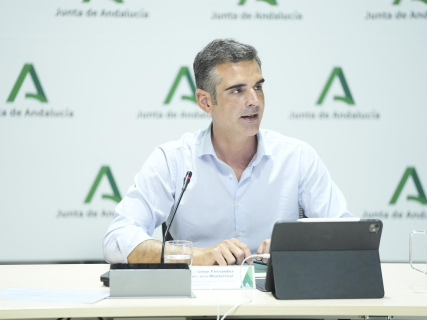

The main agricultural organizations of Andalusia have expressed their satisfaction with the continuity of Ramón Fernández-Pacheco at the head of the Ministry of Agriculture, Fisheries, Water and Rural Development of the Junta de Andalucía, emphasizing that this decision allows for the continuation of coordinated work between the regional administration and the sector to face the challenges of Andalusian agriculture.
In statements to Europa Press, the organizations have recalled that the sector faces challenges of great importance, such as the future reform of the Common Agricultural Policy (CAP), the defense of a sufficient agricultural budget, the improvement of farm profitability, water management, generational renewal, or administrative simplification.
Asaja Andalucía: continuity in a scenario of uncertainty
The president of Asaja Andalucía, Ricardo Serra, has expressed his agreement with Fernández-Pacheco and his team continuing at the head of the Ministry of Agriculture, Fisheries and Rural Development of the Junta de Andalucía, recalling that "we had asked for the team that was working to continue, and that is what has happened, so we can only be satisfied."
Serra has stressed that "we have a period of uncertainties and very important challenges ahead, and having a capable team that knows the subject and is up-to-date on the problems facing the sectors is good news." He also pointed out the new CAP as one of the key issues to be addressed in the coming years and warned that "the price crisis constitutes a constant threat to the agricultural sector."
The Asaja leader added that water management is another of the "critical" elements that requires a decisive response from the Administration. On this point, he acknowledged that he does not yet know the new Minister of Environment and has chosen to remain cautious about her future management.
UPA Andalucía: stability and defense of family farming
UPA Andalucía has also positively assessed Ramón Fernández-Pacheco's continued leadership of the Ministry of Agriculture, Fisheries and Rural Development, considering that this decision "brings stability at a key moment for the future of Andalusian agriculture." The organization has considered it "especially important" that the management and technical team, with whom a "fluid, permanent and constructive" dialogue has been consolidated over the last four years, is also maintained.
The general secretary of UPA Andalucía, Jesús Cózar Pérez, has highlighted that the relationship of this legislature has allowed numerous issues of interest to family farmers and ranchers to be addressed through dialogue and institutional cooperation. For this reason, he indicated that "we value continuity because it guarantees stability and because it allows us to follow up on the work done during the last four years."
Likewise, he stated that "we trust that the management and technical team of the Ministry will be maintained, with whom we have built a permanent, loyal, and effective dialogue that must continue to be the basis for facing the important challenges that the Andalusian countryside has." On that basis, UPA Andalucía has offered the minister "permanent" and "loyal" collaboration to continue defending family farmers and ranchers.
The organization has reiterated that its "absolute" priority is to ensure the economic viability of the farms, considering that the lack of profitability is the main problem of the sector. In this regard, Cózar Pérez has stressed that "the Andalusian priority must be that those of us who produce food can live with dignity from our work. Without profitability, there will be no generational change, nor innovation, nor sustainability, nor a future for our towns."
UPA Andalucía understands that the roadmap for agricultural policy must continue to focus on a CAP with more budget and a fairer and more social distribution of aid; on strengthening the Food Chain Law to ensure fair prices; on the incorporation of young people and women; on administrative simplification; on the modernization and digitalization of farms; on the improvement of irrigation; on adaptation to climate change; on seeking solutions to the labor shortage; and on the approval of an Andalusian Law for Family Agriculture and Livestock.
The organization has also defended that the autonomous community "continue to lead the major European agricultural debates" and has called on the community institutions for real protection for a sector considered strategic for food sovereignty and security. "Andalusia is the main agricultural power in Europe and its voice must have a decisive weight in the decisions made in Brussels." Therefore, he pointed out that "we need policies that protect those who produce food and that place agriculture and livestock in the strategic position they deserve."
UPA Andalucía has reiterated its commitment to maintaining a "permanent, loyal, and constructive" dialogue with the Ministry of Agriculture, betting on unity and institutional cooperation to face the great challenges of the countryside. "Our organization will always find the path of dialogue and collaboration with the Junta de Andalucía." In its opinion, "the challenges facing the Andalusian countryside require stability, continuity, responsibility, and fluid communication that allows for effective solutions to be adopted for family farmers and ranchers."
COAG and Agro-food Cooperatives: dialogue and knowledge of the sector
COAG Andalucía, for its part, has congratulated Ramón Fernández-Pacheco on his appointment as Minister of Agriculture, Fisheries, Water, and Rural Development for the new term and has wished him "the greatest success in this new stage." The organization trusts that "this new term will allow us to continue advancing through dialogue and collaboration to face the important challenges ahead for the sector, including the future reform of the Common Agricultural Policy (CAP), the defense of a sufficient agricultural budget, the improvement of farm profitability, water management, generational renewal, and administrative simplification."
Cooperativas Agroalimentarias de Andalucía has also made a positive assessment of the new Andalusian government, emphasizing continuity in areas it considers strategic for the sector. It has stressed that the ministries with direct impact on key issues for the future of the cooperative model maintain their line of work, and has considered it particularly relevant that the Ministry of Agriculture, Fisheries, Water, and Rural Development remains under the responsibility of Ramón Fernández-Pacheco.
The president of Cooperativas Agro-alimentarias de Andalucía, Fulgencio Torres, has argued that it is essential to have teams that have in-depth knowledge of the reality of agro-food cooperatives, their economic and social dimension, their role in structuring the territory, and their capacity to create employment, retain population, and add value to Andalusian agricultural and livestock production.
Finally, the federation has emphasized the need to preserve the already consolidated channels of dialogue with the Junta de Andalucía and to continue advancing from dialogue, institutional stability, and coordination between departments to respond to the sector's needs.