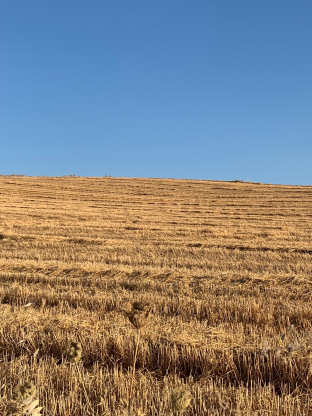

Asaja Córdoba has denounced this Tuesday the "grave situation" currently experienced by the cereal sector in the province and, "especially, the cultivation of durum wheat, whose profitability is at historic lows, due to the sharp increase in production costs and sale prices that do not compensate for the farmers' effort", to the point that "the majority of cereal farmers in the province have closed the campaign with losses".
Through a statement, the professional agricultural organization has urged the various administrations to approve "urgent measures to guarantee the economic viability of the farms and avoid a progressive abandonment of cultivation".
According to the study prepared by Asaja Córdoba, "with real data from farms in the province from the 2019/20 campaign to the current 2025/26, the cultivation of durum wheat has reached a critical situation", since "with the current price set at the Córdoba Market, around 250 euros per ton, a farmer needs to obtain 3,800 kilos per hectare in dryland and 4,400 kilos per hectare in irrigated land solely to cover production costs".
Despite this, "in a large part of the cereal-growing areas of the province, the yields obtained this year have been well below these figures, causing widespread losses", which is explained by the fact that "the price of durum wheat has practically not evolved in the last 15 years", given that "while on June 6, 2011, the Córdoba Market quoted type 2 durum wheat at 273 euros per ton, its current price stands at 250 euros per ton, that is, even below the registered fifteen years ago".
In parallel, "production costs have not stopped increasing. In dryland farms, they have gone from 481 euros per hectare in the 2019/20 campaign to 952 euros per hectare in the 2025/26 campaign, which represents an increase of 98%", while "in irrigated land, costs have increased from 640 to 1,062 euros per hectare, 66% more". Furthermore, the organization recalls that these figures "do not include other expenses such as agricultural insurance, tax burden, or land cost, which further increase the outlay that the farmer must face".
Among the factors that most pressure expenses upwards are fertilizers, which already "represent close to 30% of the total cost of cultivation and continue to become more expensive as a consequence of geopolitical conflicts and community policies", to the point that "a farmer needs to allocate approximately 800 kilos of wheat from their harvest solely to pay for fertilizer".
To this increase are added other essential inputs, given that "phytosanitary treatments in dryland have gone from 63 to 192 euros per hectare, which represents an increase of 205%, while the cost of sowing also experienced strong increases during the 2021/22 and 2022/23 campaigns, due to the scarcity of certified seed".
In the case of irrigated farms, "fixed expenses associated with irrigation communities continue to grow", that is, due to "energy, maintenance, and hydraulic infrastructures, even in campaigns like the current one, in which the price of cereal does not compensate for the cost of irrigation".
Asaja Córdoba has also censured that "the decisions adopted by the European Union (EU) further aggravate the loss of competitiveness of the sector". In this regard, it has focused on the application of the Carbon Border Adjustment Mechanism (CBAM), given that "it incorporates new taxes on the import of fertilizers".
In this context, it recalls that "although the European Commission has recently announced a safeguard clause, which would eliminate these taxes only if fertilizers increase their price by more than 50% compared to the average of the last ten years", the organization considers that "by the time that happens, the farmer will have abandoned, so it is clearly insufficient".
For Asaja Córdoba, "the lack of profitability will inevitably cause many farmers to reduce the area dedicated to cereal or even abandon its cultivation in upcoming campaigns". This "will mean lower national production, an increase in dependence on imports from third countries, and an increase in the cost of food, compromising food sovereignty and generational replacement in the field".
For all of the above, the agricultural organization demands from public administrations "the immediate implementation of measures that allow the recovery of the profitability of the cereal sector". Among these measures, it cites "a reduction in the regulated costs borne by farms, an improvement in agricultural insurance, an upward revision of intervention prices, and a European trade policy that protects Community producers against imports from countries with lower environmental, labor, and health requirements".
In the words of Asaja Córdoba, "food sovereignty cannot remain a slogan", since "it will only be possible to guarantee the supply of food if the economic viability of those who produce it is ensured".