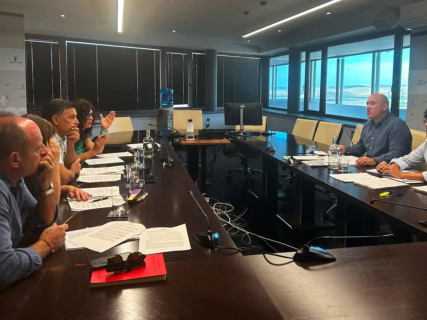

The Deputy Minister of Common Agricultural Policy and Agro-environmental Policy, José Manuel Martín Aparicio, has held a working meeting with representatives of Asaja, UPA, and Agricultural Cooperatives of Castilla-La Mancha to advance a common position on the future design of the Common Agricultural Policy (CAP) starting in 2027, which will be submitted to the Ministry in the first week of September.
In this meeting, developed in an atmosphere of dialogue and understanding, the regional Executive and the agricultural organizations exchanged points of view with the goal of supporting "a CAP sufficiently funded from a financial point of view, that maintains support for the income of farmers and ranchers and that responds to the social, economic, and environmental challenges facing the agricultural sector," as noted by Martín Aparicio.
As the regional Government has recalled, this meeting is part of the line of work opened by the Minister of Agriculture, Livestock, and Rural Development, Julián Martínez Lizán, in the meeting held with the main organizations in the field last April. Before that date, the joint work with the OPAs and Agricultural Cooperatives had been ongoing for more than a year and culminated in a common document delivered to the European Commissioner for Agriculture, Christophe Hansen, in February 2025 in Madrid.
In April of that same year, the President of Castilla-La Mancha presented that document again in a meeting held in Brussels. Subsequently, in October, another text was sent to the Minister of Agriculture, Luis Planas, so that, as Spain's representative to the European Commission, he could convey Castilla-La Mancha's position on the future CAP.
Consensus to strengthen the active farmer
Among the agreements reached, the Deputy Minister has emphasized "the need to strengthen the figure of the active farmer, in order to ensure that European aid reaches primarily those who effectively engage in agricultural activity and obtain a significant part of their income from it."
The organizations present and the Board have emphasized that this approach must be maintained as one of the essential axes of the next CAP, "to guarantee a fairer and more effective distribution of community funds."
Likewise, it has been bet that the main income support interventions will be financed entirely with the future single community fund, "guaranteeing sufficient resources to sustain the profitability of agricultural operations," added Martín Aparicio. In this framework, the future Decreasing Income Aid per Surface has also been analyzed, contrasting different approaches to ensure a balanced application adjusted to the productive reality of Castilla-La Mancha.
Another of the points discussed has been the definition of the crops that could benefit from the new associated aids that the community will propose to the Ministry for their eventual inclusion in the next programming period. Both agricultural organizations and Cooperatives have agreed with the Ministry on the convenience of having specific support instruments for those strategic sectors with greater needs from an economic, social, or territorial perspective.
Likewise, all parties have placed generational renewal among the priorities of the future CAP, advocating for a dedicated and sufficiently funded budget for the measures for the incorporation of young farmers and ranchers integrated into the so-called 'welcome package.'
In this line, the position already raised by the president of Castilla-La Mancha, Emiliano García-Page, at the 172nd Plenary of the European Committee of the Regions has been emphasized, where he demanded that the Common Agricultural Policy allocate 10 percent of its funds to policies for the incorporation of young people into the countryside, accompanied by measures such as aids for the establishment of productions, access to machinery, and other support instruments that facilitate access to agricultural activity. A proposal that aims to ensure the viability of the sector, European food sovereignty, and the future of rural areas.