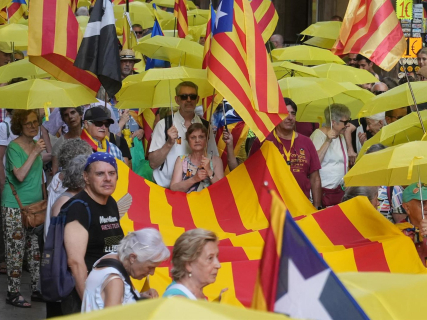
Demonstration of the Diada 2026: schedule, route, and where it starts in Barcelona

The mobilization begins this Friday at 17:14 hours with two columns that will depart from Gran Via-Casanova and Via Laietana and will converge in Plaza de Catalunya.

fotonoticia 20260826174234 1920

fotonoticia 20260826174234 1920

Add DEMÓCRATA to Google

Ask FREN

Published

Last updated

2 minutes

Most read

The Diada 2026 demonstration in Barcelona will start this Friday September 11 at 5:14 PM and will have a different configuration than a march with a single starting point: participants will be able to join two simultaneous columns that will end up converging in plaza de Catalunya.

The mobilization carries the slogan "Here I am. We are here. For the present and for the future. Independence" and is driven by the Assemblea Nacional Catalana along with Òmnium Cultural, the Consell de la República, the AMI, the Intersindical, and the CIEMEN.

What time does the Diada demonstration start

The chosen time for the start is 5:14, in reference to the year 1714, a central date in the commemoration of the Onze de Setembre.

The two columns will simultaneously begin their routes from different points in the center of Barcelona.

Route of the "Present" column

The first column will leave from the intersection of Gran Via de les Corts Catalanes and Casanova street.

Its planned route is:

Gran Via - Casanova → plaza Universitat → ronda Universitat → plaza de Catalunya.

The organization points out the Urgell station, line 1 of the Metro, as one of the options to access the starting point.

Route of the "Future" column

The second route will begin at Via Laietana, next to the Cathedral square.

From there it will advance along ronda de Sant Pere until it also flows into plaza de Catalunya.

To access this second starting point, the organization indicates the Jaume I station, line 4 of the Metro as a reference.

Where the demonstration ends

Both columns have plaza de Catalunya as their destination, which will serve as the meeting point for the two routes.

The scheme allows the mobilization to access the center from two different directions: one from the area of Gran Via and Universitat and the other from Via Laietana.

Who calls the Diada 2026 demonstration

The demonstration is promoted by six organizations:

  • Assemblea Nacional Catalana
  • Òmnium Cultural
  • Consell de la República
  • Associació de Municipis per la Independència
  • Intersindical
  • CIEMEN

The official agenda of the Barcelona City Council also includes the call, the time of 5:14 PM, and the two planned itineraries.

Diada 2026 route, at a glance

Present Column: Gran Via with Casanova → plaza Universitat → ronda Universitat → plaza de Catalunya.

Future Column: Via Laietana-Cathedral square → ronda Sant Pere → plaza de Catalunya.

Departure time: 5:14 PM.

Date: Friday September 11, 2026.

More key points, information and questions with FREN

AI-GENERATED CONTENT

What municipal procedures and authorizations are necessary to organize a demonstration in Barcelona?

To organize a demonstration in Barcelona there are two distinct aspects: the exercise of the right to assembly (state competence, no prior authorization but mandatory communication) and, separately, municipal permits to use public space with infrastructures, sound, etc. It is advisable to address them separately.

1. General framework: right to assembly

The right to assembly and demonstration is mainly regulated in Article 21 of the Constitution and in Organic Law 9/1983, regulating the right to assembly. This regulation applies throughout Spain, including Barcelona.

  • There is no prior “license”: demonstrations in public spaces are not authorized, they are communicated in advance to the governmental authority. The Administration can only prohibit them or modify the route/time for justified reasons of public order with danger to people or property.
  • Who can call them: natural or legal persons in full exercise of their civil rights. City councils, when acting as Administration, are not holders of the right to assembly; they can organize institutional acts, but not “demonstrations” under the Organic Law as if they were a group of citizens.
2. Communication to the Government Delegation in Catalonia

In Barcelona, the competence to receive the communication of demonstrations in public spaces corresponds to the Government Delegation in Catalonia (or, in practice, the Government Subdelegation in Barcelona).

The communication must normally be submitted:

  • At least 10 calendar days in advance and a maximum of 30, with respect to the planned date.
  • In case of justified urgency due to extraordinary causes, a shorter period may be accepted (for example 24–48 hours), but it must be well justified.

The document must be signed by the conveners and include, at least:

  • Identification of the promoters (name, ID number, address, and contact).
  • Planned date and time.
  • Starting and ending place, or detailed route through streets and squares.
  • Purpose or reason for the demonstration.
  • Estimated number of attendees.
  • Whether there will be support vehicles, megaphones, stages, etc.

Once communicated, the Delegation can:

  • Not oppose and coordinate with Mossos d’Esquadra, Guardia Urbana, and other forces.
  • Propose changes of date, time, or route.
  • Prohibit it with justification if it perceives serious risks to public order with danger to people or property.
3. What role does the Barcelona City Council have?

For a “standard” demonstration, with people on foot, banners, and perhaps a vehicle with megaphone, no permission is requested from the City Council for the mere act of demonstrating. Street closures and traffic management are handled by the Guardia Urbana in coordination with the Delegation and Mossos, based on the state communication.

However, the City Council does intervene when the demonstration involves an intensive or special use of public roads:

  • Fixed or temporary installations (stages, platforms, tents, stands, sales points, bars, bulky structures): require a public domain occupation authorization, processed before the City Council (often through the corresponding district).
  • Powerful sound equipment, concerts or musical activities: may require specific authorization and limitations on schedule and sound level, according to the noise and acoustic pollution ordinance and, in some neighborhoods, stricter criteria in “areas with acoustic tension.”
  • Complementary activities (food trucks, street vending, etc.): are governed by municipal economic activity regulations and may also require a license or specific communication.
  • Prolonged use of central squares or streets for camping, continuous performances, or very intense occupations: the City Council may deny or condition the occupation for reasons of coexistence, mobility, or noise impacts.

These municipal permits usually require location plans, description of structures, assembly and disassembly schedules, audience estimates, and, if applicable, safety reports. Deadlines vary, but it is prudent to request them several weeks in advance, especially if what is planned approaches an event rather than a mere march.

4. Practical summary of steps
  • Define the call: promoters, slogan, date, time, route, format (march, fixed gathering, with or without stage, etc.) and estimated attendees.
  • Submit communication to the Government Delegation/Subdelegation in Barcelona within the legal deadlines, with all required data.
  • Check if you need municipal permits: if you are going to install a stage, tents, stalls, relevant sound equipment, or intensely occupy a square, process the corresponding public road occupation authorization and, if applicable, activity and noise permits before the City Council.
  • Coordinate with police forces (usually through the Delegation): they may propose adjustments to the route or schedule to make the demonstration compatible with other events or general mobility.

Finally, it is advisable to review updated information on the websites of the Government Delegation in Catalonia and the Barcelona City Council, or seek specific legal advice, because forms, telematic channels, and some municipal criteria may change over time.

What are the competencies of the Barcelona City Council in regulating demonstrations and gatherings?

The Barcelona City Council has a relevant role in the practical management of demonstrations and gatherings in the city, but its competencies are limited regarding the “regulation” of the right to assembly. The core of the right and the prior communication regime is established by the Constitution and Organic Law 9/1983, while the council mainly acts on the use of public space, coexistence, and road safety through the Guardia Urbana and its ordinances.

1. Constitutional framework and Organic Law 9/1983

The right to assembly and demonstration is recognized in Article 21 of the Constitution as a fundamental right. The Organic Law 9/1983, regulating the right to assembly, develops this provision and sets several key points:

  • Meetings and demonstrations in public transit places are not subject to prior authorization, but to a communication regime to the “governmental authority.”
  • This authority may, exceptionally, prohibit a demonstration or modify its route, date, or time if there are justified reasons of public order disturbance with danger to people or property.
  • Promoters must be persons in full exercise of their civil rights; city councils, as public administrations, are not holders of the right to assembly when acting as such, which prevents them from calling “demonstrations” under LO 9/1983, although they can organize institutional acts.

This criterion has been applied in other Spanish municipalities, where the Government Delegation has reminded that city councils lack legitimacy to appear as promoters of demonstrations subject to this law, although they may organize gatherings as their own institutional acts.

2. Competence distribution in Catalonia and Barcelona

In Catalonia, the general scheme is as follows:

  • The governmental authority competent for the communication of demonstrations is, generally, the State Government Delegation/Subdelegation in Catalonia, according to LO 9/1983.
  • The Generalitat, through the Department of Interior and the Mossos d’Esquadra, assumes security police and public order and organizes security devices for mass gatherings, as recalled by an official Govern note on gatherings in Catalonia (Interior note).
  • The Barcelona City Council does not decide on the authorization or prohibition of demonstrations (it has no competence over the core of the right to assembly), but it does manage public space, mobility, and civility in the city.

3. Own competencies of the Barcelona City Council

On this basis, municipal competencies in Barcelona focus on:

  • Public space management and coexistence: through the Ordinance of measures to promote and guarantee citizen coexistence in Barcelona’s public space (Coexistence or Civility Ordinance), reformed in 2025 and in force since February 2026 (note on the new ordinance). This regulation:
    • Does not regulate the right to assembly itself, but does regulate behaviors in public space (street drinking, noise, public urination, vandalism, etc.).
    • Allows sanctioning uncivil behaviors occurring in the context of gatherings, always respecting the essential content of the right to demonstrate.
  • Mobility and road use: the City Council can:
    • Establish traffic cuts, detours, parking restrictions, and temporary pedestrianizations to guarantee safety and mobility during demonstrations or large gatherings (for example, the Sant Jordi or Mercè devices, covered in municipal press releases).
    • Signal alternative routes and coordinate with public transport when a march affects main roads.
  • Action of the Guardia Urbana:
    • The Guardia Urbana performs administrative police and traffic functions and participates in security devices together with Mossos d’Esquadra.
    • It monitors gatherings, provides attendance data, and draws up incident reports, which may lead to municipal sanctioning proceedings or be forwarded to the Prosecutor’s Office or judicial authority.
    • A recent example is the “Save Europe Act” gathering: the City Council announced it would report racist messages detected during the event to the Prosecutor’s Office with information provided by the Guardia Urbana, which monitored it along with the Mossos (municipal note).
  • Mayor’s powers:
    • The mayor holds the highest responsibility for security and coexistence at the municipal level and directs the Guardia Urbana.
    • He can issue ordinances or instructions on the use of public space and the application of the coexistence ordinance, and set action criteria for gatherings that may seriously affect civility or local security.

4. Usual practice: communication and management

In practice, demonstrations in Barcelona are communicated to the competent governmental authority (Government Delegation), which may request security reports from Mossos d’Esquadra and, if applicable, from the Guardia Urbana. The City Council:

  • Does not “authorize” or “deny” the demonstration, but does organize the municipal deployment (traffic, cleaning, local security, civil protection).
  • Can condition accessory uses of space (e.g., amplified music schedules due to noise, additional occupation with platforms or tents) through licenses and ordinances, as long as it does not empty the right to assembly of content.
  • Acts afterwards on possible infractions (civility, damage to furniture, disorders) through the Guardia Urbana and its sanctioning regime, and collaborates with the Prosecutor’s Office when it detects signs of crime, such as in cases of possible hate crimes.

In summary, the Barcelona City Council is not the authority that recognizes or limits the exercise of the fundamental right to demonstrate, but it is the central actor in the material and coexistence management of gatherings taking place in the city.

What results did Òmnium Cultural obtain in the last elections to the Parliament of Catalonia, if it ran?

Òmnium Cultural did not run as an electoral candidacy in the last elections to the Parliament of Catalonia (those of May 12, 2024). It is a civil society entity and not a political party, so it does not appear on the ballots or in the official results as its own list. Consequently, it did not obtain any seats or vote percentage, neither in the whole of Catalonia nor in any of the four constituencies (Barcelona, Girona, Lleida, and Tarragona).

The information available in the consulted sources shows Òmnium acting as a independentist civic organization, focused on defending the Catalan language, culture, and certain deep political objectives, but not as an actor competing in elections. In a recent profile, the newspaper Demócrata describes Òmnium as the “main civil society organization” in the sovereignist sphere, emphasizing precisely that it does not position itself in institutional opposition, but in the field of social and cultural mobilization.

Under the presidency of Xavier Antich (reelected in 2026), the entity has strengthened its role of:

  • Promotion of the Catalan language and culture, with public campaigns and agreements with other social actors to strengthen the use of Catalan in areas such as school, culture, and associative fabric.
  • Coordination of sovereignist actors and the cultural world, seeking meeting points among parties, institutions, unions, employers, and entities.
  • Political influence from civil society: positions on judicial decisions, laws, or situations considered contrary to self-government or the linguistic and educational model of Catalonia.

An example of this role, completely separate from the electoral logic of parties, is given by a Demócrata report from January 2, 2026. Antich then addresses members and supporters to call for “defending the school in Catalan again” in the face of judicial rulings expected that year. He demands that:

  • Public institutions and political formations organize themselves in advance.
  • The defense of the language is understood as defense of the country and a legal and social response is prepared.
  • Both parties and civil society, companies, unions, and cultural and educational sectors are involved.

Such calls illustrate that Òmnium positions itself as a motor of mobilization and political pressure from outside institutions, but without becoming its own electoral list.

Another piece from Demócrata, about Antich’s reelection in 2026, insists on this idea: Òmnium strengthens its function as a reference organization of the sovereignist civil society, emphasizing:

  • The defense of Catalan as a country axis, including calls to companies, unions, cultural and educational sectors to commit to the language.
  • The integration of the “new Catalans” in the national project, against the rise of a more exclusionary independentist far right.
  • The idea of national construction from the social base, rather than from direct electoral competition.

In the journalistic coverage consulted about the 2024 Catalan elections, the electoral protagonists are the political parties (PSC, Junts, ERC, Comuns, CUP, PP, Vox, Aliança Catalana, etc.), but Òmnium Cultural does not appear as a registered candidacy. It is observed, however, that its agenda (defense of Catalan, denunciation of certain judicial decisions, criticism of linguistic regression) influences the political debate framework and the demands presented by various forces in campaign and in the Parliament.

Regarding whether Òmnium explicitly supported a specific candidacy in those elections to the Parliament, the reviewed sources focus more on its general calls linked to language, school, and national rights than on formal backing of a particular list (for example, asking to vote for a specific party). Òmnium traditionally maintains a profile of cross-cutting pressure within the sovereignist space, demanding strategic unity and commitment to certain objectives, but without becoming a party itself or appearing as an electoral brand.

In summary: in the last elections to the Parliament of Catalonia, Òmnium Cultural did not run as a list, so it did not obtain its own electoral results. Its role was that of a independentist civil society actor, aimed at influencing the agenda (especially in linguistic and cultural matters) and mobilizing citizens and institutions, but remaining outside the direct competition for seats.

Play

Test your knowledge with FREN!

How much do you know about this topic? Answer the following 3 questions.

What is the final destination of both columns of the Diada 2026 demonstration in Barcelona?

Question 1 of 3

How many organizations are driving the Diada 2026 demonstration?

Question 2 of 3

From which intersection will the 'Present' column depart in the Diada 2026 demonstration?

Question 3 of 3