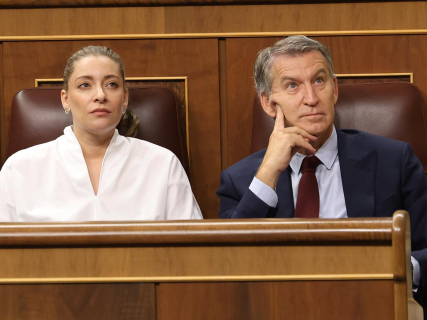
General elections in Spain: Polymarket gives an 81% to Feijóo as president and bets more and more on the advance in 2026

The predictions market places Sánchez at around 13% to lead the next Government. Another bet assigns a 63% chance that early elections will be called before the end of December, although that does not imply voting in 2026.

2 minutes

fotonoticia 20261002102625 1920

fotonoticia 20261002102625 1920

Add DEMÓCRATA to Google

Ask FREN

Published

Last updated

2 minutes

Most read

The uncertainty about the future of the legislature is also quoted on Polymarket. While the parties calculate whether Pedro Sánchez will advance the general elections, the participants of the platform place Alberto Núñez Feijóo as the clear favorite to lead the next Government and consider it more likely that there will be an early call before the end of the year.

These are two different questions, with two distinct markets. In the survey conducted this Saturday, October 3, Feijóo has an 81% implied probability of becoming the next invested president. Pedro Sánchez is around 13%. These percentages come from the operations of the participants: they do not represent voting intention.

The other figure that concentrates attention is the 63% assigned to an early electoral call until December 31, 2026. The condition refers to calling the elections, not to holding them within that timeframe.

Feijóo is the favorite, but his advantage does not arise this weekend

The historical graph allows for a nuanced first impression. In the snapshot from this Saturday, Feijóo appears accompanied by a green upward indicator of 38 points. However, the entire market period is selected.

The trajectory shows that the leader of the PP already maintained a wide advantage during the previous months. Therefore, that accumulated variation cannot be presented as a jump that occurred after the voting on the housing decrees nor as a reaction exclusive to the last hours.

What it means to be the "next president" in this bet

The rules require that the person obtain the confidence of Congress and take office, leading to the formation of a new Government. A merely interim or acting presidency is not enough to resolve the market.

The set horizon is March 31, 2028. Therefore, Feijóo's favoritism does not allow for deducing when there will be elections: this bet can be resolved either after an advance or after subsequent elections.

The advance exceeds 50% in all three deadlines

The market on the call offers three deadlines. The shown probability is 56% until October 31, 60% until November 30, and 63% until December 31.

The percentages should not be added. They are cumulative deadlines: a call in October would also meet the conditions for November and December. They do not equate to specifically betting on elections on November 29.

The reading is that the consulted prices favor the possibility of a call before closing 2026. They do not confirm that Sánchez has made that decision nor do they allow identifying a specific voting date.

A signal of expectations, not an electoral poll

Polymarket allows observing how those operating on the platform value different outcomes. Their prices can change with new information, but also with the purchases and sales of their participants.

There is no representative sample of the Spanish electorate nor an estimation of seats behind these percentages. The 81% of Feijóo is not the electoral support of the PP, just as the 13% of Sánchez is not the voting percentage of the PSOE.

The difference is decisive for interpreting the political data: the market favors Feijóo for the next investiture and considers a close call plausible. When voting will take place and what majority will come out of the urns remain open questions.

More key points, information and questions with FREN

AI-GENERATED CONTENT

What are the parliamentary procedures required to call early general elections in Spain?

In Spain, there are two main ways to call early general elections: (1) early dissolution at the initiative of the Prime Minister and (2) automatic dissolution due to investiture failure. In both cases, the Congress and Senate are dissolved simultaneously and voters are called through a royal decree published in the Official State Gazette (BOE).

1. Early dissolution at the initiative of the Prime Minister

This route is mainly regulated in Article 115 of the Spanish Constitution and in the Organic Law of the General Electoral Regime (LOREG). It is not, strictly speaking, a complex parliamentary procedure: the initiative is governmental and the intervention of the Cortes is limited to being dissolved, without prior votes.

1.1. Constitutional requirements and limits
  • Exclusive initiative of the Prime Minister, who proposes the dissolution to the King, after deliberation by the Council of Ministers.
  • The King does not act on his own initiative: he merely signs the royal decree of dissolution and call at the Prime Minister's proposal.
  • There are three key limits (Art. 115 CE):
    • Dissolution cannot be agreed upon while a motion of censure is in process.
    • Dissolution cannot be agreed upon when a state of exception or siege has been declared.
    • A new dissolution cannot be agreed upon before a year has passed since the previous one.
1.2. Procedures until the publication of the decree
  • 1) Deliberation in the Council of Ministers: the Government examines the political and legal opportunity of the dissolution. This is not a parliamentary procedure, but a governmental one.
  • 2) Formal proposal from the Prime Minister to the King: the Prime Minister requests the dissolution of the Cortes and the call for general elections.
  • 3) Signing of the royal decree of dissolution and call: the King signs the decree, which must be countersigned by the Prime Minister. The text dissolves the Congress and Senate and sets:
    • The date of the elections (usually a Sunday).
    • The main electoral deadlines (campaign, submission of candidacies, etc.), according to the LOREG.
  • 4) Publication in the BOE: the royal decree is published in the Official State Gazette. From that moment:
    • Both Chambers are dissolved.
    • Parliamentary functions are reduced to strictly closing and managing the dissolution (Permanent Deputation, etc.).

From the publication of the decree until election day, there must generally be between 54 and 60 days, according to the LOREG.

2. Automatic dissolution due to investiture failure

This second route is provided for in Article 99.5 of the Constitution. Unlike the previous case, here the trigger is a parliamentary deadlock to invest the Prime Minister.

2.1. Preliminary procedure: the investiture process
  • After the elections, the King, after a round of consultations with group representatives, proposes a candidate for Prime Minister to the Congress of Deputies.
  • The investiture debate is held in Congress. In the first vote, the candidate needs an absolute majority (176 deputies). If not achieved, a second vote is held 48 hours later, where a simple majority suffices.
  • If the candidate is not invested, the King may propose successive candidates, repeating the debate and voting scheme.
  • Then a maximum period of two months from the first investiture vote opens: if no candidate is invested within that time, automatic dissolution is triggered.
2.2. Activation of dissolution and call
  • If two months pass without an invested Prime Minister, the Constitution provides that the King shall dissolve both Chambers and call new elections.
  • In this case, the royal decree of dissolution and call is signed by the King and countersigned by the President of the Congress (not by a Prime Minister in acting capacity resulting from that failed investiture).
  • The content of the decree is analogous: simultaneous dissolution of Congress and Senate and setting of election date and deadlines, according to the LOREG.
  • With the publication of the decree in the BOE:
    • The failed legislature ends.
    • Electoral deadlines begin (between 54 and 60 days until voting).

In summary, the early call of general elections does not require a complex parliamentary procedure (nor a specific vote in the Chambers): it either responds to a political decision by the Prime Minister, subject to certain constitutional limits, or it is the almost mechanical consequence of the Congress's inability to invest a Prime Minister within two months, which obliges the King to dissolve and call new elections.

What powers does the Prime Minister have in the decision to bring forward elections according to the Spanish Constitution?

According to the 1978 Spanish Constitution, the Prime Minister plays a central role in the decision to bring forward general elections, but that power is framed within very clear legal and political limits. The key authority is set out in Article 115 of the Constitution.

First, the Prime Minister is the one who can propose the dissolution of the Cortes Generales (Congress and Senate) to the King. This proposal is a political act of enormous significance because the dissolution of the Chambers entails the call for new general elections. The King does not decide on his own initiative; he merely formalizes, by decree, the Prime Minister's proposal.

This mechanism works as follows in constitutional terms:

  • Exclusive initiative of the Prime Minister: only the Prime Minister can take the initiative to propose dissolution. Neither the Chambers, the King, nor other constitutional bodies can force this decision by themselves, except for the specific case of automatic dissolution due to lack of investiture within two months (Art. 99.5 CE), which is a different mechanism.
  • Formal participation of the King: the King signs the dissolution decree, which must be countersigned by the Prime Minister. The countersignature implies that the political and legal responsibility for the decision lies with the Prime Minister, not the Head of State.

However, this presidential power is not absolute. The Constitution introduces several limits and conditions on the power to dissolve the Cortes and, therefore, to bring forward elections:

  • Prohibition to dissolve during a state of exception or siege (Art. 116.5 CE). While one of these states is in force, the Prime Minister cannot propose dissolution, thus blocking the call for early elections in these circumstances of constitutional abnormality.
  • Prohibition of a new dissolution before one year has passed since the previous one (Art. 115.3 CE). The Constitution prevents the Prime Minister from repeatedly and very frequently using dissolution of the Cortes as a tactical tool, guaranteeing a minimum of institutional stability.
  • Impossibility of dissolution while a motion of censure procedure is underway (Art. 115.2 CE, in connection with Art. 113). If a motion of censure has been presented and is pending a vote, the Prime Minister cannot preempt it with a dissolution to avoid it. The Chamber thus retains its political control capacity.

Alongside these explicit limits, there are other political and temporal conditions. For example, early dissolution is usually not exercised in the last weeks of the legislature, when the "natural" dissolution approaches upon completion of the Congress's four-year term, although legally the margin exists until that period expires. Also, although the Constitution does not detail it, in practice the decision to bring forward elections is usually preceded by political consultations and an assessment of governability, parliamentary majority, and social context.

Regarding the relationship with the Chambers, the Prime Minister does not need prior authorization from the Congress or the Senate to propose dissolution. It is not a power conditioned on a parliamentary vote. However, the use of this power is subject to subsequent political control: the Cortes resulting from the elections can judge that decision politically, and the citizenry does so directly through the vote.

Moreover, the presidential power is framed within the principle of political responsibility of the Government before the Congress (Art. 108 CE). The Prime Minister may choose to bring forward elections when he considers that:

  • He does not have a sufficient majority to support his program.
  • He prefers to submit to the judgment of the polls rather than face a motion of censure or a deadlock situation.
  • He seeks to strengthen or renew his political legitimacy in a context of change.

In summary, the Constitution assigns the Prime Minister a very relevant power in the decision to bring forward elections: the initiative to dissolve the Cortes and thus trigger a new electoral call. But that initiative is legally framed: it requires formalization by the King, is subject to temporal prohibitions and exceptional situations, and is balanced by parliamentary control and, above all, by democratic control of the electorate at the polls.

Could you explain in more detail how the automatic dissolution mechanism due to lack of investiture works? What differences are there between an early election decided by the Prime Minister and a successful motion of censure in terms of legitimacy and political effects? What limits and procedures exist to dissolve regional parliaments early compared to the Cortes Generales?

What has been Alberto Núñez Feijóo's political trajectory before leading the Popular Party?

Before becoming the national president of the Popular Party in April 2022, Alberto Núñez Feijóo's political trajectory was the result of a long career in public administration, first in Galicia and then at the State level, followed by solid regional leadership in the Xunta de Galicia and the Galician PP. This combination of managerial profile and territorial political weight largely explains his subsequent leap to party leadership.

From Galician administration to high public management at the state level

Born in 1961 in Os Peares (Ourense) and holding a law degree, Feijóo began his professional career in the public service of the Xunta de Galicia in the mid-1980s. In this first stage, his role was eminently technical, linked more to regional administration than to partisan politics in the strict sense.

The first clearly political-institutional leap came in 1991, when he became technical secretary general of the Ministry of Agriculture, Livestock, and Forests of the Xunta de Galicia. This position, of high administrative responsibility, already placed him within the environment of government political teams and allowed him to gain experience in sectoral management and the internal functioning of Galician administration. Shortly after, he also took on responsibilities in the health sector, as secretary general of Health, consolidating his specialization in public policies and service management.

With José María Aznar's rise to power in 1996, Feijóo made the jump to the State administration. Various journalistic and biographical sources agree that his political career "begins" broadly when, at just over 30 years old, he assumed the presidency of the National Health Institute (Insalud), then a key body in managing public health in much of the country. This position projected him onto the national stage as a reference health manager within the Popular Party's area of influence.

He was later appointed president of the State Society of Posts and Telegraphs. At the head of Correos, Feijóo broadened his public management profile: moving from health to directing a large public company, with thousands of workers and presence throughout the territory. This stage in Madrid reinforced his image as a competent public administration executive and consolidated his ties with the national PP, although he maintained a discourse of "manager rather than politician" during those years.

Return to Galicia and entry into frontline politics

In the early 2000s, Feijóo returned to Galicia alongside Manuel Fraga, then president of the Xunta. In 2003, he was appointed Minister of Territorial Policy, marking his full incorporation into the political core of the Galician Government. Shortly after, during the PSdeG–BNG bipartite legislature, he became first vice president of the Xunta, already in the phase prior to his rise as the main center-right reference in Galicia.

In parallel, he integrated organically into the Popular Party. After his time in the State administration and his return to Galicia, he joined the PP and took on increasing responsibilities in the regional organization. The turning point came in January 2006, when, amid internal transition following Manuel Fraga's political retirement, Feijóo was elected president of the Galician Popular Party (PPdeG). From that moment, he became the leader of the opposition to the coalition government led by Emilio Pérez Touriño.

President of the Xunta and consolidation as a territorial baron

At the head of the PPdeG, Feijóo led the party to the 2009 regional elections. Against expectations, he won and was invested president of the Xunta of Galicia. From then on, he secured four consecutive absolute majorities (2009, 2012, 2016, and 2020), something unprecedented in recent Galician politics, consolidating himself as one of the main territorial "barons" of the PP.

During those thirteen years as president of the Xunta (2009–2022), Feijóo combined institutional leadership of the Galician Government with organic control of the PPdeG. His profile is associated with management considered pragmatic, with strong budgetary discipline and a discourse of moderation that, according to various analyses, allowed him to maintain a broad electorate in a fragmented political context. This stage was decisive: he made Galicia his power base and, at the same time, became a reference figure for the PP at the national level.

Starting point for the leap to Génova

When the internal crisis of the Popular Party arrived in 2022, Feijóo already had extensive experience as a senior official in the State administration, as minister and vice president of the Xunta, and as regional president with several absolute majorities, in addition to more than a decade leading the PPdeG. It was from this position—president of the Xunta and leader of the Galician PP—that he accepted to lead the transition in the national PP after Pablo Casado's departure.

In summary, before leading the Popular Party at the national level, Alberto Núñez Feijóo's political trajectory is structured in three major stages: technical manager and senior official in the Xunta, director of major state bodies under Aznar's governments, and hegemonic regional leader in Galicia and president of the PPdeG. This itinerary, more administrative and territorial than parliamentary in its early decades, served as a platform for his final leap to the party's national presidency.

Could you now provide me with a synthetic timeline, with years and key positions of Feijóo up to 2022? What role did his experience in Insalud and Correos play in building his political image within the PP? How did his absolute majorities in Galicia influence the PP's decision to offer him national leadership in 2022?

Play

Test your knowledge with FREN!

How much do you know about this topic? Answer the following 3 questions.

What is the implied probability that Polymarket assigns to Alberto Núñez Feijóo as the next invested president of Spain according to the October 3rd poll?

Question 1 of 3

What condition is necessary for a person to be considered the 'next president' according to Polymarket's rules?

Question 2 of 3

What percentage does Polymarket assign to the probability of an early general election call before December 31, 2026?

Question 3 of 3