General elections survey: the PSOE narrows the gap with the PP, but the right would maintain the majority, according to 40dB

The survey by 40dB. for 'El País' and Cadena SER places the PSOE at 28.1%, the PP at 31.9%, and Vox at 18.9%, with 198 deputies for the populars and Vox in the central estimate.

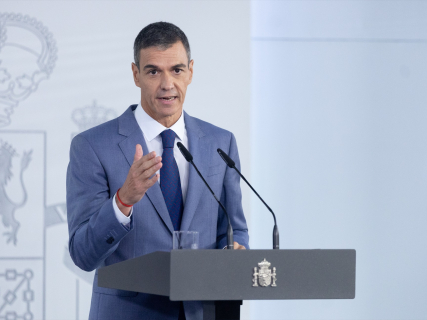
EuropaPress 7824171 presidente gobierno pedro sanchez rueda prensa posterior consejo ministros

EuropaPress 7824171 presidente gobierno pedro sanchez rueda prensa posterior consejo ministros

Add DEMÓCRATA to Google

Ask FREN

Published

Last updated

2 minutes

Most read

Elecciones 29N · Encuestas

La media de las encuestas

Media a 18 de noviembre de 2026 · 17 institutos

  • PP31,4 %
  • PSOE27,4 %
  • Vox19,0 %
  • Frente Amplio6,1 %
  • ERC2,4 %
  • SALF2,0 %
01020304050ene 2024jul 2024ene 2025jul 2025ene 2026jul 2026

Media del último estudio de cada instituto en 30 días y su evolución semanal desde el 23J. Partidos con al menos un 2 %.

Todas las encuestas

Elecciones generales del 29 de noviembre · Demócrata

In the general elections on November 29, the PP would obtain 132 deputies and Vox would reach 66, according to the central estimate of the 40dB survey published by El País and Cadena SER. The PSOE would achieve 110 seats, according to a poll conducted on October 7 and 8, after the announcement of the electoral call.

The sum of the central estimates of PP and Vox would be 198 deputies, 22 above the 176 that mark the absolute majority of Congress. The study also contemplates an alternative scenario in which Sumar and Podemos run in a joint candidacy.

Vote and seat estimation

Party Estimated vote Central seat estimate Seat range
PP 31.9% 132 123–140
PSOE 28.1% 110 105–117
Vox 18.9% 66 63–74
Sumar 5.3% — 5–7
Podemos 2.3% — 2

The changes in voting intention compared to the previous poll

The comparison between the two deliveries of 40dB. shows variations in the five state parties included in the provided data.

Party Vote variation Current vote
PP +0.3 points 31.9%
PSOE +0.7 points 28.1%
Vox +0.5 points 18.9%
Sumar −0.3 points 5.3%
Podemos −0.4 points 2.3%

The distance between PP and PSOE would be 3.8 points. By blocks, the sum of the votes of PP and Vox would reach 50.8%, compared to 35.7% of PSOE, Sumar and Podemos. The difference between both aggregates would be 15.1 points and does not include the territorial formations.

The comparison with the 2023 elections

The central estimates also allow contrasting the current projection with the results of the last general elections.

Party Seats in 2023 Current estimate Variation
PP 137 132 −5
PSOE 121 110 −11
Vox 33 66 +33

A joint candidacy of Sumar and Podemos would achieve up to 19 seats

The poll contemplates a second electoral hypothesis in which Sumar and Podemos present themselves under the same candidacy. In that case, the joint space would reach 9.5% of the votes and a range of between 15 and 19 deputies.

Separately, the two formations would gather in the general elections on November 29 7.6% of the votes and would obtain between seven and nine seats in total, according to the published intervals. The unitary candidacy would raise its estimated representation, although it would still be below the 31 deputies achieved by the coalition in 2023.

In this alternative scenario, the joint central estimate of PP and Vox would drop from 198 to 196 deputies. The projection would still place both parties above the absolute majority.

Check the original survey from 40dB. and the technical sheet in El País.

More key points, information and questions with FREN

AI-GENERATED CONTENT

What is the current status of the official call for the general elections and what are the next steps in the electoral calendar?

As of October 9, 2026, the official call for the general elections is fully in effect: the Cortes are already dissolved and the electoral calendar is running. The date for the polls will be Sunday, November 29, 2026 and the new Chambers will be constituted on December 23, 2026 at 10:00 a.m..

Current status of the call

The call was made through Royal Decree 806/2026, of October 5, dissolving the Congress of Deputies and the Senate and calling elections, published in the Official State Gazette (BOE) of October 6, 2026 (text in BOE).

According to that royal decree and the press releases from the Congress and the Senate (Congress note, Senate note):

  • The Congress and Senate elected on July 23, 2023, are declared dissolved.
  • Elections to both Chambers are called for November 29, 2026.
  • The constitutive session of the new Chambers is set for December 23 at 10:00 a.m..
  • The distribution of deputies and senators by constituency is determined according to the LOREG, with the adjustment of one less seat for Cádiz (from 9 to 8) and one more for Madrid (from 37 to 38).

According to the data consulted in the official bulletins up to October 9, there is no record of any correction or subsequent modification of Royal Decree 806/2026. Therefore, the legal framework of the call is stable and definitive at this time.

Next steps in the electoral calendar

The calendar is governed by the royal decree itself and by the deadlines of the Organic Law 5/1985, of the General Electoral Regime (LOREG). The main dates are:

  • October 6: publication in the BOE of the royal decree and entry into force of the dissolution of the Cortes. From that moment the electoral period begins and the deadline to request postal voting opens (summary in Demócrata).
  • Until October 16: deadline for parties and federations to communicate the formation of electoral coalitions to the electoral administration (detailed calendar).
  • From October 21 to 26: submission of candidacies to the Congress and Senate before the competent electoral boards.
  • October 28: publication of the submitted candidacies, opening the period for corrections and challenges.
  • November 2: official proclamation of candidacies by the electoral boards.
  • November 3: publication in the BOE of the proclaimed candidacies.
  • November 13, 00:00 h: start of the electoral campaign, which lasts 15 days.
  • November 27, 24:00 h: end of the electoral campaign.
  • November 28: reflection day, during which it is forbidden to ask for votes.
  • November 29: voting day. Polling stations are expected to be open from 9:00 a.m. to 8:00 p.m.
  • December 2 (approx.): start of the general scrutiny by the provincial electoral boards, according to the LOREG.
  • December 23, 10:00 a.m.: constitution of the new Congress and new Senate, within the maximum period of 25 days from the voting, according to article 68.6 of the Constitution (date expressly set in Royal Decree 806/2026 and reiterated by Congress and Senate).

Relevant deadlines for voters

In addition to the institutional calendar, there are specific milestones for the electorate, especially regarding postal voting:

  • From October 6: postal voting can be requested.
  • Until November 19: deadline to request it, both at post offices and electronically with electronic identification.
  • From November 9: sending of electoral documentation to those who have requested postal voting.
  • Until November 25: ordinary deadline to deposit the postal vote at post offices.

In summary, the call is already fully effective, the Cortes are dissolved, and the process enters the phase of preparing coalitions and candidacies, before moving on to the formal campaign prior to the November 29 vote.

What are the powers of the Congress of Deputies in the investiture process after general elections?

After general elections, the Congress of Deputies is the Chamber with decisive competence in the investiture process: it grants or denies confidence to the candidate for the Presidency of the Government. The King or Queen proposes the candidate, but without a favorable vote from the Congress there can be no President of the Government.

Relationship with the King and candidate proposal

The Constitution (article 99) establishes that, after the elections are held and the Congress is constituted, the King or Queen, after consulting with representatives designated by the political groups with parliamentary representation, and through the Presidency of the Congress, proposes a candidate for the Presidency of the Government.

At this point, the powers of the Congress are:

  • To serve as institutional interlocutor between the King and the political forces: consultations are channeled “through” the Presidency of the Congress.
  • To formally receive the proposal of the candidate made by the Head of State.
  • From that proposal, to assume the exclusive competence to debate and vote the investiture.

Calling and development of the investiture debate

Upon receiving the proposal, it is the responsibility of the Presidency of the Congress to:

  • Set the date and time of the Investiture Plenary.
  • Order the agenda and communicate it to the groups.
  • Direct the investiture debate according to the Rules of Procedure.

The Rules of Procedure of the Congress expressly dedicate a chapter to investiture. Although the technical details are there, for the purposes of the Chamber's powers, the basic outline of the debate is:

  • Initial intervention of the candidate, who presents their government program and requests the confidence of the Chamber, without a strict regulatory time limit (or with a broad time set by the Presidency).
  • Intervention of parliamentary groups, usually in order from largest to smallest representation, with turns set by the Rules and the Presidency.
  • Possible replies and rejoinders between the candidate and the spokespeople, moderated by the Presidency to ensure order and respect for times.

All this shows that the Congress controls the deliberative framework in which the aspirant's program is contrasted before the vote.

Voting regime

The investiture vote is a core competence of the Congress and has a reinforced regime:

  • According to the Rules (article 85.2), votes for the investiture of the President of the Government are always public by roll call: each deputy is named and responds aloud with their vote.
  • In the first vote, the candidate must obtain an absolute majority of the total number of members of the Congress to be invested.
  • If that majority is not reached, a second vote 48 hours later is held. In it, a simple majority (more votes in favor than against) of the deputies present is sufficient.

The function of the Congress is not limited to voting: the Presidency proclaims the result and the Chamber, through it, communicates it to the King. If the candidate obtains confidence, that communication enables the Head of State to proceed with the formal appointment as President of the Government.

New proposals and two-month time limit

If the initial candidate does not obtain confidence in either the first or second vote, the Congress maintains an active role in the following phases:

  • The King may make new candidate proposals, each of which leads to a new debate and a new voting cycle, always under the direction and competence of the Congress.
  • According to the Rules (article 172) and the Constitution, if two months pass from the first investiture vote without any candidate having obtained confidence, the Presidency of the Congress must submit to the King's signature the decree of dissolution of the Cortes Generales and the call for new elections, and communicate it to the Presidency of the Senate.

This emphasizes that it is the result of the Congress votes (or lack thereof) that triggers dissolution and repeat elections: the Head of State acts formally, but the legal and political key lies in the decisions of the lower chamber.

In short, in the investiture process the Congress concentrates the decisive powers: it organizes and directs the debate, determines by majority whether to grant confidence or not, communicates the result to the King, and, if the two-month period expires without a President, promotes dissolution and new elections. Without a favorable vote from the Congress, investiture is not possible.

What were the exact results of the last general elections of 2023 for each party and how were the seats distributed among the main political groups?

In the general elections to the Congress of Deputies on July 23, 2023, the distribution of votes and seats produced a very fragmented landscape. The Popular Party was the force with the most seats, but without an absolute majority, and the final configuration of parliamentary groups in the XV Legislature required deputies to be lent between parties so that some forces could form their own group.

Statewide results by party or coalition

According to the official state count (summary published by the electoral administration and collected, among others, in this official summary and in the analysis by RTVE), the main results for the Congress were:

Party / coalition Votes % valid votes Seats
Popular Party (PP) 8,091,840 33.05 % 137
Spanish Socialist Workers' Party (PSOE) 7,760,970 31.70 % 121
Vox 3,033,744 12.39 % 33
Sumar 3,014,006 12.31 % 31
Republican Left of Catalonia (ERC) 462,883 1.89 % 7
Junts per Catalunya (Junts) 392,634 1.60 % 7
Basque Country Gather (EH Bildu) 333,362 1.36 % 6
Basque Nationalist Party (PNV) 275,782 1.12 % 5
Galician Nationalist Bloc (BNG) 152,327 0.62 % 1
Canarian Coalition (CC) 114,718 0.46 % 1
Navarrese People's Union (UPN) 51,764 0.21 % 1
PACMA 165,768 0.67 % 0

Approximately 24.7 million votes were counted in total and the 350 deputies of the Congress were elected. In addition to the candidacies in the table, other minor lists ran that did not obtain representation, which is why the sum of percentages does not reach 100 %.

Two relevant political clarifications should be noted:

  • Sumar was a statewide coalition that grouped various left-wing forces to the left of the PSOE (including Podemos, United Left, Más País, and Compromís); their votes and seats are counted jointly.
  • UPN ran in Navarre linked to the PP, but for parliamentary purposes its deputy is identified as a separate force and is usually counted separately in alliance analyses.

Distribution of seats by parliamentary groups

Based on these results, the constitution of parliamentary groups in the Congress was not a mere mechanical translation of seats by party. The Rules require thresholds of deputies and vote percentage that some territorial forces did not reach on their own, so the already usual practice of temporary lending of deputies from other allied parties was used to facilitate the creation of their own group.

The initial configuration of the XV Legislature was thus distributed into eight groups plus the Mixed Group (according to journalistic counts based on the decisions of the Congress Board, for example in this summary):

Parliamentary group Integrated parties Deputies
Popular Group PP 137
Socialist Group PSOE 117
Vox Group Vox 33
Plurinational Sumar Group Sumar 31
Junts per Catalunya Group Junts 11
Republican Group ERC 7
Euskal Herria Bildu Group EH Bildu 6
Basque Group (EAJ-PNV) PNV 5
Mixed Group UPN, Canarian Coalition, BNG 3

The sum of these groups again totals the 350 seats of the hemicycle. The most striking difference compared to the strictly “by party” distribution is twofold:

  • The Socialist Group started the legislature with 117 members, four fewer than the 121 seats won by the PSOE at the polls, because some socialist deputies were temporarily lent to other nationalist groups so they could meet the regulatory requirements.
  • The Junts group grew from the 7 deputies elected under its banner to 11 members, temporarily incorporating parliamentarians from other allied lists precisely to be able to form their own group.

The Mixed Group initially included the three seats of UPN (1), Canarian Coalition (1), and BNG (1), who preferred that option rather than participating in cross-lending to other groups. This distribution conditions all subsequent parliamentary arithmetic: the PP–Vox–UPN bloc initially sums 171 deputies, while the coalition government PSOE–Sumar depends for almost any vote on ERC, Junts, EH Bildu, PNV, BNG, and CC, which together complete the necessary majority in the Congress.

Play

Test your knowledge with FREN!

How much do you know about this topic? Answer the following 3 questions.

How many seats would the PP obtain according to the central estimate of the 40dB survey?

Question 1 of 3

What percentage of votes would PP and Vox jointly reach according to the sum of their estimates?

Question 2 of 3

How many deputies could a joint candidacy of Sumar and Podemos obtain according to the maximum estimated range?

Question 3 of 3