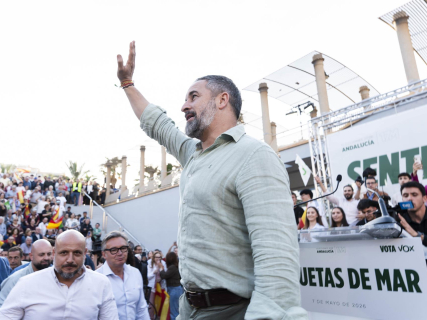
General elections survey: Vox surpasses double the seats of 23J and maintains a majority of 212 with the PP, according to Hamalgama

The PSOE recovers two deputies since September, up to 103, but would lose 18 compared to the last general elections. PP and Vox maintain their majority while Sumar and Podemos decrease from ten to seven joint representatives.

fotonoticia 20261010105947 1920

fotonoticia 20261010105947 1920

Add DEMÓCRATA to Google

Ask FREN

Published

Last updated

7 minutes

Most read

Elecciones 29N · Encuestas

La media de las encuestas

Media a 13 de noviembre de 2026 · 15 institutos

  • PP31,5 %
  • PSOE26,8 %
  • Vox19,1 %
  • Frente Amplio6,4 %
  • ERC2,4 %
01020304050ene 2024jul 2024ene 2025jul 2025ene 2026jul 2026

Media del último estudio de cada instituto en 30 días y su evolución semanal desde el 23J. Partidos con al menos un 2 %.

Todas las encuestas

Elecciones generales del 29 de noviembre · Demócrata

The first survey of Hamalgama Métrica for Vozpópuli after the electoral advance maintains a wide majority of PP and Vox: 212 deputies and 53% of the vote. The Popular Party would win with 144 seats and Abascal would reach 68, more than double the 33 he obtained in the July 2023 elections.

The PSOE would remain at 103 deputies. This is 18 less than in the 23J, although the comparison with the previous study by the same firm introduces an important nuance: the socialists recover two representatives since September. The right maintains exactly the same parliamentary sum as then.

The survey, published this October 11, was conducted between October 5 and 8 through 1,000 telephone interviews. It portrays the first days of the call for 29N, but it does not allow attributing the movements solely to the electoral advance.

Compared to September: the PSOE gains two seats and PP and Vox maintain their sum

The previous Hamalgama, published on September 13, granted 145 deputies to the PP, 101 to the PSOE, and 67 to Vox. Now the distribution changes to 144, 103, and 68, respectively. The deputy that the PP loses is compensated, in the sum of the right, by the one that Vox gains.

The movements in votes are also small. The PP drops from 33.6% to 33.4%; the PSOE rises from 25.1% to 25.3%; and Vox advances from 19.3% to 19.6%.

The distance between the Popular Party and the socialists narrows from 8.5 to 8.1 points. The parliamentary advantage of the PP goes from 44 to 41 deputies. Therefore, the PSOE slightly improves compared to the previous study, although it remains far from the first position.

Compared to the 23J: Vox contributes 35 of the 42 additional seats of the right

The transformation is much greater when comparing with the 2023 ballots. The PP goes from 137 to 144 deputies: it gains seven. Vox rises from 33 to 68: it gains 35. Together they would advance from 170 to 212, an increase of 42 representatives.

More than eight out of ten additional seats from that sum would come from the growth of Vox. The PP would still clearly be the first force, but Abascal would have a much greater weight within a potential government negotiation.

In votes, the Popular Party would barely surpass its result from the 23J: from 33.1% to 33.4%. Vox, on the other hand, would go from 12.4% to 19.6%, an improvement of 7.2 points.

The PSOE would follow the opposite trend: from 31.7% to 25.3%, a loss of 6.4 points, and from 121 to 103 seats. Its recovery since September does not compensate for the setback compared to the last general elections.

Sumar and Podemos lose three deputies since September

The clearest deterioration between the last two measurements appears on the left of the PSOE. Sumar drops from seven to five deputies and Podemos, from three to two. Their joint representation goes from ten to seven.

The survey attributes 5.4% of the vote to Sumar and 3.3% to Podemos. Together they gather 8.7%, compared to the 12.3% that the Sumar candidacy obtained in 2023, when it included Podemos. The joint comparison avoids presenting two distinct electoral offers as equivalents.

PSOE, Sumar, and Podemos would now total 110 deputies: one less than in September. The two representatives that the socialists recover do not compensate for the three that the candidacies situated to their left lose.

A broad majority, still subject to the polls

The 212 deputies of PP and Vox would be 36 above the 176 needed for an absolute majority. If both parties achieved that result and agreed on an investiture, they would not need other support. The snapshot maintains the advantage of the right, but does not show a leap since September: their joint representation remains intact. The main change is in the distribution between parties and in the weakness of the space that in 2023 ran under a single Sumar candidacy.

Democrat · Polls · Hamalgama

What changes since September

Vote estimate. PP and Vox go from 52.9% to 53%.

Swipe the table to see all columns →
Party or grouping Sep 13, 2026 Oct 11, 2026 Change in points
PP 33.6% 33.4% −0.2
PSOE 25.1% 25.3% +0.2
Vox 19.3% 19.6% +0.3
Sumar 5.6% 5.4% −0.2
Podemos 3.8% 3.3% −0.5
PP + Vox 52.9% 53.0% +0.1
PSOE + Sumar + Podemos 34.5% 34.0% −0.5

Source: Hamalgama Metric for Vozpópuli, publications of September 13 and October 11, 2026. Changes expressed in percentage points.

The grouped rows are subtotals: they should not be summed again. They do not include all the forces that could participate in an investiture.

Democrat · Congress Distribution

212 seats: the same total as in September

PSOE recovers two deputies; PP loses one and Vox gains another.

Swipe the table to see all columns →
Party or grouping 23J of 2023 Sep 13, 2026 Oct 11, 2026 Since September Against 23J
PP 137145 144 −1 +7
PSOE 121101 103 +2 −18
Vox 3367 68 +1 +35
Sumar 31Included Podemos 7 5 −2 See joint sum
Podemos Integrated in Sumar 3 2 −1 See joint sum
Sumar + Podemos 31107 −3 −24
PP + Vox 170212212 0 +42
PSOE + Sumar + Podemos 152111110 −1 −42

Absolute majority: 176 deputies. Source: Hamalgama Metric for Vozpópuli and definitive results of 23J.

Podemos ran integrated in Sumar in 2023. The joint comparison of that space goes from 31 to seven seats. The grouped rows are subtotals, not additional candidacies. This table does not show the complete distribution of the 350 deputies.

Democrat · Comparison with the polls

Vox gains 7.2 points against 23J

PP barely varies and PSOE loses 6.4 points compared to 2023.

Swipe the table to see all columns →
Party or space 23J of 2023 Oct 11, 2026 Change in points
PP 33.1% 33.4% +0.3
PSOE 31.7% 25.3% −6.4
Vox 12.4% 19.6% +7.2
Sumar + Podemos 12.3% 8.7% −3.6

Percentages rounded to one decimal. Differences calculated with the figures shown. In 2023, Sumar and Podemos ran together; in this poll they appear separately, with 5.4% and 3.3%, respectively.

Sources: current poll and technical sheet, previous Hamalgama and official results of 23J.

Check the poll and the technical sheet published by Vozpópuli.

More key points, information and questions with FREN

AI-GENERATED CONTENT

What is the current status of the electoral advance process and what are the deadlines planned until the election day?

The electoral advance is now fully formalized: the Royal Decree 806/2026, dated October 5, has dissolved the Congress of Deputies and the Senate and has called for general elections on Sunday, November 29, 2026. The decree was published in the Official State Gazette (BOE) on October 6, 2026 and came into effect that same day, so the procedure is underway and the ordinary calendar established by the Constitution and the LOREG applies.

1. Status of the electoral advance process

  • Political decision and announcement: on October 5, 2026, the Prime Minister announced the electoral advance to November 29 in an institutional statement from Moncloa, following the rejection in Congress of the housing decrees.
  • Council of Ministers and signing: that same day, an extraordinary Council of Ministers meeting was held that approved the draft royal decree dissolving the Cortes and calling elections. The text is issued “at the proposal of the President of the Government and after deliberation of the Council of Ministers,” in accordance with Article 115 of the Constitution.
  • Signing by the King: Royal Decree 806/2026 is signed by the King and the Prime Minister, fulfilling the constitutional framework of dissolution and call.
  • Publication in the BOE and entry into force: the decree was published in the BOE on October 6, 2026 (official text of RD 806/2026) and the final provision establishes that it came into force that same day. From that moment:
    • The Chambers elected on July 23, 2023, are dissolved.
    • The electoral date of November 29 is officially called.
    • The 54-day period between the call and the vote, established in Article 42 of the LOREG, is activated.
  • Regime with dissolved Cortes: the General Courts are dissolved, but the Permanent Deputation of each Chamber remains in function, with the powers granted by the Constitution (mainly, ratification or repeal of royal decree-laws and management of possible states of alarm, exception, or siege).

In summary, the advance is no longer a hypothetical scenario: the decree is approved, signed, published, and in force. The process is in the execution phase of the electoral calendar.

2. Deadlines and calendar until the November 29 elections

Between October 6 and November 29, the main milestones of the process occur, combining what the royal decree itself establishes and what results from the LOREG and electoral administration resolutions:

2.1 Basic institutional milestones
  • October 5, 2026: deliberation of the Council of Ministers and issuance of Royal Decree 806/2026 (dissolution and call).
  • October 6, 2026:
    • Publication in the BOE of RD 806/2026 and entry into force.
    • Effective dissolution of the Congress and Senate.
    • Start of the electoral period.
  • December 23, 2026: the decree itself sets that the new Chambers will meet in constitutive session that day at 10:00 a.m. The date fits within the 25-day limit after the elections established by Article 68.6 of the Constitution.
2.2 Census, candidacies, and coalitions
From the call, the LOREG deadlines apply, specified by the Electoral Board and administrations:
  • October 12–19: period for consultation and claims of the electoral census in town halls and statistics offices, according to the INE note and various municipalities.
  • Until October 16: deadline for parties to notify the electoral administration of the formation of coalitions wishing to run jointly (10 days from the call, according to the LOREG).
  • October 21–26: window for the submission of candidacies to the Congress and Senate, between the 15th and 20th days after the call.
  • October 28: publication of the submitted candidacies.
  • November 2: final proclamation of candidacies by the electoral boards.
  • November 3: official publication of the proclaimed candidacies.
2.3 Electoral campaign and postal voting
  • From October 6: it is possible to request postal voting, both at post offices and online, according to information disseminated by Correos and collected by Demócrata.
  • November 9: expected start of sending postal voting documentation to applicants.
  • November 19: last day to request postal voting.
  • November 25: ordinary deadline to deposit postal votes at post offices.
  • Voters abroad: a resolution dated October 9 determines the authorized centers and sets that depositing the vote in ballot boxes at embassies and consulates may be done between the eighth and third days prior to election day (November 21–26).
  • November 13–27: official electoral campaign, fifteen days, from 00:00 on the 13th until 24:00 on the 27th, according to RD 806/2026 and notes from the Congress and Senate.
  • November 28: reflection day, without electoral propaganda.
  • November 29: general elections for the Congress and Senate; polling stations open from 9:00 to 20:00.

After the vote, the electoral boards carry out the general count in the following days (starting December 2, according to the indicative calendar) and proclaim the elected, culminating the process with the constitutive session on December 23.

What margin of action does the Permanent Deputation have now with the Cortes dissolved until December 23? How does this electoral calendar affect the processing of the bills that were underway in the Congress and Senate? What specific deadlines and conditions govern the vote of residents abroad in these November 29 elections?

What are the main powers and functions of the Prime Minister according to the Spanish Constitution?

The Prime Minister is the central figure of the executive power in Spain. The 1978 Constitution assigns him a set of powers and functions that can be grouped into four main blocks: direction of the Government and general policy, relationship with the Cortes Generales, relationship with the Crown, and appointment and coordination functions within the Executive itself.

1. Direction of Government action and internal and external policy

Article 97 of the Constitution establishes that the Government directs internal and external policy, the civil and military Administration, and the defense of the State, and that the Prime Minister directs the Government's action and coordinates the functions of its members. From this derive several essential powers:

  • Set the major political orientations: the Prime Minister sets the priorities of the Executive (economic, social, territorial, foreign, security, etc.) and defines the general line that the different ministries must follow.
  • Coordinate the ministers: ensures coherence among the actions of the different departments, resolves conflicts between them, and can give political directives to each minister.
  • Politically represent the Government: appears before public opinion, other institutions, and internationally as the highest political authority of the Executive, without prejudice to other ministers having sectoral representation.
  • Promote Government regulations and legislative initiatives: although formally the Government acts collegially, it is the Prime Minister who leads which bills or reforms are promoted, when, and with what scope.
2. Relationship with the Cortes Generales: confidence, control, and political responsibility

The parliamentary system designed by the Constitution is articulated around the relationship of confidence between the Congress and the Prime Minister:

  • Investiture (art. 99): the Prime Minister only acquires that status after obtaining the confidence of the Congress of Deputies. He is elected by the Chamber, not directly by the Head of State nor by direct popular election.
  • Political responsibility (arts. 108 et seq.): the Government, and particularly its Prime Minister, are politically responsible before the Congress. The latter can demand responsibility through instruments such as the motion of censure or the vote of confidence.
  • Direction of relations with the Chambers: the Prime Minister appears before the Congress and, if applicable, the Senate to inform about Government policy, participate in general debates (for example, on the state of the Nation), and respond to parliamentary control.
  • Legislative promotion: leads, on behalf of the Government, the presentation and defense of bills, as well as other initiatives (for example, constitutional reform proposals arising from the Executive).
3. Relationship with the Crown and countersigned acts

The Constitution configures the King as Head of State with essentially representative and arbitral functions, but his acts almost always require the countersignature of the Prime Minister or other members of the Executive (art. 64). Within this framework:

  • Propose to the King his own appointment: after the consultation round with parliamentary groups, the King proposes a candidate for the Presidency; the election depends on the Congress, but the institutional relationship is channeled through the candidate and then the Prime Minister.
  • Countersign acts of the King: in matters such as dissolution of the Cortes (when appropriate), calling elections, appointment and dismissal of ministers, or sanctioning laws, the Prime Minister countersigns acts of the Head of State, assuming political responsibility.
  • Propose the dissolution of the Chambers and the call for elections (within constitutional limits): the political decision to call early elections is taken by the Prime Minister, who submits it to the King to formalize the dissolution and call.
4. Appointment, dismissal, and internal coordination of the Government

Another key function of the Prime Minister is that of “head of the government team”:

  • Propose the appointment and dismissal of ministers: the King appoints and removes Government members at the proposal of the Prime Minister. This grants the Prime Minister broad capacity to configure and reshape his cabinet.
  • Organize the Government structure: within the limits allowed by law, the Prime Minister decides the creation, merger, or suppression of ministries and the distribution of portfolios and political competences among them.
  • Preside over the Council of Ministers: convenes, sets the agenda, and directs Council meetings, where the Executive's collegiate decisions are made (including bills, legislative decrees, and royal decree-laws).
  • Assume the supreme representation of the State in political crisis situations of the Government: for example, in the event of resignation, loss of a vote of confidence, or internal crisis, the Prime Minister decides whether to resign, propose cabinet changes, or call for a new investiture.
5. Summary

Overall, the Spanish Constitution configures the Prime Minister as the true center of political decision-making in the system: he directs Government action, answers to the Congress, coordinates and chooses ministers, channels relations with the King, and assumes the highest political responsibility before the citizenry through Parliament. Although many formal decisions are collegial or materialize through acts of the King, the political drive and direction correspond prominently to the Prime Minister.

Can you explain in more detail how the investiture procedure of the Prime Minister works according to the Constitution? What are the differences between the functions of the Prime Minister and those of the King in the Spanish constitutional system? How can the resignation or replacement of a Prime Minister be forced according to parliamentary control mechanisms?

What results did the PSOE and PP obtain in the 2019 general elections and how has their parliamentary representation evolved since then?

In the 2019 general elections, PSOE and PP experienced a profound change in the party system balance, first with the collapse of the PP in April and then with its recovery in November. Since then, the parliamentary representation of both has evolved to the current scenario, in which the PP is the largest group in Congress and the PSOE maintains the Presidency of the Government supported by other parties.

Results of the 2019 general elections

April 28, 2019 (28‑A)

According to official data consulted, in the April 28, 2019 elections the PSOE clearly won the polls:

  • PSOE: 7,513,142 votes (28.67 %) and 123 seats in Congress.
  • PP: 4,373,653 votes (16.69 %) and 66 seats.

It was a broad victory for the socialists, both in votes and seats, with a difference of 57 deputies over the Popular Party. For the PP, those 66 seats represented one of its worst historical results in a general election since the consolidation of bipartisanship.

November 10, 2019 (10‑N)

The November 2019 repeat election modified that initial balance. The PSOE remained the first force but declined slightly, while the PP began a significant recovery:

  • PSOE: around 6.75 million votes (approx. 28 %) and 120 seats.
  • PP: around 5.04 million votes (20.81 %) and 89 seats.

Between April and November, the PSOE lost 3 deputies (from 123 to 120), while the PP gained 23 (from 66 to 89). This PP jump is largely explained by the reconfiguration of the center-right space and the decline of other forces that had grown in 2015‑2016.

Evolution up to the current legislature

General elections of July 23, 2023 (23‑J)

In the following general elections, held on July 23, 2023, there was a turnaround in terms of the most voted force, although without an absolute majority for any bloc. The results for PSOE and PP were:

  • PP: more than 8.16 million votes (33.06 %) and 137 seats.
  • PSOE: more than 7.82 million votes (31.88 %) and 121 seats.

The PP thus became the largest parliamentary force, with 137 deputies, while the PSOE came second with 121, very close in votes but behind in seats. However, subsequent negotiations allowed Pedro Sánchez's investiture and the continuation of a Government led by the PSOE.

Comparison of seats and trajectory

If we observe the 2019‑2023 series, the evolution in Congress is as follows:

Party 28‑A 2019 10‑N 2019 23‑J 2023
PSOE 123 120 121
PP 66 89 137

In terms of parliamentary representation, the PSOE shows a relatively stable trajectory: a slight downward correction between April and November 2019 (loses 3 deputies) and a minimal recovery in 2023 (gains 1, up to 121). Its number of seats remains within a narrow range between 120 and 123 throughout the period, although its effective political weight varies according to available allies at each moment.

The PP, on the other hand, experiences a much more abrupt path. It starts from 66 seats in April 2019, rises to 89 in November —a gain of 23 deputies in a few months— and culminates in 2023 with 137, which means adding 48 additional seats compared to 2019 and regaining the status of the largest group in Congress. This rise implies that, in just two full electoral cycles, the PP goes from its historical low to a position of clear hegemony within the right-wing bloc.

Situation in the current legislature

With the results of 23‑J, the current legislature is characterized by:

  • A PP with 137 deputies, as the main opposition group.
  • A PSOE with 121 deputies, which supports the Government thanks to agreements with other forces in Congress.

The evolution since 2019 can be summarized as follows: the PSOE wins and governs after 28‑A, resists as the first force after 10‑N despite slight wear, and finally maintains a very similar representation in 2023, although it cedes primacy in seats to the PP. The latter, for its part, transforms a very weak result in 2019 into clear parliamentary leadership in 2023, in a context where fragmentation and competition with other conservative forces condition government possibilities.

Play

Test your knowledge with FREN!

How much do you know about this topic? Answer the following 3 questions.

How many deputies do PP and Vox add up to according to the Hamalgama survey for Vozpópuli published on October 11?

Question 1 of 3

How many seats would Vox obtain according to the survey estimate after the early election?

Question 2 of 3

How many representatives would Sumar and Podemos have together according to the October 2026 survey?

Question 3 of 3