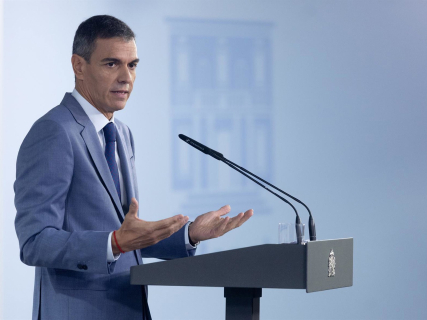
General elections survey: PSOE barely improves and PP and Vox maintain more than 200 seats, according to NC Report

The NC Report survey for 'La Razón' places the PP at 34.1%, the PSOE at 25%, and Vox at 18.2%, with a total of between 207 and 212 deputies for the popular and Vox.

fotonoticia 20261007212150 1920

fotonoticia 20261007212150 1920

Add DEMÓCRATA to Google

Ask FREN

Published

Last updated

3 minutes

Most read

Elecciones 29N · Encuestas

La media de las encuestas

Media a 13 de noviembre de 2026 · 15 institutos

  • PP31,5 %
  • PSOE26,8 %
  • Vox19,1 %
  • Frente Amplio6,4 %
  • ERC2,4 %
01020304050ene 2024jul 2024ene 2025jul 2025ene 2026jul 2026

Media del último estudio de cada instituto en 30 días y su evolución semanal desde el 23J. Partidos con al menos un 2 %.

Todas las encuestas

Elecciones generales del 29 de noviembre · Demócrata

The PSOE still fails to find a relevant recovery in the estimates from NC Report, although it does not worsen compared to the previous general elections survey from the firm. The survey published this Thursday, October 8, by La Razón grants it 25% of the votes and between 98 and 102 deputies. The PP would win with 34.1% and between 146 and 148 representatives, while Vox would obtain 18.2% and between 61 and 64.

The sum of the popular and Vox would be between 207 and 212 deputies by adding the extremes of their respective ranges: a comfortable majority, but slightly lower than that of September. The change in the political scenario does not translate into a turnaround in this comparison.

Party Estimated Vote Seats
PP 34.1% 146–148
PSOE 25.0% 98–102
Vox 18.2% 61–64
Sumar 5.3% 6–8
Podemos 3.9% 2–4
Junts 2.9% 10–11

The PSOE improves the ceiling of its range, but remains around one hundred deputies

The socialists maintain the minimum of 98 representatives and raise the maximum from 100 to 102. That does not equate to a guaranteed gain of two deputies: it improves the upper extreme of the estimate, while the lower remains intact.

The distance with the PP narrows from 9.5 to 9.1 points. It is a small movement that does not alter the order of the parties nor allows for talking, by itself, of a comeback.

It is advisable to separate two comparisons. Regarding the 2023 elections, the socialist result would be clearly worse. In contrast to the previous NC Report, however, there is a slight improvement, not an additional drop.

PP and Vox maintain the majority, although their sum retreats

In September, both parties gathered 52.7% of the estimated vote and between 209 and 213 seats. Now they sum 52.3% and between 207 and 212.

The right maintains a very favorable parliamentary position, but the numbers do not support that it has expanded its advantage over that measurement.

The information from La Razón includes an inconsistency: it mentions a sum of between 201 and 212 deputies. However, the individual intervals published —146–148 for the PP and 61–64 for Vox— yield between 207 and 212. That is the arithmetic sum used here, not an additional joint projection provided by the polling firm.

Junts would surpass Sumar in seats

Junts appears with 2.9% of the national vote and between ten and eleven deputies, above the six to eight attributed to Sumar. La Razón places it as the fourth force in Congress by representation.

The party of Carles Puigdemont would improve compared to its seven deputies from 2023. This comparison should not be confused with an increase compared to September: to quantify this last one, it is necessary to have the previous data of Junts contrasted.

Nor should the coincidence of PP, Vox, and Junts against the housing decrees be interpreted as the existence of a government coalition. With the published figures, PP and Vox would not need Junts' seats to exceed the absolute majority.

Podemos improves while Sumar loses ground

Among the five state candidacies compared, Podemos registers the largest percentage advance: half a point. Its range maintains the minimum of two deputies and raises the maximum to four.

Sumar, on the contrary, loses four tenths and one deputy at each end of its interval. The study presents both formations separately: their results cannot be automatically transferred to a potential joint candidacy.

The survey does not demonstrate an effect of the advance

Publishing a survey after an electoral announcement is not enough to attribute the observed changes to it. To evaluate that relationship, it is necessary to know the dates of the interviews and how they were distributed before and after the announcement. The complete technical sheet of the new study could not be verified in this review.

The conclusion that the comparison does allow is more concrete: the PSOE barely improves, PP and Vox maintain a wide majority although they slightly regress, and Podemos gains ground while Sumar loses it. Talking about a reward or a punishment caused by the decrees or by the advance would require additional evidence.

Survey NC Report: comparison between September and October 2026

Party Vote September 7 Vote October 8 Change in points Seats September Seats October
PP 34.4% 34.1% −0.3 147–149 146–148
PSOE 24.9% 25.0% +0.1 98–100 98–102
Vox 18.3% 18.2% −0.1 62–64 61–64
Sumar 5.7% 5.3% −0.4 7–9 6–8
Podemos 3.4% 3.9% +0.5 2–3 2–4

Source: NC Report for La Razón, publications from September 7 and October 8, 2026. The dates correspond to the publication, not to the fieldwork. Data collected in the texts of both pieces of information. Variations expressed in percentage points. The ranges of seats do not imply guaranteed gains or losses.

More key points, information and questions with FREN

AI-GENERATED CONTENT

What is the usual process and timeline for the official publication of electoral results in Spain after a general election?

In Spain, the results known on the night of a general election are only provisional. The process until their official proclamation and publication is strictly regulated by the Organic Law of the General Electoral Regime (LOREG) and unfolds in several phases, with staggered involvement of electoral boards, electoral commissions, and, finally, the Official State Gazette (BOE).

1. Election night: provisional counting at the polling stations

The first count is carried out at each polling station when the polls close:

  • The members of the polling station open the ballot boxes and count the ballots one by one.
  • Scrutiny records are drawn up, recording the number of voters, valid votes, null votes, blank votes, and those obtained by each candidacy.
  • These records are placed in official envelopes that are sent to the local or provincial electoral boards and other recipients provided by law.

The famous “election night count” disseminated by the Interior Ministry and the media is, therefore, a provisional advance based on the telematic transmission of these data; it has no legal effects and can be corrected later.

2. General scrutiny: official review of the results

The count with legal value is the so-called general scrutiny, carried out by the electoral boards:

  • It corresponds to the provincial electoral boards (and, where applicable, the local ones), which meet a few days after the vote, on a date set quite precisely by the LOREG.
  • In this session, the envelopes with the records are opened one by one, it is verified that they match the received documentation, and the results are summed.
  • Votes that are usually not counted on election night are also included, such as certain votes cast abroad and other special modalities.

This general scrutiny serves to correct material errors in the provisional count (for example, incorrectly transmitted figures) and to resolve incidents documented in the records.

3. Claims during the general scrutiny

The LOREG provides that, during the general scrutiny session, poll watchers and candidacy representatives may:

  • File claims and protests regarding the vote count or the validity of a polling station.
  • Request that certain envelopes of electoral documentation be checked or even opened when there are well-founded doubts.

The electoral board resolves these claims in the same session or in the immediately following one, recording them in the minutes. Only once these are resolved can the general scrutiny in that constituency be considered closed.

4. Proclamation of elected candidates

Once the general scrutiny is concluded, the provincial electoral boards proceed to the proclamation of elected candidates:

  • They apply the legal formulas for seat allocation (D’Hondt system for the Congress, specific rules for the Senate) to the definitive results.
  • They declare which candidates are proclaimed deputies and senators in each constituency.
  • They issue credentials to the proclaimed individuals.

The Central Electoral Board coordinates and unifies this data for the entire State and resolves certain conflicts or queries that may arise at the provincial level.

5. Electoral contentious appeals

Against the proclamation of elected candidates, a contentious-electoral appeal may be filed before the competent jurisdiction, within a very short period (a few days) from the notification or publication of the proclamation agreement. These appeals are resolved by:

  • The Supreme Court, in the case of elections to the Congress and certain Senate constituencies.
  • The High Courts of Justice, in other elections and cases provided for in the LOREG.

Until these appeals are resolved, the result in the affected constituencies may remain pending confirmation, although in practice they usually affect few seats and are resolved before the constitution of the new Cortes.

6. Official publication of the results

The official publication of electoral results takes place on two levels:

  • Provincial/autonomous level: the agreements proclaiming elected candidates are published in the corresponding official journals (provincial or autonomous bulletins), making public the names of the proclaimed individuals.
  • State level: the definitive proclamation of deputies and senators is recorded in the Official State Gazette, along with the list of elected candidates by constituency. Additionally, the Central Electoral Board and the Electoral Census Office disseminate detailed results by polling stations, municipalities, and constituencies.

In practice, between election day and the complete and refined publication of official results in the BOE, several weeks usually elapse: a few days until the general scrutiny, some more days for the proclamation and, if applicable, the eventual filing and resolution of appeals, and finally the insertion in the official journals. This entire schedule is designed so that the definitive results are consolidated before the constitutive session of the new Cortes Generales.

How exactly does the provisional election night scrutiny differ from the general scrutiny in legal and practical terms? What real margin do contentious-electoral appeals have to alter the distribution of seats after a general election? What role does the Central Electoral Board play compared to the provincial boards in managing and publishing electoral results?

What are the main powers and functions of the President of the Government of Spain according to the Constitution?

The President of the Government of Spain is the highest authority of the Executive Power and the central figure of the parliamentary system designed by the 1978 Constitution. His powers and functions are divided into three main areas: the direction of the Government and political action, the relationship with the Cortes Generales and the King, and political responsibility before Parliament.

1. Direction of Government action and general policy

Article 97 of the Constitution establishes that the Government directs domestic and foreign policy, the civil and military administration, and the defense of the State, and that it exercises executive function and regulatory power. Within that Government, the president holds a prevailing position:

  • Directs Government action: sets the major political lines, coordinates the work of ministers, and resolves conflicts between departments. He is not a “primus inter pares” but the true director of the Executive.
  • Guides general policy: in practice, he sets the agenda of national priorities (economic, social, foreign, security, etc.), in accordance with the program submitted to the Congress during investiture.
  • Drives Government regulations: although the Council of Ministers collectively adopts decisions, the president decides which bills, royal decree-laws, or royal decrees are submitted, when, and with what scope.
  • Institutional representation: politically embodies the Government before the other branches of State and the citizenry, appearing in parliamentary sessions and public spaces to explain and defend governmental action.

2. Appointment, dismissal, and relationship with the King

The Constitution assigns the president a key role in articulating the Executive with the Crown:

  • Appointment by the King after investiture (art. 99): although the King designates and appoints him, he necessarily does so based on the candidate who has obtained the confidence of the Congress of Deputies.
  • Appointment and dismissal of ministers (art. 100): the King appoints and dismisses other Government members exclusively on the president’s proposal. In practice, this grants the president the power to configure, reshape, and dismiss his ministerial team.
  • Permanent relationship with the King: the president regularly informs the King about State affairs. This is a customary political obligation that serves as a channel between the Head of State and the Executive.
  • Responsibility before the King upon resignation: when the president resigns, he communicates his decision to the King, which initiates the consultation and new investiture process provided in article 99.

3. Relations with the Cortes Generales and political responsibility

The President of the Government is politically responsible before the Congress of Deputies. This translates into specific powers and obligations:

  • Investiture (art. 99): he must present his political program before the Congress and request the confidence of the Chamber. Without this initial confidence, he cannot be appointed.
  • Parliamentary control (arts. 66 and 108): the Government, particularly its president, answers for its management before the Congress, which may direct questions, interpellations, and request appearances.
  • Vote of confidence (art. 112): the president may submit a vote of confidence to the Congress on his program or a general policy declaration. If lost, he must resign.
  • Motion of censure (art. 113): the Congress may demand his responsibility through a constructive motion of censure which, if successful, replaces him with another president. The Government is obliged to accept this result.
  • Collective responsibility of the Government (art. 108): the president assumes, along with the Cabinet, the overall political responsibility of the Executive’s action before the Cortes.

4. Dissolution of the Cortes and calling elections

One of the president’s most relevant powers is his ability to influence the political calendar:

  • Proposal to dissolve the Cortes (art. 115): he may propose to the King the dissolution of the Congress, the Senate, or both Chambers, which leads to the calling of general elections.
  • Limits to this power: dissolution cannot be agreed while a motion of censure is pending, before one year has passed since the previous dissolution, nor during states of emergency or siege.

5. States of alarm, exception, and siege

The Constitution grants the president a central role in constitutional crisis situations regulated in article 116:

  • Declaration of state of alarm: corresponds to the Government, at the president’s proposal, to declare it by decree, with the obligation to immediately report to the Congress.
  • Proposal of states of exception and siege: the Government, presided over by him, proposes to the Congress the declaration of these states and executes the authorized measures.

Overall, the president’s powers, as defined by the Constitution, make him the center of gravity of the Spanish political system: he directs and coordinates the Executive, answers before Parliament, relates institutionally with the King, and has decisive instruments (dissolution, confidence, crisis management) to lead the country’s political life.

How is the President of the Government elected and appointed step by step according to the Constitution? What differences does the Constitution establish between the functions of the President of the Government and those of the King? What exactly does the constructive motion of censure against the President of the Government consist of?

What legal requirements must an electoral poll meet to be considered valid and publishable in media according to Spanish regulations?

In Spain, the specifically legal requirements for an electoral poll to be valid and publishable in media mainly derive from the Organic Law of the General Electoral Regime (LOREG) and the instructions of the Central Electoral Board (JEC). The regime is activated between the call and the holding of elections; outside that period, mainly professional standards and general regulations (consumer protection, data protection) apply, but not such a detailed electoral regime.

1. Minimum content of the technical sheet (art. 69 LOREG)

During the electoral period, every poll or survey published in a media outlet must be accompanied, under the responsibility of those who conduct it, by a series of mandatory data. Article 69 of the LOREG requires that the publication include at least:

  • Identification of those responsible: name and address of the entity, public or private, or individual who conducted the poll, as well as who commissioned or financed it.
  • Essential technical characteristics:
    • Sampling system used.
    • Sample size.
    • Margin of error.
    • Level of representativeness.
    • Procedure for selecting respondents.
    • Dates when the fieldwork was conducted.
  • Questionnaire and non-response: full text of the questions asked and number of people who did not answer each of them.

These elements practically define the legally required “minimum technical sheet” for the survey to be disseminated in media during the electoral period.

2. Control and communication obligations with the Electoral Board

The LOREG assigns the Central Electoral Board the function of:

  • Ensuring that published survey data do not contain deliberate falsifications, concealments, or manipulations.
  • Verifying compliance with the above specifications and ordering, if necessary, corrections that media must publish within three days, in the same spaces or pages.
  • Requesting from the poll conductor the complementary technical information necessary for its verifications.

Additionally, article 69.8 LOREG and Instruction 1/2024 of the JEC regulate a specific regime for intention-to-vote polls conducted by bodies dependent on Public Administrations (e.g., CIS, CEO, CENTRA):

  • They must notify the JEC in advance of the poll’s conduct, before starting fieldwork.
  • They must send the JEC the main planned technical characteristics (sampling system, sample size, dates, questionnaire, etc.).
  • Once results are available, they must make them available to political parties that request them within the territorial scope of the poll, within a maximum of 48 hours, preserving personal data protection according to Organic Law 3/2018.
3. Temporal limitations on publication in media

Article 69.7 LOREG establishes the so-called “poll ban”:

  • Absolute prohibition to publish, disseminate, or reproduce electoral polls or surveys by any media during the five days prior to the voting day.

Instruction 3/2019 of the JEC clarifies that, when there are simultaneous electoral processes (general, local, autonomous, European), this prohibition applies jointly: in the five days before the general elections, polls related to the other processes cannot be published either.

4. Transparency, financing, and data protection

Although the LOREG does not require publishing the exact cost of the poll, it does require clearly identifying who pays for it and who conducts it, which functions as a transparency mechanism regarding financing and possible biases.

Regarding personal data, polls must always comply with Organic Law 3/2018 on personal data protection and digital rights guarantee, particularly concerning anonymization and statistical treatment of responses.

5. Sanctioning regime

The LOREG foresees two sanctioning levels:

  • Administrative sanctions (articles on electoral infractions): violations of the electoral poll regime are punishable with fines between 3,000 and 30,000 euros, imposed by the competent Electoral Board.
  • Criminal liability: those who violate the current regulations on electoral polls may be punished with prison sentences from three months to one year, fines from twelve to twenty-four months, and special disqualification from related professions or trades for one to three years.

In summary, for a poll to be legally “publishable” in media during the electoral period, it must respect the five-day temporal ban, be accompanied by a complete technical sheet according to article 69 LOREG, guarantee transparency about who commissions and conducts it, and comply with any additional obligations if promoted by a public body, under the supervision and sanctioning power of the Electoral Board.

Play

Test your knowledge with FREN!

How much do you know about this topic? Answer the following 3 questions.

What percentage of votes does the PSOE obtain according to the latest NC Report survey published by La Razón?

Question 1 of 3

How many seats do the maximum intervals of PP and Vox add up to according to the survey?

Question 2 of 3

Which party surpasses Sumar in number of deputies according to the estimate?

Question 3 of 3