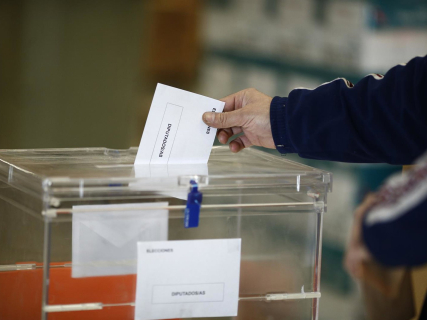

Some early general elections would be held in a demographic scenario in which the PP appears as the first force in most recent polls, while the PSOE moves around 25%-26% and Vox is positioned near 18%. A simple average of the eight most recent national studies available depicts a PP at 33.1%, a PSOE at 25.6%, and Vox at 18.5%.
The calculation takes the latest studies published by SocioMétrica, Celeste-Tel, DYM, Target Point, Hamalgama Métrica, GAD3, Sigma Dos, and EM-Analytics, with fieldwork carried out between early and late September. This is an average of voting percentages, not a projection of seats, as the translation of votes to deputies depends on the territorial distribution of the vote and the electoral system.
The PP, above 30% in all included polls
The main agreement among the studies is the position of the PP. None of the eight polls included in the average places the popular party below 31%. The highest result corresponds to DYM, with 34.7%, while GAD3 records 31.1%. SocioMétrica attributes 33.9% to it and Sigma Dos, 33.1%.
The Celeste-Tel poll, conducted on September 22, places the PP at 33.9%; Hamalgama Métrica, at 33.6%; EM-Analytics, at 32.3%; and Target Point, at 31.5%.
The PSOE moves around 26%
The studies offer a more concentrated scenario for the PSOE. The average of the eight polls places it at 25.6%, with a range from 24.9% from NC Report to 26.3% from DYM.
SocioMétrica grants it 25.7%, Celeste-Tel 25.4%, Target Point 25.6%, Hamalgama 25.1%, GAD3 26.1%, Sigma Dos 25.4%, and EM-Analytics 25.3%.
The CIS constitutes a significant exception against this set of studies: its September barometer, conducted between the 1st and 4th of that month, placed the PSOE at 31%, the PP at 25.5%, and Vox at 16.6%. Due to being a different methodology and estimation model and a fieldwork prior to a good part of the polls used in the average, it has not been incorporated into the calculation.
Vox remains close to 18%
Vox appears as the third force in all included studies and registers an average of 18.5%.
The percentages range between 17.3% from DYM and 19.3% from Hamalgama Métrica. GAD3 grants it 19.2%, Target Point 18.9%, EM-Analytics 18.8%, SocioMétrica 18%, Sigma Dos 17.9%, and Celeste-Tel 17.8%.
The sum of the average percentages of PP and Vox reaches 51.6% in this exercise. That data exclusively describes the average voting intention of the two parties and does not equate to an estimation of parliamentary majority, since seats are assigned by constituencies.
Sumar and Podemos, in different positions
The average places Sumar at 6%. The included studies present considerable differences: DYM attributes it 4.5%, while GAD3 reaches 7% and Target Point 6.9%.
Podemos moves around 3.4% in the studies that offer a differentiated estimation. Its percentage ranges between 2.8% from Target Point and Sigma Dos and 3.8% from Hamalgama and EM-Analytics.
The configuration of the alternative left space remains an open variable for future general elections. In September, the creation of a new brand, Frente Amplio, around Sumar, Izquierda Unida, Comuns, and Más Madrid has been proposed, while the uncertainty about a possible incorporation of Podemos continues.
Seats cannot be calculated by adding percentages
The polls that include an estimation of deputies show that the territorial distribution can substantially modify the translation of votes into seats.
For example, GAD3 estimates 133 deputies for the PP, 105 for the PSOE, and 69 for Vox, while Sigma Dos calculates 143, 101, and 61, respectively. DYM places the PP between 144 and 148 seats, the PSOE between 102 and 105, and Vox between 58 and 61.
Therefore, the average vote allows observing the demoscopic scenario, but does not determine by itself what the composition of Congress would be. Additionally, the studies have different field dates, sample sizes, and methodologies, so their results are not directly equivalent.
Overall, the most recent polls depict a scenario in which the PP appears ahead, the PSOE is around a quarter of the vote, and Vox hovers around 18%, while the parliamentary dimension of that scenario would depend on how those supports are distributed in each constituency.
A defeat that could open the door to the polls
Possible general elections could be near. If the vote on the housing decrees this Friday declines, the parliamentary defeat would add pressure on Pedro Sánchez and could open the door to an early dissolution of the Cortes, at a moment when Junts still maintains its position in the air.
Featured story
Elections on November 29? This would be the date if Sánchez brings forward the general elections.
2 minutes
If the president finally opts to call elections, the date of the elections would depend on the day the dissolution decree is signed. In the scenario of a call this Saturday, October 3, the elections would be set for Sunday, November 29.