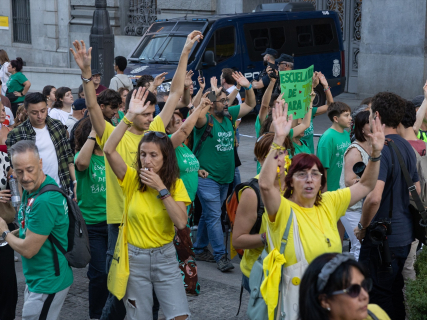

The educational strike of the Community of Madrid continues this Thursday, October 15 after a first day marked by a demonstration that brought together thousands of people in the center of the capital. The organizing groups maintain the mobilizations to demand labor improvements and an increase in resources allocated to public education, without any agreement announced so far that would allow the strikes to be called off.
For Madrid families, the main consequence is that the disruptions in teaching activities may extend beyond this week, as two calls coincide with different calendars. While CCOO, UGT, STEM, CGT, CNT, and Solidaridad Obrera, along with several teaching platforms, are pushing for an indefinite strike, CSIF has organized three full days of strikes between October 14 and 16, in addition to planned partial interruptions during the school year.
The indefinite strike remains in effect and CSIF maintains its own call
Although the first day of mobilizations has concluded, the strike committee that groups the main trade unions and educational platforms keeps open a protest that affects the teaching staff of non-university public education, including schools, institutes, and vocational training centers.
The call from CSIF, which shares some demands with those of the other unions, is carried out independently and has its own strike committee. The organization demands, among other measures, a capital salary supplement to compensate for the cost of living in Madrid, improvements in staffing, and compliance with the sectoral agreement.
This distinction is particularly important starting Saturday, October 17, as the conclusion of the first three full strike days called by CSIF does not imply that the indefinite strike promoted by the other organizations ends.
Education estimates participation at 44.6% and CCOO raises it to 70%
The first day ended with a difference of 25.4 percentage points between the participation figures reported by the Ministry of Education and CCOO. The regional Administration placed participation at 44.6%, while the union raised it to approximately 70% of the summoned teaching staff.
The counselor of Education, Science and Universities, Mercedes Zarzalejo, assured that the day had developed normally, except for some isolated incidents, and described the strike as "political and electoralist." For her part, the general secretary of the Federation of Education of CCOO Madrid, Aida San Millán, considered that the participation had been a "resounding success" and highlighted the impact of the strike in the Early Childhood and Primary centers.
Although both percentages aim to reflect the participation of the teaching staff, they cannot be compared accurately without knowing the calculation bases used by each party. The result depends on the number of workers considered summoned, the treatment of teachers required to provide minimum services, and the moment when the counting is carried out.
The Ministry has the administrative records sent by the educational centers, while the unions prepare their balances based on the information collected by their representatives and territorial organizations. To determine the real extent of the discrepancy, it would be necessary to know how many teachers each count includes and what criteria have been applied to account for the absences.
The mobilization was also reflected in the streets, where the Government Delegation counted 25,000 attendees at the demonstration held on Wednesday afternoon between Atocha and Puerta del Sol. This figure measures participation in the protest and not the labor follow-up of the strike, so it is not comparable to the percentages disseminated by Education and the unions.
The minimum services that educational centers must guarantee
The Community of Madrid maintains during the strikes the minimum services established in the order published on October 9, which requires certain workers to remain in their positions to guarantee essential attention to the students. Its application varies according to the educational stage and the specific needs of each center.
In the second cycle of Early Childhood and in Primary, the Administration requires one teacher for every 50 students or fraction, while in Compulsory Secondary Education and Basic Vocational Training it establishes one teacher for every 90 students or fraction. These provisions are in addition to the management staff provided for in the order.
The ordinary centers must also have an additional teacher for every 25 students with special educational needs, a ratio that is reduced to one for every 15 students in specific Special Education centers. For early childhood schools for children aged zero to three years, specific ratios are established, according to the age of the minors.
Although the minimum services allow for the maintenance of opening and basic attention, they do not guarantee that all classes will proceed normally nor that each group will have its usual teacher. The activity will depend on the number of teachers supporting the strike and the organization that each center establishes with the available staff.
The unions have questioned the breadth of the minimum services, considering that they may reduce the effect of the call, while the regional Government defends their necessity to reconcile the right to strike with educational attention.
The upcoming mobilizations on Thursday and Friday
The calendar announced by the strike committee includes new protests in the coming days, with activities aimed at both the teaching staff and families and the rest of the educational community.
For this Thursday, October 15, the organizers have planned informational pickets starting at 8:00 AM and a human chain at 12:00 PM in front of the Department of Education, followed by assemblies and informational tables during the afternoon.
On Friday, October 16, an open assembly will be held at 12:00 PM in Retiro Park, while at 6:00 PM another demonstration is called from Atocha to Puerta del Sol, which will replicate the route of the march held during the first day.
For its part, CSIF has scheduled partial strikes from 9:00 AM to 11:00 AM and from 5:00 PM to 7:00 PM on October 20, 22, 26, and 30, with new dates spread between November and December. These interruptions are part of their differentiated call and do not replace the indefinite strike of the other organizations.
The consequences for families and the development of classes
The continuity of the mobilizations potentially affects approximately 65,000 teachers of non-university public education in Madrid, who attend to more than 666,000 students. However, the specific scope of the interruptions may vary considerably between schools and institutes, depending on the participation of the teaching staff and the minimum services assigned.
Families can take their children to the centers that remain open, although they must keep in mind that the attention guaranteed by the Administration does not necessarily equate to the ordinary development of teaching activities. Therefore, it is advisable to consult the communications of each school or institute to know the conditions planned for the following days.
Among the main union demands are the reduction of ratios, the decrease in teaching hours and bureaucratic tasks, improvements in pay, and the reinforcement of attention to diversity. The Department, for its part, maintains that some of these demands are unacceptable and reminds that it is negotiating on the teaching professional career.
As long as an agreement is not reached that allows for the end of the conflict, educational centers will have to continue adapting their organization to the strike days, whose impact will depend on the participation recorded in each call and the decisions made by the union organizations.