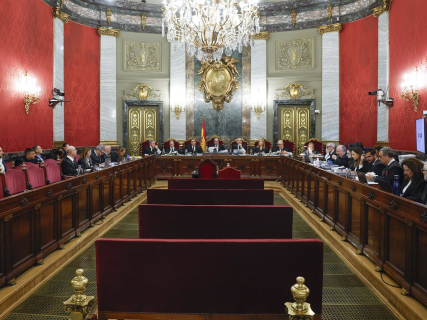

The trial that is being held in the Supreme Court for alleged irregularities in the acquisition of masks during the pandemic enters its decisive phase this week with the interrogations of the three defendants: former minister José Luis Ábalos, his former advisor Koldo García, and the businessman Víctor de Aldama, considered the alleged facilitator, once the agents of the Central Operational Unit (UCO) of the Civil Guard responsible for the main reports of the case have testified.
According to the Court's planning, on Monday seven civil guards will appear to explain the different reports on the alleged corruption scheme, Wednesday will be reserved for taking statements from the three defendants and Thursday, in principle, will be dedicated to the presentation of the final reports by the prosecution and the defense.
However, legal sources cited by Europa Press warn that the interrogations of the accused could be prolonged and that a single day would not be enough to complete them. In that scenario, the oral hearing would resume the following week, on May 4, according to the same sources.
The order of the statements set by the court places Aldama first, followed by Koldo and, finally, Ábalos. The lawyers for the former minister and his former advisor had asked to intervene at the end, and the Chamber ended up agreeing that the former minister would close the round, after Koldo's lawyer stressed that her priority was "to testify after" Aldama.
Accusation of a plot for enrichment
The Anti-Corruption Prosecutor's Office maintains that Ábalos, Koldo, and the businessman "agreed" to take advantage of the position of the then minister, who took over the Ministry of Public Works in June 2018, later renamed Ministry of Transport.
The chief prosecutor, Alejandro Luzón, states that they coordinated to "favor", "in exchange for the corresponding economic benefit", the awarding of public contracts "on as many occasions as there was opportunity, by companies whose interests he would capture and promote" the businessman, all of this, in his opinion, with "the aim of enrichment".
In its indictment, Anticorruption emphasizes that the three "agreed to the future commission of crimes as opportunities to commit them arose" and underlines that they had "timely or continuous" support from other authorities and officials of the Ministry of Transport, as well as from people in Aldama's business circle and from Koldo's relatives.
The Public Prosecutor's Office insists that the alleged network was born "with an undeniable vocation for permanence over time", since "it was operating for several years and projecting its criminal action in different spheres or illicit conducts that stemmed, however, from the same structure that only began to weaken after the simultaneous departure" of Ábalos and Koldo from Transport in July 2021.
Up to 30 years in prison requested
For Luzón, that "cohesion" between the three "was not only manifested in the commission of different crimes, but also in the facilitation" to Aldama of a "privileged interlocution" in his contacts with Transport and "other ministerial departments", as well as with "different public administrations".
In attention to these facts, the Anti-Corruption Prosecutor's Office claims 24 years in prison for Ábalos and 19 and a half years for Koldo for alleged crimes of belonging to a criminal organization, bribery, misuse of privileged information, influence peddling, and embezzlement, in addition to the payment of a joint fine of 3.8 million euros.
In the case of Aldama, he requests 7 years in prison and a financial penalty of 3.7 million for these first three offenses, for which he declared himself guilty in his defense brief, which leads the prosecutor to apply the mitigating circumstance of confession.
The popular prosecutions, led by the PP, raise the request to 30 years in prison for the former minister and his former advisor, while for the businessman they adhere to the penalty requested by the Public Prosecutor's Office.
"The boss" and the "alter ego" in the alleged network
According to the Public Prosecutor's narration, each of the accused "assumed a diverse and complementary role in the organization, in a precise division of functions that proved very effective", and details that both Koldo and Aldama "considered" Ábalos as "the boss".
Luzón explains that the former minister "contributed the authority conferred by his highest responsibility in the Ministry of Transport and his direct influence when necessary", and that for the rest of the tasks he relied on Koldo as "his trusted man".
In the Prosecutor's opinion, Koldo ended up being "more of an assistant than an advisor," since he "performed a good number of tasks of very diverse kinds for Ábalos, both professional and personal, lawful and unlawful," before, during, and after the three years of his ministerial term.
"Koldo García was the 'alter ego' of José Luis Ábalos during his tenure at the head of the Ministry to the point that, both within the Ministry itself and within other public administrations, it was understood that Koldo was the faithful transmitter of Ábalos' decisions and desires, usually sheltered behind his advisor," describes Luzón.
The prosecutor emphasizes that "Koldo handled Ábalos's illegal sources of cash, which were often confused with his own, acting 'de facto' as his superior's frontman in the criminal activities that both soon undertook under the protection of their positions with the collaboration, among others, of the also accused Víctor de Aldama".
Aldama's "privileged dialogue"
Regarding Aldama, Anticorruption defines him as "a Spanish businessman, with interests in a good number of companies, linked to various sectors, such as real estate, hospitality, and the sale of hydrocarbons", highlighting his "preferential access" to the former minister.
That "privileged dialogue" would have allowed Aldama, in the midst of the health crisis, to know firsthand the needs for purchasing sanitary material, locate the appropriate company, and design the most convenient offer to achieve the contracts, first in Transportes and its dependent entities and, subsequently, in the Canarian and Balearic administrations.
The Prosecutor's Office maintains that Aldama "was in charge of locating companies or individuals interested in any kind of dealings with the administration to, by articulating their interests, assert them preferentially and arbitrarily before it, always in exchange for the corresponding economic benefit, of which he also made Ábalos and Koldo participants".
Luzón details the alleged considerations they would have received from Aldama and his partners, starting with "the continued payment of large sums of money" --10,000 euros per month-- and continuing with the payment of rent for housing for them or their partners, some of the latter also incorporated into public companies.