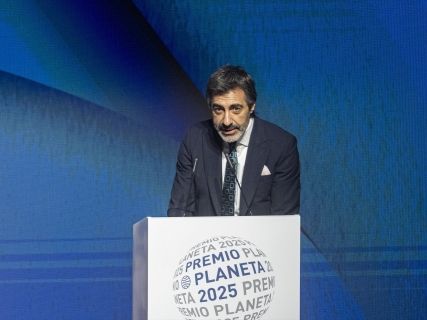

The Planeta Prize 2026 announces this Thursday, October 15, the name of its winner during a gala held in Barcelona, which this year will have the presence of Kings Felipe VI and Letizia. The literary contest reaches its 75th edition with a record of 1,424 submitted manuscripts, from which the jury will choose the two novels that will receive the most financially endowed awards in Spanish literature.
The event adds a new name to a list that includes writers such as Juan del Val, Paloma Sánchez-Garnica, Sonsoles Ónega, or Luz Gabás, whose victories in recent editions have helped place the prize at the center of cultural and media attention. Along with the interest in knowing the distinguished works, the decision again focuses on the selection criteria and the relationship between literary recognition, the popularity of the authors, and the commercial projection of their novels.
Schedule and where to watch the Planeta Prize 2026 live
The organization has announced that the broadcast of the gala will begin at 8:45 PM, one hour less in the Canary Islands, although it has not specified the exact moment when the jury's decision will be known. The names of the winner and the finalist will be revealed during the evening, once the deliberations are concluded.
Those interested can follow the ceremony live through the PlanetadeLibros YouTube channel, while the official page of the Planeta Prize and the publisher's social media profiles will provide information about the development of the event.
The literary dinner will be held in the Pavilion 1 of the Montjuïc venue of Fira de Barcelona, after the organization decided to move the gala there due to the high number of confirmations of attendance, which exceeded initial capacity forecasts.
One million euros for the winner and 200,000 for the finalist
The Planeta Prize maintains in 2026 an endowment of one million euros for the winning novel and 200,000 euros for the finalist, amounts that place the contest among the literary awards with the highest financial rewards in the world. The publisher raised the first prize to one million euros in 2021 and, since then, has maintained both amounts.
As a novelty of this edition, the finalist novel will also receive a trophy, in addition to the corresponding financial endowment.
Unlike other recognitions that distinguish already published works or the trajectory of a writer, the Planeta is reserved for unpublished novels, which are subsequently edited and marketed by the group.
The nine finalist novels of the Planeta Prize 2026
The jury has selected nine works from the received manuscripts, of which seven have been presented under pseudonym. The list includes historical novels, intrigue stories, and narratives centered on personal and family conflicts.
| Novel | Author or pseudonym |
|---|---|
| The Shadow of Isabel | Pedro Regalado Rodríguez |
| Letraherido | Pepe M. Carrascosa |
| Alba Naranja | Tamsilt El Hayani (pseudonym) |
| The Walkers | Martín Guerrero (pseudonym) |
| Kintsugi or Three Broken Souls | Hugalma de la Sierra (pseudonym) |
| The Night of the Lanterns | Mencía Salazar (pseudonym) |
| Those Who Are Missing | Luz Ventura (pseudonym) |
| The Garden of Lennon | Jorge Herrero (pseudonym) |
| The Naked Woman Goes Out at Eleven | Bernardo Galeana (pseudonym) |
Source: PlanetadeLibros.
During the presentation of the candidacies, the organizers of the contest explained that one of the novels initially selected had been excluded after verifying that it had already been published, a circumstance incompatible with the rules of the contest.
The jury this year is made up of Luz Gabás, Pere Gimferrer, Eva Giner, Carmen Posadas, Paloma Sánchez-Garnica, Javier Sierra, and Belén López, director of Editorial Planeta, who serves as secretary with a vote. Sánchez-Garnica and Sierra join this edition of a body whose deliberations are secret and that makes its decisions by simple majority.
The last ten winners of the Planeta Prize
The writer and television collaborator Juan del Val won the Planeta Prize 2025 with Vera, a love story, while Ángela Banzas was a finalist with When the Wind Speaks. His victory followed that of Paloma Sánchez-Garnica, distinguished in 2024 for Victoria, and that of Sonsoles Ónega, who received the award in 2023 for The Daughters of the Maid.
These are the authors and the awarded novels during the last decade.
| Year | Winner | Novel |
|---|---|---|
| 2025 | Juan del Val | Vera, a love story |
| 2024 | Paloma Sánchez-Garnica | Victoria |
| 2023 | Sonsoles Ónega | The Daughters of the Maid |
| 2022 | Luz Gabás | Far from Louisiana |
| 2021 | Carmen Mola | The Beast |
| 2020 | Eva García Sáenz de Urturi | Aquitaine |
| 2019 | Javier Cercas | Terra Alta |
| 2018 | Santiago Posteguillo | I, Julia |
| 2017 | Javier Sierra | The Invisible Fire |
| 2016 | Dolores Redondo | All This I Will Give You |
Source: official list of the Planeta Prize.
The controversies surrounding the Planeta Prize
Throughout its seven decades of history, the Planeta Prize has been the subject of controversies related to the literary criteria of the jury, the identity of some authors, and the influence that media popularity can have on the recognition of their works.
One of the most well-known discrepancies occurred in 2005, when Juan Marsé left the jury after questioning the literary quality of the finalist works and demanding modifications in the selection procedure.
The writer explained that he had proposed changes in the evaluation of the manuscripts without receiving the response he expected, so he decided to stop participating in the deliberations. His departure opened a public debate about the internal functioning of the prize and the weight of commercial criteria versus strictly literary ones.
Carmen Mola and the three writers behind the pseudonym
The 2021 edition sparked a different controversy when the authors of La Bestia, awarded that year, revealed that Carmen Mola was the shared pseudonym of Jorge Díaz, Agustín Martínez, and Antonio Mercero.
Until then, the identity of the supposed writer had remained hidden, while her novels had achieved considerable editorial success. The revelation generated criticism for the commercial use of a fictitious female identity, especially in contrast to the historical tradition of female writers who resorted to male names to get published.
The three authors defended their decision to write together under a pseudonym and asserted that the novels should be valued for their content, regardless of the identity of those who signed them.
Sonsoles Ónega and Juan del Val, from the set to literary recognition
The victories of Sonsoles Ónega in 2023 and Juan del Val in 2025 reignited criticism about the relationship between the television popularity of certain authors and the promotional possibilities of their books.
After the award granted to Ónega, the writer and collaborator Bob Pop publicly questioned the recognition, while Del Val later responded to the criticism received for his own victory in statements to Cadena SER. The author defended the freedom of readers to choose their novels and rejected the disqualifications directed at both the writers and their audience.
The controversies have starred in different editions of the contest, although the criticisms of its selection criteria or the commercial projection of the winners do not constitute, by themselves, evidence of irregularities in the jury's decisions.
A literary award with more than 47 million copies sold
The Planeta Prize has established itself as one of the main events of the Spanish editorial calendar due to its ability to combine literary recognition, commercial promotion, and media impact. The publisher publishes the winning and finalist novels and organizes launch campaigns that allow both titles to be among the most visible new releases in the market.
According to the data provided by José Creuheras, president of the Planeta Group, during the presentation of this edition, the books linked to the contest have accumulated more than 47 million copies sold throughout its history.
The history of the prize dates back to 1952, when the editor José Manuel Lara Hernández created it with a prize of 40,000 pesetas. The first winner was Juan José Mira, with In the Night There Are No Paths, and since then the recognition has been awarded annually until reaching its 75th edition.
Among the writers distinguished during these decades are Ana María Matute, Juan Marsé, Camilo José Cela, Mario Vargas Llosa, and Eduardo Mendoza, whose names are part of a list that brings together different generations and literary currents. The evolution of the contest also reflects the changes experienced by the Spanish publishing sector, in which the public impact of an author and the distribution capacity of their works have acquired increasing importance.