How to get to the Shakira Stadium in Madrid: Metro, Commuter Trains, buses, and road closures

The City Council recommends using public transport to the twelve concerts of Shakira in Villaverde: there will be Metro reinforcements in the early morning and a free shuttle to Atocha.

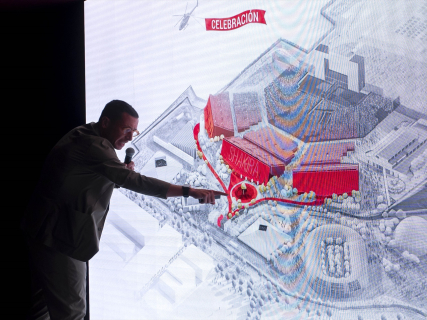
EuropaPress 7684052 arquitecto joao alburquerque rueda prensa live nation ofrecer avances

EuropaPress 7684052 arquitecto joao alburquerque rueda prensa live nation ofrecer avances

Add DEMÓCRATA to Google

Ask FREN

Published

4 minutes

Most read

Elecciones 29N · Encuestas

La media de las encuestas

Media a 19 de noviembre de 2026 · 17 institutos

  • PP31,3 %
  • PSOE27,5 %
  • Vox19,0 %
  • Frente Amplio6,2 %
  • ERC2,5 %
01020304050ene 2024jul 2024ene 2025jul 2025ene 2026jul 2026

Media del último estudio de cada instituto en 30 días y su evolución semanal desde el 23J. Partidos con al menos un 2 %.

Todas las encuestas

Elecciones generales del 29 de noviembre · Demócrata

The twelve concerts of Shakira in Madrid will presumably bring together around 57,000 people each day at the Iberdrola Music space in Villaverde. Given the high attendance, the Madrid City Council has prepared a special mobility plan and recommends using public transport to reach the venue.

The European residence of the Colombian artist will take place on September 18, 19, 20, 25, 26, and 27 and October 2, 3, 4, 9, 10, and 11, 2026. The venue will open at 12:00 PM, access to the floor and stands will begin at 8:00 PM, and the concerts are scheduled between 9:00 PM and 11:00 PM.

The evacuation will be gradual until 1:00 AM, which has led to a special reinforcement of public transport during the exit.

How to get to the Shakira Stadium by Metro

One of the main options is Villaverde Alto, on Metro line 3. From there, the pedestrian route established by the City Council leads to the venue via Valle de Tobalina, Real de Pinto Avenue, and Laguna Dalga, although there will be alternative routes via Laguna del Marquesado, Laguna de Cameros, and San Erasmo depending on the assigned access.

You can also use Los Espartales, on Metro line 12. Metro will maintain its usual schedule, from 6:00 AM to 1:30 AM, but there will be a special measure to facilitate the return: lines 3 and 12 will be reinforced between 12:00 AM and 1:30 AM during the concert days.

How to get there by Cercanías

Cercanías offers two other alternatives. The Villaverde Alto station is connected by lines C4a, C4b, and C5, while San Cristóbal Industrial has service from C3.

Those arriving at San Cristóbal Industrial can head to the venue via Laguna Dalga street.

Here there is an important difference compared to the Metro for planning the return. The City Council indicates the usual schedule for Cercanías is approximately between 5:30 AM and 11:45 PM, so those who stay until the end of the show should check the last available trains.

Free shuttle from Villaverde to Atocha

One of the main innovations of the device is the launch of a free electric bus shuttle from EMT to facilitate the exit after the concerts.

The buses will depart from Avenida de Gran Vía de Villaverde, near San Jenaro street, and will head to Atocha. The service will have stops at Legazpi and Atocha, both exclusively for dropping off passengers.

It will operate between 11:00 PM and 2:00 AM, with expected frequencies of between 7.5 and 15 minutes. The City Council estimates that the journey will take approximately between 14 and 35 minutes, depending on traffic conditions.

Which buses arrive at the venue

The regular lines serving the area will also operate. In the case of the EMT, lines 22, 79, T41, and N14 can be used. Among the intercity buses are lines 428, 432, 441, 442, 443, 446, 447, 448, 450, 455, 461, 488, N805, and N807. Some routes may experience detours as a result of the planned traffic cuts around the venue.

Where the access points are

The main pedestrian access will be at Laguna Dalga, in front of numbers 36-38 and at the height of Laguna de Cameros. It can be used by both the general public and people with reduced mobility.

There will also be two other accesses on Laguna Dalga. The one designated for VIP entries and also for people with reduced mobility will be near the Real de Pinto avenue. Another access for the general public, PMR, and logistics-related personnel will be located at numbers 32-34, near San Erasmo.

Taxi and VTC: where the pickup zones will be

The plan also establishes specific spaces for taxis and VTC. The taxi stand will be located on San Eustaquio street, between San Norberto and Resina.

The VTC will have their pickup point on Valle de Tobalina, at the confluence with San Ezequiel. It will not be a waiting area: only vehicles that have previously booked a pickup service will be able to access. There will also be a Kiss & Ride area for private vehicles to drop off or pick up passengers. It will be located on Acebeda street, at the confluence with San Ezequiel.

Traffic cuts around the Shakira Stadium

Arriving by car will be the most complicated option. The City Council anticipates cuts and restrictions on numerous streets in Villaverde during the concert days.

Laguna Dalga will remain closed between Real de Pinto avenue and San Erasmo during the event hours, except for authorized vehicles and emergencies. Laguna de Cameros will also be affected.

Depending on the turnout, additional restrictions may occur on other sections of Laguna Dalga, San Eustaquio, Laguna del Marquesado, Resina, Real de Pinto avenue, Valle de Tobalina, and Acebeda.

The device will also affect the accesses of the M-45 at the roundabout that connects Villaverde Alto with Getafe. It is planned, among other measures, to close the access from Getafe to the M-45 East and the exit from the M-45 East to the Real de Pinto avenue. The Municipal Police may extend the restrictions to other nearby roads if the influx makes it necessary.

Can you park nearby?

The possibilities will be very limited. The organization has 648 ordinary spaces and 22 for people with reduced mobility within the venue, but they are exclusively linked to certain types of entry or accreditation.

In addition, from 3:00 PM each day, parking will be prohibited on several of the streets affected by the device.

For this reason, the City Council recommends avoiding private vehicles. For long-distance travel, it advises using the M-30 and M-40 and, to get to the concert, preferably using Metro, Cercanías, or bus.

With around 57,000 attendees expected each day, the municipal recommendation is especially relevant at the exit: Metro will reinforce lines 3 and 12 and the EMT will maintain until 2:00 AM the free shuttle that will connect Villaverde with Legazpi and Atocha.

More key points, information and questions with FREN

AI-GENERATED CONTENT

What powers does the Madrid City Council have in organizing special mobility plans for major events?

The Madrid City Council has very broad powers to organize special mobility plans and traffic arrangements on the occasion of major events (sports, cultural, demonstrations, etc.). These powers are supported on three levels: basic local government legislation, state traffic regulations, and, very specifically, Law 22/2006, on the Capital Status and Special Regime of Madrid, as well as municipal mobility and traffic ordinances.

1. Basic state framework of local government regime

Law 7/1985, Regulating the Bases of the Local Regime, together with its reforms – including Law 11/1999, which expressly modifies it "in matters of traffic, motor vehicle circulation, and road safety" – establishes municipalities as competent entities in:

  • The regulation of traffic and circulation on urban roads and public spaces within their municipal area.
  • The approval of ordinances regarding circulation, parking, and use of the public road domain, with the possibility of defining infractions and sanctions within the basic state framework.
  • The exercise of administrative and sanctioning police powers related to road safety in the urban environment.

This basic block legitimizes the Madrid City Council to plan and regulate mobility within its municipal area, always within the limits and criteria established by state traffic regulations.

2. Consolidated text of the Traffic Law

The Royal Legislative Decree 6/2015, which approves the consolidated text of the Law on Traffic, Motor Vehicle Circulation, and Road Safety, aims to "regulate traffic, the circulation of all vehicles, and road safety" and, among other matters, defines:

  • The powers of the General State Administration and the autonomous communities.
  • The "determination of those that correspond in all cases to local entities" in this matter.
  • Authorizations and precautionary measures to guarantee safety and traffic flow on the occasion of activities related to traffic.

In practice, this law reserves the basic regulations to the state level and empowers municipalities, like Madrid, to regulate circulation and adopt specific measures (restrictions, detours, controls, etc.) on their urban roads, including those linked to major events.

3. Special regime of Madrid: an extra set of powers

Law 22/2006, on the Capital Status and Special Regime of Madrid, is the key that specifies and expands the City Council's powers in mobility and traffic:

  • Recognizes Madrid's own powers in mobility and vehicle traffic regulation, as well as safety, civil protection, environment, etc.
  • Establishes that the City Council exercises its powers over traffic, circulation, and road safety on urban roads, declared urban crossings, and "any space open to the free circulation of people, animals, and vehicles" within the municipality.
  • Empowers the City Council to regulate the different uses of urban roads and public spaces (pedestrian, circulation, parking, sports, recreational), harmonizing them with road safety, mobility, and environmental protection.
  • Authorizes municipal ordinances to:
    • Set limits on noise, gases, and other vehicle emissions.
    • Establish control and sanction procedures, including the precautionary immobilization of vehicles and intervention of the circulation permit when nuisances are serious or repeated.
  • Explicitly recognizes the competence of preventive administrative police of road safety, which includes:
    • Ordering, signaling, and directing traffic.
    • Limiting, restricting, or prohibiting circulation and parking, and differentiating access conditions (for example, badges, restricted zones, positive discrimination for disability).
    • Adopting precautionary measures such as immobilization and removal of vehicles.
  • Explicitly foresees the approval of road safety and mobility plans by the Madrid City Council and its participation in those approved by the Community of Madrid or the General State Administration.
4. Ordinances and special plans for major events

Based on this legal framework, the City Council develops mobility, circulation, and parking ordinances that detail:

  • Exceptional traffic and public transport arrangements planned for major events (traffic cuts and detours, access restrictions to sensitive areas, reinforcement of public transport, park-and-ride facilities, etc.).
  • Coordination protocols with the Community of Madrid (Regional Transport Consortium, Metro, Cercanías, etc.) and with the General State Administration (for example, in matters of security and civil protection).
  • Conditions for occupying the public road domain (stages, stands, fences, etc.) and the associated authorization and sanction regimes.

In summary, the Madrid City Council can design and approve special mobility plans for major events, define necessary circulation and parking restrictions, implement control and sanction measures, and formally coordinate with other administrations and transport operators, all under the umbrella of the Basic Law, traffic legislation, and especially its Capital Status Law.

What are the legal requirements for authorizing traffic closures at mass events in Madrid?

Traffic closures for mass events in Madrid are supported by a “mosaic” of state regulations (traffic, citizen security, civil protection, and right of assembly) and the mobility ordinance of the City Council itself. In practice, authorization requires requesting permission in advance, providing a basic project of the event, a mobility and security plan, proof of civil liability insurance, and acceptance of conditions from the competent authority (City Council or Government Delegation) regarding routes, schedules, and protection measures.

Below is a practical summary applied to the case of Madrid city.

1. Basic regulatory framework

  • Traffic and road safety (state scope): consolidated text of the Law on Traffic, Motor Vehicle Circulation, and Road Safety (Royal Legislative Decree 6/2015), which grants competent authorities the power to issue prior authorizations for activities affecting circulation and to impose measures to guarantee safety and flow.
  • General Traffic Regulations (approved by Royal Decree 1428/2003 and subsequent amendments): develops, among other aspects, the occupation of public roads, signaling, and priority of road safety.
  • Civil protection: Law 17/2015, of the National Civil Protection System, and basic self-protection regulations, which require anticipating and planning emergencies in events with large crowds.
  • Citizen security and right of assembly: Organic Law 9/1983, regulating the right of assembly in public transit places, and Organic Law 4/2015, on citizen security protection, which regulate marches, demonstrations, and gatherings occupying public roads.
  • Autonomous/local scope: regulations coordinating local police and, specifically for Madrid city, the municipal mobility ordinance and internal City Council rules on public road occupation, which set specific procedural requirements (deadlines, documentation, and fees).

2. Who authorizes the traffic closure

  • Festive, sports, or commercial events (popular races, street concerts, filming, fairs, etc.):
    • Main competence of the Madrid City Council (mobility and public space area).
    • The Municipal Police provides reports on the feasibility of the closure, detours, and signaling measures.
  • Demonstrations and protest marches:
    • Governed by LO 9/1983: there is no “license” but a prior notification to the Government Delegation in Madrid, which may propose route or schedule modifications or even a motivated prohibition if there is a serious risk to people or property.
    • Traffic closures derived are coordinated among the Government Delegation, National Police, and City Council (Municipal Police and mobility services).

3. Deadlines and application procedure

  • Demonstrations:
    • Written notification, as a general rule, at least 10 calendar days in advance.
    • In urgent and justified cases, a minimum period of 24 hours is accepted.
  • Other events (races, concerts, neighborhood parties, etc.):
    • Deadlines are set by the City Council in its ordinance and calls: for large events it is common to require between one month and several weeks in advance, especially if they affect main roads or require extensive arrangements.
    • For minor closures strictly within neighborhoods, deadlines may be shorter, but a formal prior request is always required.

4. Documentation and minimum content

Indicatively, in Madrid the organizer is usually required to provide:

  • Formal application identifying the organizer (individual, association, or company) and the event manager.
  • Descriptive report of the event:
    • Type of event and purpose.
    • Date, schedule, and expected duration.
    • Limits of the closure (streets, sections, and direction of circulation affected).
    • Estimate of capacity or number of participants.
  • Map or sketch detailing:
    • Route (if marches or races) or fixed occupation area.
    • Access and evacuation points, location of stages, tents, stands, etc.
  • Mobility and traffic plan:
    • Proposed detours for vehicles and public transport.
    • Closure points and temporary signage.
  • Security and self-protection measures, with reference to civil protection:
    • Basic risk assessment (crowds, evacuation, fires, weather, etc.).
    • Sanitary and first aid arrangements, when applicable.
    • Designation of event security managers.
    • For large capacity or high-risk events, a Self-Protection Plan adjusted to basic civil protection regulations may be required.
  • Civil liability insurance covering third-party damages.
  • Where applicable, additional authorizations (noise, public domain occupation, street vending, etc.).

5. Safety criteria and organizer obligations

  • The authority may modify route and schedules to make the event compatible with general mobility and essential services.
  • It must always be guaranteed:
    • Access for emergency vehicles (firefighters, ambulances, police).
    • Proper signage of closures and detours.
    • Respect for capacity limits and conditions set in the authorization.
  • The organizer is obliged to:
    • Comply with all conditions imposed by the City Council and, if applicable, the Government Delegation.
    • Provide necessary auxiliary personnel (private security, volunteers, etc.) if required.
    • Collaborate with Police and municipal services before, during, and after the event.
  • Non-compliance may lead to:
    • Administrative sanctions in traffic, citizen security, or civil protection matters.
    • Possible civil or criminal liabilities if damages or injuries occur.

Which other Spanish cities have recently implemented similar public transport arrangements for concerts or large attendance events?

In recent years many Spanish cities have implemented special public transport arrangements to manage large flows of people to concerts, festivals, and other mass events. There is no single state-wide list, but several recent examples (2025–2026) can be identified that well illustrate the trend and models being replicated.

Main cities that have deployed special arrangements

  • Las Palmas de Gran Canaria. The municipal company Guaguas Municipales has organized very structured arrangements for the GranCa Live Fest both in 2025 and 2026. For the 2025 edition, a mobility plan was activated with about 35 exclusive vehicles, intensification of several regular lines, and a specific terminal on Hoya de la Gallina street for evacuation after concerts, with shuttles to Teatro, Santa Catalina/Port, and Auditorium (see note from the Las Palmas de Gran Canaria City Council: GranCa Live Fest 2025 arrangement ). In 2026 the scheme was repeated, with 35 dedicated vehicles and a special return terminal at the end of each festival day ( GranCa Live Fest 2026 arrangement ).
  • Madrid (City and Community). The Municipal Transport Company (EMT Madrid) has enabled specific shuttles for festivals:
    • During Mad Cool 2025, EMT provided a special free articulated bus service between Villaverde and Atocha, operating overnight with intervals of 5–10 minutes for audience departure ( Mad Cool 2025 shuttle ).
    • The Community of Madrid has reported more than a hundred mobility plans in 2024 for mega-events, including festivals like Mad Cool and major concerts (Metallica, Karol G, Bruce Springsteen, etc.), with reinforcements of Metro, EMT, night shuttles, and traffic detours ( mobility plans for major events ).
    Additionally, for festivities like San Isidro 2026, multiple EMT and Metro lines have been reinforced to absorb the influx to concerts and street parties in La Pradera and other city points (according to the newspaper Demócrata).
  • Palma (Mallorca). There is a combination of reinforcements in urban bus and rail:
    • Serveis Ferroviaris de Mallorca enabled in 2025 special night train and metro services for the Reggaeton Beach Festival (RBF) at Son Fusteret, including shuttle metro between Intermodal and Son Fuster Vell and 12 special night trains for attendee return ( SFM special services for RBF ).
    • EMT Palma has reinforced bus lines for specific concerts (for example, Alejandro Sanz at Son Moix in 2026) and for recitals at the Illes Balears Velodrome, placing buses at venue exits and coordinating them with the Nit Bus network ( EMT Palma reinforcement for concerts ), as well as for the Elrow XXL Mallorca 2026 festival ( Elrow XXL arrangement ).
  • Valladolid. The operator AUVASA has deployed a shuttle bus scheme and reinforcement of urban lines to the Pingüinos Arena venue for the Conexión Valladolid festival, individual concerts (Loquillo, Anastacia), and events like Tardeo XXL. The arrangement includes:
    • Shuttles from Plaza Poniente with frequencies of 15–30 minutes during access and return hours.
    • Coordination with regular lines 18 and 19 and provision of a temporary BIKI public bike station next to the venue entrance.
    All detailed in the municipal note about AUVASA and Pingüinos Arena .
  • Bilbao. The City Council has used Bilbobus as a specific shuttle for concerts at Bilbao Arena. In May 2025, for example, a special E7 line was created from near Plaza Circular to the venue, with departures every 10 minutes before and after the concert, and adjustments to line G5, as well as coordination with metro, train, and tram ( Bilbobus shuttle service ).
  • Málaga. The 2025 Málaga Fair featured a large EMT arrangement that, although not limited to concerts, functions as a special service for a massive event: 16 direct lines from neighborhoods to the Fairgrounds starting at 8:00 p.m., reinforcements of the ordinary service, a specific 24-hour line between downtown and Cortijo de Torres, and an overall supply increase of up to 70% on weekends ( transport arrangement for the 2025 Fair ).
  • Barcelona. Although the clearest recent “concert” examples are the visit of Pope Leo XIV and the Diada, the pattern is comparable: reinforcements of metro, additional trains, and, in the case of the papal visit, shuttle buses to access main events, as reported by the press ( Barcelona papal visit arrangement ).

Overall, these cases show that the most widespread formula combines intensive reinforcement of existing networks (metro, bus, commuter train) with specific shuttle lines and, in some cases, extended night services. The approach is repeated in large and medium-sized cities and tends to be integrated into formal mobility plans for major events, coordinated among city councils, transport operators, and sometimes regional governments.

Play

Test your knowledge with FREN!

How much do you know about this topic? Answer the following 3 questions.

How many people are expected each day at Shakira's concerts in the Iberdrola Music space in Villaverde?

Question 1 of 3

What schedule will the free EMT shuttle buses from Villaverde to Atocha have during the concerts?

Question 2 of 3

Where will the main pedestrian access to the Shakira Stadium be located?

Question 3 of 3