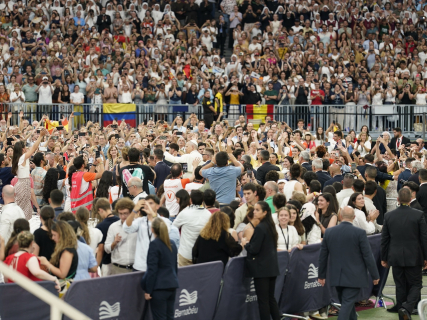
The Pope says goodbye to Madrid with a meeting with thousands of volunteers before traveling to Barcelona

Before his arrival in Barcelona, Pope Leo XIV thanks the work of 12,000 volunteers at an event at IFEMA

2 minutes

papa madrid barcelona

papa madrid barcelona

Add DEMÓCRATA to Google

Published

Last updated

2 minutes

Most read

Pope Leo XIV has concluded his stay in Madrid this Tuesday with a meeting dedicated to the volunteers who participated in the organization of his apostolic journey to Spain. The event, held in pavilion 3 of IFEMA, constitutes the Pontiff's last engagement in the capital before traveling to Barcelona to continue a visit that will later conclude in the Canary Islands. According to the organization, around 12,000 volunteers are participating in the meeting, out of more than 17,000 registered to collaborate in the various events held during these days.

The meeting has been conceived as a gesture of gratitude to those who have worked altruistically in the logistics and development of the papal visit. After this event, Leo XIV will travel to Adolfo Suárez Madrid-Barajas Airport to fly to Barcelona, where a new phase of his Spanish agenda will begin, focusing on some of the main religious and institutional symbols of Catalonia.

Arrival in Barcelona and first events

The Pope's agenda in Barcelona will begin this Tuesday with his arrival at Josep Tarradellas Barcelona-El Prat Airport at 12:25 PM. From there, he will travel to the Cathedral of the Holy Cross and Saint Eulalia, where a prayer service is scheduled shortly after landing. The day will conclude with a large vigil at the Estadi Olímpic Lluís Companys in Montjuïc, one of the most attended events planned during the entire visit.

The presence of Leo XIV has necessitated the deployment of an extensive security and mobility operation in the Catalan capital. Restrictions began on Monday and particularly affect areas such as Ciutat Vella, the surroundings of Montjuïc, El Raval, and the areas around the Sagrada Família.

Among the affected areas are the Cathedral Avenue, Plaça Nova, Plaça Antoni Maura, and various streets in the historic center. There will also be significant restrictions on Reina Maria Cristina Avenue, Plaça d'Espanya, Paral·lel Avenue, and access to the Olympic Stadium during the events planned in Montjuïc.

Montserrat, Brians, and the Sagrada Família

Wednesday will be the most intense day of the Pope's trip to Barcelona. Leo XIV will visit the Brians 1 prison center in the morning before traveling to Montserrat, where he will participate in various events at one of the most significant religious sites in Catalonia.

In the afternoon, the Pontiff will attend a meeting at the church of Sant Agustí, in the Raval neighborhood, before presiding over a mass at the Sagrada Família, considered one of the central moments of the entire visit.

The celebration will require reinforcing security measures in the Eixample and will cause significant disruptions to traffic and public transport. The restrictions will be concentrated especially in the area between Provença, Còrsega, Rosselló, Mallorca, Marina, Sardenya, and other streets near the temple designed by Antoni Gaudí.

In addition, the Sagrada Família metro station will remain closed for a large part of the day, and various transport services will be reinforced to facilitate access for attendees.

With his farewell from Madrid, Leo XIV leaves behind some of the most notable events of his trip, such as his address to the Congress of Deputies or the massive gathering held at the Santiago Bernabéu. Now, the focus shifts to Barcelona, where he will face two days of intense activity before continuing his tour of Spain.

More key points, information and questions with FREN

AI-GENERATED CONTENT

What is the status of parliamentary processing of the laws regulating visits of foreign heads of state to Spain?

Parliamentary status of the regulations affecting visits of foreign heads of state

In the General Courts, from legislatures X to XV, there is no law or bill that specifically and exclusively regulates the status, treatment, immunities, or honors of foreign heads of state visiting Spain. What does exist in the XV Legislature are some bills that indirectly affect the legal regime and protocol of these visits, especially regarding official symbols and the State's external action. All these initiatives are still in the parliamentary processing phase; none have culminated in a law published in the BOE. Below is the detailed status of each detected initiative.

1. Bill on the defense and protection of official symbols (Congress)

In the Congress of Deputies, the “Bill on the defense and protection of official symbols” is under processing, presented by the People's Parliamentary Group in the Congress (first signatory, Ester Muñoz de la Iglesia). It was registered on October 17, 2025 and has the nature of a bill. According to the official Chamber record, the initiative is “admitted, pending consideration”, meaning the debate for consideration in the Plenary of the Congress has not yet been held nor has the amendment period opened.

This bill regulates the protection and display of official symbols of Spain, the Autonomous Communities, and Local Entities, and explicitly mentions the protocol for displaying symbols during official visits of representatives of other States or autonomous communities, as well as the Government's and the King's competencies in protecting these symbols at official acts. Due to its content, it impacts the protocol framework of visits by foreign heads of state, although it is not solely focused on them. The full text and processing status can be consulted in the official Congress publication: View publication.

2. Bill on the defense and protection of official symbols (Senate)

In parallel, another “Bill on the defense and protection of official symbols” is being processed in the Senate, promoted by the People's Parliamentary Group in the Senate. It was registered on September 20, 2023 and also has the form of a bill. According to official information, its current status is “extension of the amendment period until June 10, 2026”, indicating the initiative is in a preliminary processing phase in the Upper Chamber, still without a definitive commission report or referral to the Congress.

The content of this bill is similar: it regulates the protection and display of official symbols at institutional acts, including official visits of representatives of other States, and establishes a regime of competencies and sanctions to ensure compliance. Again, it affects the protocol context of visits by foreign heads of state regarding flags and other symbols but does not constitute a complete statute for those visits. The text can be consulted in the Official Bulletin of the General Courts – Senate: View publication.

3. Bill to amend the Law on State External Action and Service

Also in the Congress, the “Bill relating to the amendment of Law 2/2014, of March 25, on State External Action and Service, for prior reporting to the General Courts of the European Councils, as well as decision-making not contemplated in the External Action Strategy” is underway, presented by the People's Parliamentary Group in the Congress (first signatory, Miguel Tellado Filgueira).

This initiative was registered on June 3, 2024 and is classified as a bill. The official status indicates that the “amendment period has been extended until June 10, 2026”, meaning the bill has already been taken into consideration by the Plenary, is in the commission phase, and the possibility of submitting amendments remains open, with no final report or vote yet in the Chamber. Law 2/2014 establishes the institutional framework of the State's external action, defining Government competencies and, in general, the international relations scheme, so any reform can indirectly affect the organization and competencies related to official visits of foreign heads of state, although the bill focuses on parliamentary control of the European Councils. Its record and publications are available at: View publication.

4. Absence of a specific law on visits of foreign heads of state

According to the parliamentary information consulted for legislatures X, XI, XII, XIII, XIV, and XV, no bills, draft laws, validated royal decree-laws, or organic law reforms have been identified that specifically and exclusively regulate the legal regime and protocol of visits by foreign heads of state to Spain. The current regulation is rather articulated through general norms of external action, State protocol, and symbol protection, as well as through diplomatic practice and decisions of the Government and the Royal Household.

Consequently, the described initiatives are all in processing and, as of now, none have culminated in a law published in the BOE that directly and conclusively modifies the framework of visits by foreign heads of state. No further information is available in the consulted sources about other texts in processing that specifically address this area.

What are the competencies and functions attributed to the Pope according to Canon Law?

Competencies and functions of the Pope according to Canon Law

Summary answer

From a strictly political and institutional point of view, the Pope is both Head of State of the Vatican City and supreme authority of the Catholic Church, an actor with notable impact on the international scene and public life in many countries, including Spain. According to Canon Law, he holds supreme, full, immediate, and universal power over the entire Church, above any other ecclesiastical authority, and his decision admits no appeal. He exercises legislative, executive, and judicial functions within the canonical order, appoints bishops and cardinals, safeguards doctrine, and directs the pastoral and diplomatic action of the Holy See. Additionally, his figure has a clear socio-political reach, as his decisions and interventions influence public debates, social policies, and State–Church relations in multiple countries.

1. Position of the Pope in the canonical and political system

In Canon Law, the Pope is defined as the Successor of Peter and Bishop of Rome, “head of the College of Bishops” and “Pastor of the universal Church.” On this theological basis, a unique legal position is articulated: he is the holder of the supreme authority in the Church, without a higher instance that can correct or review him. At the same time, in the realm of international law and political organization, he acts as Head of State of the Vatican City and as authority of the Holy See, a sovereign subject of international law. This dual dimension (religious and state) explains his participation in world politics through concordats, bilateral agreements, diplomatic mediations, and pronouncements on social issues that then impact legislation and public debate in numerous countries.

2. Legislative power: making and modifying Canon Law

The Pope possesses the supreme legislative power in the Church. He can promulgate universal laws binding all the faithful and all particular churches, as well as modify or repeal existing canonical norms. This power is exercised through various instruments, including:

Apostolic constitutions, which usually regulate matters of special relevance (reforms of the Code of Canon Law, reforms of the Roman Curia, fundamental institutions).
Motu proprio, legislative documents that the Pope issues on his own initiative and authority to reform norms, create bodies, or introduce procedural changes.
General decrees and other norms that specify the application of Canon Law or reorganize ecclesiastical structures.

Within this legislative competence is also included the faculty to approve, review, or confirm statutes of episcopal conferences, synods of Eastern churches, and other canonical entities, as well as to intervene directly in the internal organization of dioceses and ecclesiastical provinces.

3. Executive and governing power

The Pope exercises the supreme executive power, which translates into the ordinary governance of the Church through the Roman Curia and direct acts of the Apostolic See. Among his functions are:

Appointment of bishops and cardinals, which allows him to shape the leadership of the worldwide Church and, institutionally, determine who will participate in a possible conclave to elect his successor.
Creation, division, suppression, or modification of dioceses, prelatures, ecclesiastical provinces, as well as approval of new forms of consecrated life or associations of the faithful of pontifical right.
Direction of the Roman Curia, which assists the Pope in the central government of the Church, with dicasteries responsible for areas such as doctrine, bishops, clergy, laity, integral human development, or economy.
Appointment of key positions in religious congregations, ecclesiastical tribunals, and Holy See offices, with effects both internal and diplomatic.

This executive dimension has a direct political reflection in the international action of the Holy See: the Pope directs Vatican foreign policy, guides the activity of the Secretariat of State, and approves the signing of agreements with States on matters such as religious education, canonical marriage, tax regime of religious entities, or legal recognition of ecclesiastical institutions.

4. Judicial power and disciplinary functions

Canon Law recognizes the Pope's supreme judicial power. He is the supreme judge of all the faithful and can:

• Hear any case directly, displacing the competence of other ecclesiastical tribunals.
• Delegate his function to tribunals of the Holy See, especially the Roman Rota Tribunal and the Supreme Tribunal of the Apostolic Signature.
• Grant pardons, dispensations, and special graces, including remission of certain canonical penalties.

In the disciplinary field, he has the ultimate authority to decide on sanctions against clerics, bishops, and religious superiors, including removal from office and, in extreme cases, reduction to the lay state. These decisions, although internal, often have public and media impacts and are frequently related to issues touching the political or social sphere (abuses, economic management, human rights).

5. Magisterium, social policies, and relations with States

The Pope also exercises the supreme magisterium in matters of faith and morals. His encyclicals, apostolic exhortations, and other documents doctrinally guide the Church and, de facto, influence public debates on issues such as social protection, migration, climate change, international peace, family, or bioethics. In majority Catholic countries — like Spain — his positions are cited in parliamentary debate, condition the actions of parties and social organizations, and are sometimes taken into account in lawmaking.

Finally, through the Holy See, the Pope maintains formal diplomatic relations with States and international organizations, intervenes in multilateral forums, and promotes bilateral agreements (concordats and specific agreements). This dimension consolidates his global political relevance and places Canon Law as a legal system that, although internal to the Church, constantly interacts with state legal systems and the international agenda on human rights, peace, and social justice.

What legal requirements must be met to organize mass events in public spaces in Barcelona?

Basic legal requirements for mass events in Barcelona

To organize a mass event in a public space in Barcelona (demonstration, concert, popular festival, sports event, etc.) it is mandatory to obtain authorization or submit prior notification to the competent administration, comply with safety and self-protection regulations, respect municipal ordinances on public space use and noise, and coordinate with the Urban Guard, Mossos d’Esquadra, and emergency services. Depending on whether the event is of a protest nature (demonstration) or recreational/commercial (concert, fair, race), a different legal regime applies: right of assembly or license/permit for occupation of public domain. Additionally, organizers assume civil, administrative, and even criminal responsibilities if basic legal obligations are not met.

Below are structured the key requirements regarding authorization, safety, use of public space, responsibilities, and differences between types of events, with special reference to the general Spanish and Catalan framework and the usual practice of the Barcelona City Council.

1. Authorization or administrative notification

In Barcelona, any mass event in public streets must comply with the state, regional, and municipal framework:

a) Demonstrations and gatherings (right of assembly)
When the event has a political, union, or protest character, the Organic Law on the right of assembly applies. In these cases:

- A classic “license” is not requested; instead, a prior notification is submitted to the Government Delegation in Catalonia, indicating date, time, route, purpose of the gathering, and organizers responsible.
- It must be submitted within the minimum advance time provided by law (usually between 10 and 30 days, except in urgent cases).
- The authority may propose changes to schedule or route for reasons of public order, safety, or serious traffic impact, and may even prohibit the event in exceptional cases.

b) Recreational, cultural, sports, or commercial events
If the event is not covered by the right of assembly, the regime of occupation of public domain applies:

- A permit must be requested from the Barcelona City Council (usually through the licensing and public space services of the relevant district or area).
- The application includes a map of the space, expected capacity, description of activities (stages, amplified music, bars, structures), schedules, and street closure needs.
- Fees may be required for occupation of public roads and other costs (cleaning, additional services).

2. Safety, self-protection, and capacity

For mass events, the authority usually requires:

- A safety and self-protection plan when a certain capacity is exceeded or complex structures are installed (stages, stands, tents). This plan details access, evacuation, meeting points, signage, fire extinguishers, private security personnel, and coordination with emergency services.
- Maximum capacity calculation, determined by available space, evacuation routes, and the nature of the event, to avoid dangerous overcrowding.
- Presence of medical service (ambulances, first aid) at large-scale or higher-risk events (mass concerts, popular races, festivals).
- Coordination with Urban Guard and Mossos d’Esquadra for traffic cuts, attendee protection, and incident response.

3. Municipal ordinances and conditions for space use

The Barcelona City Council applies its own ordinances, including those related to civility, noise, cleaning, and occupation of public space:

- Noise and schedules: time limits are set for amplified music and maximum sound levels, especially at night and in residential areas.
- Cleaning and waste: a cleaning plan after the event and installation of containers or selective collection points is usually required. In many cases, the organizer assumes the costs.
- Furniture and structures: any stage, tent, stand, or fixed or removable installation must comply with structural safety regulations and, if applicable, have a technical project signed by a competent professional.
- Compatibility with other uses: the City Council will assess coexistence with public transport, businesses, residents, and other simultaneous events.

4. Insurance and responsibilities

The event promoter is usually obliged to:

- Contract a civil liability insurance covering personal and material damages to attendees and third parties.
- Assume responsibility for possible administrative sanctions (for noise excess, lack of permits, damage to urban furniture, etc.).
- Be liable, if applicable, for civil damages caused to participants or neighbors if negligence in organization is proven.
- Bear in mind that, in serious cases, criminal liability could be considered (for example, if basic safety rules are consciously ignored and serious injuries occur).

5. Practical differences between types of events

In practice, in Barcelona:

- A demonstration is mainly processed through the right of assembly, with notification to the governmental authority and security coordination, but without the same logic as a “commercial event” (bars or lucrative activities in public streets are not considered essential parts of the event).
- A street concert or festival requires a more complex municipal file: temporary activity license, public road occupation, technical project of installations, self-protection plan, and insurance.
- A popular race requires, in addition to space occupation, a specific device for traffic cuts, volunteers, refreshment points, and medical service along the route.

6. Operational recommendation

To ensure legal compliance in Barcelona it is essential to:

- Contact well in advance with the Barcelona City Council (or the Government Delegation, if it is a demonstration) to know exactly which permits and deadlines apply to the specific type of event.
- Develop from the start a safety, capacity, and cleaning plan that facilitates authorization.
- Document organizational decisions in writing, so there is evidence that due diligence has been exercised, especially regarding safety.

What specific steps must be followed before the Barcelona City Council to request permission for a concert in a public street? What legal differences exist between organizing a demonstration and a cultural festival in the street in Barcelona? What types of sanctions can the Barcelona City Council impose if a mass event is held without the necessary permits?

Play

Test your knowledge with FREN!

How much do you know about this topic? Answer the following 3 questions.

Where did the last meeting of Pope Leo XIV with the volunteers take place in Madrid?

Question 1 of 3

Which metro station in Barcelona will remain closed during the mass at the Sagrada Família?

Question 2 of 3

What will be one of the main events on Pope Leo XIV's agenda after arriving in Barcelona?

Question 3 of 3

Hola, soy Fren. ¿Cómo te ayudo?