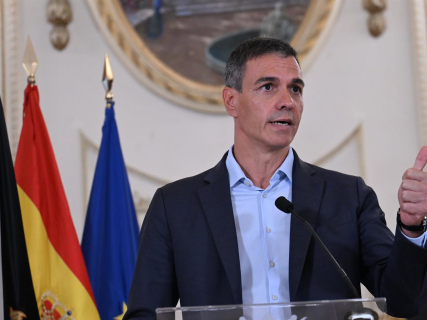
Pedro Sánchez defends his vacation against criticism: "I have worked and I have rested. It is my right."

The president of the Government assures that he takes the reproaches received during August with "sportsmanship" and claims his right to rest.

fotonoticia 20260831085858 1920

fotonoticia 20260831085858 1920

Add DEMÓCRATA to Google

Ask FREN

Published

Last updated

2 minutes

Most read

Elecciones 29N · Encuestas

La media de las encuestas

Media a 13 de noviembre de 2026 · 15 institutos

  • PP31,4 %
  • PSOE26,8 %
  • Vox19,1 %
  • Frente Amplio6,3 %
  • ERC2,4 %
01020304050ene 2024jul 2024ene 2025jul 2025ene 2026jul 2026

Media del último estudio de cada instituto en 30 días y su evolución semanal desde el 23J. Partidos con al menos un 2 %.

Todas las encuestas

Elecciones generales del 29 de noviembre · Demócrata

Pedro Sánchez defended this Monday, August 31, his right to enjoy vacations after the criticisms received during this month. The president of the Government has assured that during this period he has worked and also rested, and has pointed out that he faces the reproaches with "sportsmanship."

According to EL PAÍS, Sánchez referred directly to the controversy during his interview this Monday on "Hoy por Hoy," from Cadena SER: "I know that for a significant part of the population I should not have the right to have vacations or to be president", he stated.

The head of the Executive added that he takes the criticisms with "sportsmanship" and has claimed his right to rest despite the responsibilities of his position. "I have worked and I have rested. It is my right," he affirmed.

The criticisms from the PP regarding Sánchez's vacations

The vacations of the president of the Government had become one of the arguments used by the Popular Party to question the actions of the Executive during the migratory crisis recorded in Ceuta this summer.

The leader of the PP, Alberto Núñez Feijóo, accused the Government this Saturday of having been "closed for vacations" during the most difficult moments of the Ceuta crisis, while demanding explanations about the response offered by the Executive.

Days earlier, the spokesperson for the PP in Congress, Ester Muñoz, had also linked her criticisms of the management of the crisis with the president's rest period and stated that Sánchez had returned from vacation to generate "more chaos than there was."

Sánchez opens the political course on "Hoy por Hoy"

The statements were made during the interview granted by Sánchez this Monday to Aimar Bretos on Cadena SER, with which the president of the Government has opened the new political course.

The interview began at 8:30 a.m. and addressed several of the main issues that have marked the news during the summer, with special prominence for the situation in Ceuta and the Government's actions in response to the massive arrival of migrants.

Regarding his vacations, Sánchez has rejected entering into a broader confrontation and has summarized his position in the defense that the exercise of the Presidency of the Government does not eliminate his right to rest: "I have worked and I have rested. It is my right".

More key points, information and questions with FREN

AI-GENERATED CONTENT

What are the powers and functions of the President of the Government according to the Spanish Constitution?

The President of the Government is the central figure of the executive power in Spain, and their basic statute is regulated by the 1978 Constitution, especially in articles 97, 98, and 99, as well as other provisions related to political responsibility and parliamentary control. From these articles derive their essential powers and functions.

1. Direction of Government action

The core competence of the President of the Government is to direct the action of the Government (art. 97 CE). This means:

  • Setting the general lines of domestic and foreign policy, economic, social, and security.
  • Coordinating the actions of the different ministers and resolving conflicts among them.
  • Establishing priorities, political calendar, and orientation of regulatory projects and reforms.

In practice, the president is the political head of the Executive and, therefore, the main person responsible for the Government's overall strategy before the Cortes Generales and the public.

2. Representation of the Government and political responsibility

The Constitution also assigns the president the function of representing the Government (art. 98.2 CE). This is not the headship of State — which corresponds to the King — but the political representation of the Executive:

  • They are the main interlocutor of the Government before the Cortes Generales, other State powers, and public opinion.
  • They appear before the Congress to present programs, reports, and respond to control initiatives (questions, interpellations, motions).
  • They assume the political responsibility of the entire Government before the Congress: they can be subject to a motion of censure and can raise a vote of confidence.

3. Relationship with the King and appointment of the Government

The president maintains a key institutional relationship with the Head of State:

  • They are proposed by the King as a candidate for the Presidency of the Government, after consultation with representatives designated by political groups (art. 99 CE).
  • Once invested by the Congress, they are formally appointed by the King.
  • They propose to the King the appointment and dismissal of the other members of the Government (ministers), a competence that the Constitution attributes to the monarch at their proposal (art. 100 CE).

Consequently, the president has the political power to configure and reshape their ministerial team, while the King acts on a formal level.

4. Normative functions and political direction

The Constitution does not detail article by article each intervention of the president in the normative process, but from their condition as director of the Government derive key competences:

  • Promote the preparation of Government bills and their political defense before the Cortes.
  • Coordinate the approval of royal decrees and royal decree-laws in the Council of Ministers, of which they are a member and which they generally preside over.
  • Set the political agenda of the Council of Ministers, guiding the legislative and regulatory initiative of the Executive.

Additionally, they direct defense policy and, although the Constitution attributes to the King the supreme command of the Armed Forces (art. 62 h) CE), the effective conduct of defense policy corresponds to the Government under the direction of its president.

5. Relations with the Cortes Generales

The Constitution establishes a parliamentary system in which the president depends on the confidence of the Congress of Deputies. From this derive several functions:

  • Present their government program and submit to the investiture debate (art. 99 CE).
  • Be able to raise a vote of confidence before the Congress to support their program or a general policy statement (art. 112 CE).
  • Be subject to a motion of censure, which if successful implies their dismissal and the investiture of a new president (art. 113 CE).

In this way, the Constitution ensures that the president's powers are subject to constant political control by the lower chamber.

6. Dissolution of the Cortes and calling of elections

Although the final decision is made by the King, it corresponds to the president to propose the dissolution of the Congress, the Senate, or the Cortes Generales (art. 115 CE), as well as the calling of general elections, respecting the temporal limits set by the Constitution. This power grants them a very relevant political tool to reorganize parliamentary majorities or unblock institutional deadlocks.

Overall, the powers of the President of the Government according to the Spanish Constitution place them as the center of the political direction of the State in the executive sphere, but always subject to the confidence of the Congress and framed within the Headship of State held by the King.

What political and academic background does Pedro Sánchez have before becoming President of the Government?

According to the information available in the consulted sources, some general traits of Pedro Sánchez Pérez‑Castejón's political and academic profile are known before his arrival at the presidency of the Government, but not a detailed chronology of all his positions and stages. He is presented as an economist and doctor, university professor, and socialist leader who, since 2014, has been at the head of the PSOE and who already then had a consolidated political career within the party. Even so, the databases used barely offer detailed data about his first elected positions or specific institutional responsibilities prior to 2018.

Basic data and political affiliation

Pedro Sánchez Pérez‑Castejón appears in political actor registers as born in 1972 and defined in his brief biography as an economist, doctor, and Spanish politician. It is indicated that he is leader of the Spanish Socialist Workers' Party (PSOE) since 2014, with a brief interruption, and that his arrival at the presidency of the Government occurred in June 2018 through a motion of censure against Mariano Rajoy.

In the strictly parliamentary sphere, the consulted databases place him linked to the Socialist Parliamentary Group in the Congress, where he appears as an author associated with that group. However, the records do not detail in which specific legislatures he acted as a deputy nor the time intervals of his membership in the group, beyond that he currently appears as an active member of that group.

Internal positions and responsibilities in the PSOE

Although it is known from the brief biography that since 2014 he leads the PSOE, the analyzed databases do not break down, with specific dates and titles, his previous organic positions within the party before reaching the general secretariat. The available institutional information is limited to indicating his status as socialist leader since that year and his subsequent continuity, with an intermediate interruption, until reaching the presidency of the Government in 2018.

Nor do the consulted records show explicit references to his participation in Socialist Youth, possible regional leaderships, or specific responsibilities in internal party bodies. It is reasonable to think that his rise to the general secretariat implies a previous trajectory of militancy and positions within the PSOE, but those intermediate steps are not documented in the sources used, so they cannot be described precisely without resorting to additional external information.

Institutional positions before 2018

Regarding his institutional and government experience before arriving at La Moncloa, the administrative and parliamentary position databases offer practically no details. In the administrative roles file, Pedro Sánchez appears as President of the Government and responsible in the Presidency of the Government, but that position starts in 2018 and is precisely the one the question sets as a cutoff point.

In the specific parliamentary position records, which usually collect deputyships, committee posts, spokesperson roles, or other elected positions, no entries prior to June 2, 2018, associated with him are found. This may be due to limitations of the record itself or that only certain types of positions have been uploaded, but the practical result is that, with these sources, it is not possible to reliably reconstruct a list of all his institutional positions prior to the presidency.

Education and academic career

The brief biography defines him as an economist, doctor, and university professor, which indicates that, before his stage as president, he already had:

  • A university education in economics.
  • The obtaining of a doctorate, which explicitly identifies him as a doctor.
  • Experience as a university professor.

However, the consulted file does not provide the data that would normally complete this profile: specific universities where he studied, exact degree title, doctoral program, institution that issued the degree, nor departments or subjects in which he taught. The specific field intended to detail academic training appears empty or marked as unavailable, so the information is limited to those general traits: economist, doctor, and university teacher.

Limitations of the available information

Overall, the consulted sources allow sketching Pedro Sánchez's situation immediately before becoming president: PSOE leader since 2014, member of the Socialist Parliamentary Group in the Congress, economist with a doctorate, and experience as a university professor. However, they do not provide an exhaustive chronology of his political career (first positions, exact years of entry as deputy, possible municipal or regional responsibilities) nor the fine detail of his academic trajectory (universities, thesis, research areas).

To accurately reconstruct each step of his political and academic path prior to 2018, it would be necessary to consult complete biographies published by other sources (for example, official biographies from the Congress, the PSOE itself, or extensive journalistic profiles), which go beyond what the institutional databases consulted in this response collect.

What requirements and procedures does Spanish legislation establish for the President of the Government to temporarily be absent from their duties?

Spanish law does not expressly regulate a “temporary suspension” of the President of the Government comparable, for example, to medical leaves of civil servants. However, it does provide mechanisms for substitution and delegation of functions that allow managing temporary absences (prolonged trips, medical interventions, convalescences, etc.) without interrupting the continuity of the Executive.

1. Is there a formal figure of “temporary suspension” of the president?

Neither the 1978 Spanish Constitution nor Law 50/1997, of the Government, contemplate a specific institution of “temporary suspension” of the President of the Government. The constitutional text distinguishes between:

  • Appointment and dismissal of the president (art. 99 and 101 CE).
  • Government in office, after elections, resignation, loss of confidence, or death (art. 101 CE).

For transitory absences (due to temporary illness, vacations, official trips, etc.) no “dismissal” nor a “government in office” is declared, but internal substitution and delegation of powers within the Council of Ministers itself are used.

2. Substitution by vice presidencies or other ministers

The Government Law provides that the president is assisted by one or more vice presidents and by the ministers. The basic rule is:

  • If there is a vice presidency, the person holding the highest-ranking vice presidency (usually the First Vice Presidency) assumes the substitution of the president in case of temporary absence.
  • If there are no vice presidencies, the substitution falls on the minister determined by the president, usually by a royal decree of substitution.

In practice, substitution is arranged through:

  • Royal decrees of substitution, published in the competent official bulletin, indicating which vice president or minister assumes “the ordinary direction of Government affairs” during a specific period or for the duration of the absence.
  • The application of precedence rules established in the royal decree of Government structure (order of Vice Presidencies–ministries), in case no specific decree is issued or for specific substitution acts.

This substitution authorizes the substitute to preside over Councils of Ministers, sign provisions, and exercise the ordinary functions of the presidency within the temporal and material framework indicated in the substitution norm, without implying that the president has formally left office.

3. Delegation and distribution of functions in case of absence

Besides substitution, the Government Law allows the president to delegate functions to the vice presidencies and ministries through royal decrees or other formal provisions. In a prolonged absence, the following are usually combined:

  • A substitution decree (who acts as president).
  • Internal orders or agreements that distribute tasks among different ministers (for example, economic policy, territorial coordination, relations with the EU, etc.).

However, doctrinally it is understood that certain decisions are not practically delegable, due to their strictly personal nature of the president: proposing the dissolution of the Cortes, raising a vote of confidence, proposing the calling of a consultative referendum, agreeing on the essential structure of the Government, among others. For those acts, if the absence were so serious or prolonged that it prevented the president from exercising them, the conflict would shift to the political arena (resignation, demand for responsibility, motion of censure) rather than the purely procedural.

4. Role of the Congress of Deputies and the King

In the temporary absences of the president, the Congress and the King do not formally intervene:

  • No authorization or vote of the Congress is required for the president to be absent or be intermediately substituted.
  • The King does not appoint a new president due to the absence; he only intervenes when there is an effective dismissal and a new investiture process is opened.

However, the Congress always maintains its political control powers:

  • It can direct questions, interpellations, or request appearances to clarify the scope of the substitution or the Government's functioning during the absence.
  • If the situation revealed a prolonged de facto incapacity or a political leadership vacuum, it could force the president's political resignation or raise a motion of censure to replace them.

Only when the president ceases (resignation, death, loss of parliamentary confidence) is the government in office regime applied, and the King, after consulting groups, proposes a new candidate for the presidency for investiture.

In summary, the Spanish system does not create an autonomous legal category of “temporary leave” of the President of the Government, but rests on the combination of internal substitution and delegation of functions, under the ultimate political responsibility of the president themselves and the permanent control of the Congress.

Play

Test your knowledge with FREN!

How much do you know about this topic? Answer the following 3 questions.

What has Pedro Sánchez defended regarding his vacations?

Question 1 of 3

What argument did the Popular Party use to criticize Pedro Sánchez during the summer?

Question 2 of 3

In which medium and context did Pedro Sánchez make his statements about vacations?

Question 3 of 3