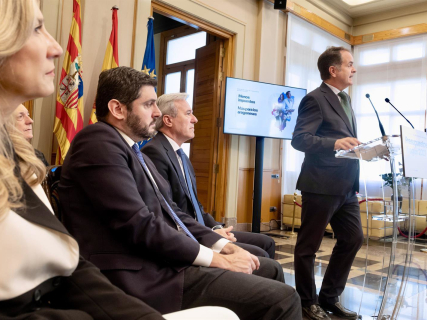

The "effort to strengthen" public services, incorporate housing policies, apply tax cuts and consolidate the principle of national priority, within the framework of the legislature agreement between PP and Vox, constitute some of the central planks of the Aragón 2027 budget bill project, which amounts to 9,594 million euros, "the largest budget in History".
The president of the Autonomous Community, Jorge Azcón, has unveiled this Wednesday the draft accounts, which have already been sent to the Cortes of Aragón so that they can begin their processing and so that they can be approved before the end of the year.
The minister of Finance, Interior and Public Administration, Roberto Bermúdez de Castro, has emphasized that "we are living in the period of greatest growth and prosperity of recent years" thanks to the volume of investment and the high level of employment, which "means that the revenues of the Autonomous Community allow us to have the largest budget in History". These accounts are aimed at shoring up public services and the "essential" needs, including education, health care, social services, the prevention and extinction of wildfires, and housing.
The 2027 budget increases by 12% compared with the last one approved, that of 2024, which represents an additional one billion euros, and gives continuity to the spending cap previously validated by the regional Cortes, set at 8,398 million euros, 11% higher than in 2024.
Bermúdez de Castro has indicated that the economic scenario expected for 2027 is "stable", which "makes it possible to undertake projects in the coming years" in areas such as roads. He has clarified that in the coming fiscal years GDP will be maintained and unemployment will remain contained, with 7.4% in the EPA for 2027 and 7.2% in that for 2028, while debt stands at 15.1% of GDP and is "very contained". The pillars of growth in the Aragonese economy are construction, services, industry and, in certain regions, the agricultural and livestock sector.
Main lines of the accounts
Among the main lines of the budget, Bermúdez de Castro has cited tax cuts "without compromising budgetary stability", the strengthening of public services, the increase in investment to stimulate growth, and the end of the "doping" of the European funds MRR.
In the tax sphere, the inheritance tax bonus for group 2 will be raised to 99%, incorporating into group 1 people with curatorship, who then come to be considered also in group 2.
Likewise, the IRPF is reduced by 0.25% for brackets below 52,500 euros, in line with the PP-Vox commitment to reduce it by one point throughout the legislature. A new deduction is introduced for large families, of 300 euros in the general category and 600 in the special category.
Support for childbirth is also contemplated, with 1,000 euros of a refund against the IRPF quota for the birth or adoption of the first child, 1,500 for the second and 2,500 for the third, doubling the amounts if the children have more than 1 33% disability and increasing by 20% in the rural setting. These measures, applying the principle of national priority, are aimed at those who have had their tax residence in Aragón during the last four years. Other reductions are also included, such as an 80% reduction in the fee for the hunting and fishing license.
Distribution by departments
In the Departments chapter, the largest increase corresponds to Education, Science and Universities, which will have 1,866 million euros, more than 350 million euros above the previous budget, which represents an increase of 24%. 15 million euros will be allocated to the program 'Aulas que respiran', teachers' salaries will rise by 7.75%, and the basic transfer to the University of Zaragoza will be reinforced.
The Department of Deregulation, Social Welfare and Family increases by 20%, with 90 million euros in additional funds, reaching 548 million euros. It includes improved care for dependency, which has gone from being the one that paid the least and took the longest to be paid to being the second fastest to be granted, with annual growth of 7%. It also includes the IASS and the works on the Valdefierro residence.
The Sanidad budget amounts to 3,162 million euros, with 15% more own resources, an additional 415 million euros, and it includes an investment of 58 million euros for the new Hospital Royo Villanova and allocations for the new health centers in Cuarte de Huervo, Zuera and Utebo, in addition to improving Caspe. The new pharmacy of Hospital Miguel Servet is also planned and the implementation of new robotic surgery services.
The Housing area, integrated in the Department led by Octavio López, increases by 45%, with an additional 107 million euros, reaching 343 million euros, of which 52 million euros are own funds. The roads program will have a budget of 159 million euros.
In the Department of the Presidency, Justice and Culture, the sports area records an increase of 23%, Culture grows by 25% --with the opening of the Centro Goya-- and in Justice the reform of the Palacio de los Luna and the updating of the modules for free legal aid are planned.
The Ministry of Finance incorporates new competencies from the Emergencies area --through Interior--, since during the first half of the year the Emergency Center will be launched and, throughout the fiscal year, fire prevention rings will be carried out in rural municipalities. In addition, the creation of an autonomous meteorology agency is added, the start of the work for the launch of the emergency agency and the firefighters’ consortium, together with the DPH, the DPZ and the DPT.
Economy, Competitiveness and Employment is the Department most affected by the reduction of European funds, although it will have 151 million in own funds, with 17 million for the DAT Alierta, progress in the construction of the new ITA building, the consolidation of the 'Volveremos' program and 10 million euros for a start-ups fund.
With regard to Agriculture, Livestock and Food, 13 million will be allocated to agricultural insurance, with the forecast of reaching 16 million at the end of the legislature, and 7 million for young farmers.
In Environment and Tourism, investments are expected in the bases of forest agents, more firefighters and a reinforcement of aerial resources, as well as the continuation of the restoration of areas affected by fires.
The budget also includes the development of the Plan Pirineos, with actions such as the recovery of the camping site in Zuriza, the reform of the parking area in Escarrilla and a new entrance to the Ordesa y Monte Perdido National Park, as well as investments aimed at reducing seasonality in tourism.