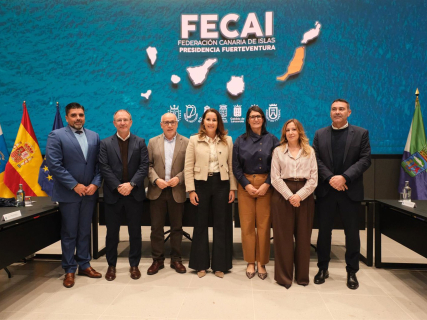

The seven island councils of the Canary Islands have requested the central Government the suspension of the spending rule that applies to the island Corporations, alleging the current scenario of international geopolitical crisis and its specific effects in an outermost region like the archipelago.
The Canary Islands Federation (Fecai) detailed this position after its last General Assembly, in which it was agreed to demand a temporary halt of said norm with the aim of adequately addressing the social, economic, and territorial needs of the islands.
The president of Fecai and of the Cabildo of Fuerteventura, Lola García, stressed that the initiative is formulated "so that we can use treasury surpluses without limitations, guaranteeing the capacity to respond to the needs of our population."
García explained that the international geopolitical situation, conditioned by the escalation of the conflict in Iran and its repercussion on the energy and financial markets, is generating a context of instability with direct effects on the cost of living and economic activity.
In this framework, it recalled that, as an outermost region (RUP), "Canary Islands especially suffers these impacts, due to the increased cost of transport, energy, and basic supplies".
Likewise, he/she warned that "however, the measures adopted to date by the State do not incorporate the singularities of the islands, limiting the capacity for response from the administrations closest to the citizenry".
The president of Fecai recalled that there are recent precedents in which, in the face of large-scale crises, such as the Covid-19 pandemic or the economic effects of the war in Ukraine, the Government of Spain opted for extraordinary decisions, temporarily suspending fiscal rules to enable an effective public response.
Finally, Fecai urges the Government of Spain and the Ministry of Finance to apply a real flexibilization of the principle of budgetary stability, explicitly incorporating the economic, fiscal, and territorial singularities of the Canary Islands, both due to its condition as an outermost region recognized by the European Union as well as due to its Economic and Fiscal Regime.