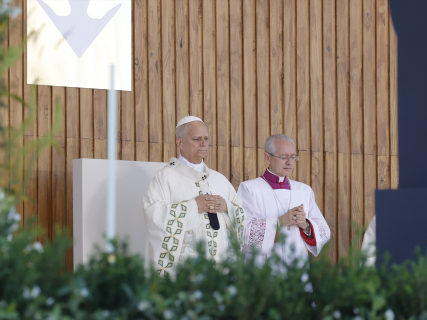
The Pope arrives in Barcelona: streets closed, routes and security device during his visit

Consult the route of Pope Leo XIV in Barcelona, the closed streets and the transport disruptions during the days of June 9, 10, and 11, 2026.

2 minutes

EuropaPress 7578031 papa leon xiv preside misa festividad corpus christi plaza cibeles junio

EuropaPress 7578031 papa leon xiv preside misa festividad corpus christi plaza cibeles junio

Add DEMÓCRATA to Google

Published

Last updated

2 minutes

Most read

The arrival of Pope Leo XIV in Barcelona this Tuesday, June 9th to the 11th will activate a broad security and mobility device in the city, with traffic cuts, parking restrictions, and significant impacts on public transport in several strategic points of the Catalan capital.

Although the main events will be concentrated on Tuesday the 9th and Wednesday the 10th, the first restrictions already began this Monday, June 8th, especially in the surroundings of the historic center and the main access roads to the planned events.

Pope's Itinerary in Barcelona

The Pontiff's official agenda includes several high-attendance events:

  • Tuesday, June 9
    • Arrival at El Prat airport (12:25 PM)
    • Prayer at the Barcelona Cathedral (1:00 PM)
    • Vigil at the Olympic Stadium of Montjuïc (8:00 PM)
  • Wednesday, June 10
    • Visit to Brians 1 prison (10:50 AM)
    • Events in Montserrat (12:00 PM–1:00 PM)
    • Meeting at Sant Agustí, Raval (4:30 PM)
    • Mass at the Sagrada Família (7:30 PM), with a parade in the popemobile along Rosselló street

Streets Closed in Barcelona

The restrictions will affect several districts of the city:

Historic Center (Ciutat Vella)

From June 8 to June 11:

  • Avenida de la Catedral
  • Plaza Antoni Maura
  • Plaza Nova

Raval (June 9 and 10)

Restrictions will affect Hospital street, La Rambla, Plaça de la Gardunya, Jerusalem street, and Plaça Sant Agustí.

Montjuïc (June 9)

  • Avenida Reina Maria Cristina
  • Plaza de Espanya
  • Avenida Paral·lel
  • Surroundings of the Olympic Stadium

Eixample – Sagrada Família (June 10)

Area especially affected between:

  • Provença and Còrsega
  • Cinc d'Oros and Lepant

Affected Streets: Rosselló, Mallorca, València, Marina, Sardenya, Nàpols, Girona, Bruc, Bailèn, Roger de Flor, Roger de Llúria, and Pau Claris.

Public Transport: Main Changes

  • Sagrada Família Metro (L2 and L5): closed all day on June 10
  • Verdaguer (L4): exit only during peak hours
  • Reinforcement of shuttle buses between Plaça d'Espanya and Montjuïc
  • Reinforced services to Montserrat with regulated access

Mobility Recommendations

Authorities recommend avoiding private vehicles in the affected areas, planning trips in advance, and using public transport whenever possible. Screens will also be set up at locations such as Arc de Triomf and Plaça de les Glòries to follow the events live.

More key points, information and questions with FREN

AI-GENERATED CONTENT

What is the process of preparation and coordination of security devices for papal visits in major Spanish cities?

Security and police devices in papal visits to major Spanish cities

Summary of the process

The preparation of a security device for a papal visit in major Spanish cities is structured as a large "state security" operation, led by the Ministry of the Interior and coordinated on the ground by the Government Delegations and the competent police forces. The process combines advance planning (intelligence, risk analysis, itinerary design), inter-institutional coordination (State, Autonomous Communities, city councils, and Church), and operational execution (police cordons, crowd control, protection of authorities, and crowd management). The key is to minimize risks in an environment with a very high concentration of people and great media exposure, while guaranteeing the free exercise of worship and the basic mobility of the city. The entire scheme fits within the general framework of national security, anti-terrorism, and major events provided for in Spanish regulations.

Institutional and command framework

In Spain, papal visits are considered events of maximum political, social, and security sensitivity. The main authority is the Ministry of the Interior, through the State Secretariat for Security, which sets the general criteria, alert levels, and extraordinary resources. In each major city (Madrid, Barcelona, Valencia, Seville, etc.), the key figure is the Government Delegation, which usually constitutes a specific coordination center for the event.

This center integrates representatives from: 1) State Security Forces and Corps (National Police Corps and Civil Guard, according to competencies and scenarios), 2) autonomous police forces (such as Mossos d’Esquadra or Ertzaintza, if the visit is in their territories), 3) local police, 4) emergency services (health, firefighters, civil protection), and 5) ecclesiastical organization leaders and local authorities. The Apostolic Nunciature and the Vatican itself provide their security requirements and personal protection protocols for the Pope.

Planning phases

Risk analysis and scenario design

The first phase consists of risk analysis: terrorist threats, violent incidents, avalanche risks, health problems, and possible protest or boycott actions. This analysis is fed by national and international intelligence information, previous city assessments, and accumulated experience from other papal visits or other major events (summits, sports finals, etc.).

Based on this, several reference scenarios are designed (from the most probable to the most critical) and the alert level and type of device are determined: security perimeters, number of agents, access controls, presence of special units (TEDAX, UIP, canine units, helicopters), etc.

Itineraries, spaces, and logistics

At the same time, the Pope’s itineraries are negotiated and finalized (transfers from the airport, Nunciature, cathedral, large outdoor events) and the spaces of maximum concentration (massive masses, youth meetings, institutional acts). Each section of the itinerary is analyzed in detail: elevated points, sensitive buildings, evacuation routes, possible crowding areas.

Critical decisions made at this stage include: delimiting free access areas and restricted areas with entry control, implementing bag and backpack checks, positioning snipers and surveillance cameras, restricting vehicle circulation in certain security rings, and creating alternative routes for public transport and essential services.

Inter-administrative coordination

The papal visit involves intense political and institutional coordination. City councils must approve or facilitate special ordinances for public space occupation, urban mobility plans, and reinforcements for cleaning and services. Autonomous communities participate through their competencies in health, civil protection, transport, and, where applicable, autonomous police.

Mixed commissions are usually established where representatives of the central government, autonomous and municipal authorities, and the ecclesiastical organization are integrated. These commissions synchronize schedules, capacity limits, temporary infrastructures (stages, fences, giant screens), and messages to the population about traffic restrictions, access recommendations, and security measures.

Operational deployment on the day of the event

During the days of the visit, a command and control center operating 24 hours is activated, linked to the operations rooms of the Police, Civil Guard, autonomous and local police. From there, flows of people are monitored through cameras, drones (when authorized), and teams on the ground; real-time traffic cuts are coordinated; and incidents are managed, from medical emergencies to suspicious objects.

The human device usually combines: static cordons to protect access and stages, mobile teams to accompany the papal entourage, public order units to prevent avalanches or disorders, and discreet close protection teams for the Pope and other authorities. Cybersecurity and communication protection measures are also reinforced, given the high media and symbolic interest of the event.

Public communication and post-event evaluation

Throughout the process, authorities inform citizens about restrictions, public transport access recommendations, and basic security measures (prohibited objects, opening hours of venues, etc.) to reduce tensions and improve citizen cooperation. After the visit, an internal evaluation is carried out analyzing incidents, device effectiveness, and possible improvements for future events.

Although each papal visit has particularities (city size, political or social context at the time), the preparation and coordination pattern in Spain always responds to these elements: clear command from the Ministry of the Interior, strong inter-administrative coordination, risk-based planning, and an operational device oriented both to security and to coexistence and normal urban functioning.

What specific competencies does the mayor of Barcelona have in security and mobility during events of this magnitude?

Competencies of the mayor of Barcelona in security and mobility

Brief answer

The mayor of Barcelona has key competencies in urban security and mobility, but always within the legal framework set by the State and the Generalitat. In terms of security, he directs the Local Police (Guardia Urbana), approves municipal devices, coordinates with Mossos d’Esquadra and state forces, and can issue decrees and orders to guarantee public order in the urban space. In mobility, he can regulate traffic, establish circulation restrictions, limited access zones, changes of direction, detours, and special public transport plans. In large-scale events, his role is mainly operational direction at the municipal level and inter-administrative coordination, while competencies over strict public order and anti-terrorist security mainly correspond to the Generalitat and the State.

General framework of competencies

The mayor’s competencies are based on local regime regulations (in particular, local regime legislation and specific regulations of Barcelona as a special regime municipality). The mayor is the highest municipal authority and, therefore, has political leadership of the Local Police and ultimate responsibility for security and mobility in the city’s urban space, without infringing on citizen security competencies that correspond to other administrations.

Security scope

In security, the most relevant competencies of the mayor of Barcelona during a large-scale event are usually:

1. Direction of the local police (Guardia Urbana)
The mayor exercises political leadership of the Guardia Urbana, defines service priorities, and approves specific municipal devices for events (reinforcement of patrols, street closures, access control to certain areas, alcohol and drug checks around the event, etc.). This includes orders to reinforce presence at sensitive points (stations, squares, main roads) and to support Mossos d’Esquadra in crowd control or public space regulation tasks.

2. Approval of municipal security plans
The mayor can approve specific municipal plans (self-protection plans and special devices) for mass events in coordination with municipal civil protection. These define evacuation zones, health care points, safe routes, and the distribution of functions among municipal services (Guardia Urbana, Barcelona Firefighters, emergency services, cleaning, etc.).

3. Decrees, orders, and proclamations in public space
Through decrees and proclamations, the mayor can: regulate activity hours in public spaces (for example, limiting terraces or street vending within the event perimeter), establish prohibitions or restrictions on certain uses of space (street drinking, concentration of dangerous objects, occupation of squares or avenues at critical times), and order extraordinary noise or coexistence control measures to reduce risks associated with crowding.

4. Coordination with other security forces and bodies
Although general citizen security and public order competence mainly corresponds to the Generalitat (Mossos d’Esquadra) and the State (National Police and Civil Guard, in their respective areas), the mayor: participates in coordination bodies and operational committees with these forces, promotes the development of joint devices (for example, security rings where Guardia Urbana manages traffic perimeter and Mossos control access), and can request reinforcements or additional measures when municipal capacity is insufficient.

Mobility and traffic scope

In mobility, the mayor concentrates much of the decision-making capacity, especially in a city like Barcelona with advanced competencies in urban transport management.

1. Traffic regulation in the city
The mayor can: order closures, detours, and traffic restrictions on municipal roads, create or reinforce bus lanes and priority access lanes for emergency services and public transport, temporarily modify traffic directions and parking zones to facilitate evacuations, service access, and mass movements of people.

2. Urban public transport management
Although operation is carried out by the corresponding public or mixed company, the mayor (through the city council and competent consortia) can: decide on frequency reinforcements for metro, bus, and tram linked to the event, open or close access to specific stations for security reasons, set special exchange and shuttle points, and coordinate information to citizens about recommended routes, restrictions, and travel alternatives.

3. Restricted access zones and security perimeters
The mayor has the capacity to delimit: temporary low emission zones or private vehicle access restrictions around the event, pedestrian perimeters and exclusive streets for attendees, reinforcing public transport use, and areas reserved for emergency services, loading and unloading of logistical material, or transport of accredited personnel.

Inter-administrative coordination and limits

In large-scale events, the mayor’s decisions are integrated into a coordination scheme with the Generalitat (civil protection, Mossos d’Esquadra, health services) and, where applicable, with the General State Administration (strategic infrastructures, air security, high-risk threats). The mayor cannot assume exclusive State or Generalitat competencies in public order, intelligence, or anti-terrorism alone, but can decisively influence urban space operations (itineraries, schedules, access, municipal control and support devices). His central responsibility is to ensure that the city—its streets, services, and transport—is prepared to host the event with the highest possible level of security and mobility fluidity, within the framework of higher security and civil protection plans.

Which other Spanish cities have received papal visits in the last decade and how were security devices managed in those cases?

Brief answer

In the last decade (approx. 2014‑2024) there have been no official apostolic trips of a pope to Spanish cities, so there are no comparable papal security devices by city in that period. According to historical summaries of papal visits to Spain, the last trip before the current one was Benedict XVI’s to Madrid in 2011 on the occasion of World Youth Day, and the next major pontiff trip to Spain is that of Leo XIV, which is already outside the timeframe you ask about. Therefore, there are no recent examples (2014‑2024) of specific operations in Barcelona, Valencia, Santiago, or other cities that allow detailing deployed forces, perimeters, or restrictions. What can be done is to extract general patterns from previous devices and Spanish experience in maximum security events.

Absence of papal visits in 2014‑2024

Official counts of papal trips to Spain consolidate the movements of John Paul II, Benedict XVI, and more recently Leo XIV, but indicate that between 2014 and 2024 no apostolic trip of a pontiff to Spanish territory took place. The annex of papal trips to Spain chronologically classifies all visits and clearly shows that, after the 2011 WYD in Madrid with Benedict XVI, a period without trips opens until the new cycle of visits by Leo XIV, already documented for dates after your timeframe (list of trips to Spain).

This absence is also confirmed in popular compilations about the “eight great papal visits to Spain,” which review major milestones (Madrid, Santiago, Barcelona, Valencia, Seville, etc.) and place the last trip prior to Leo XIV’s era also in 2011, without recording new cities visited during 2014‑2024 (historical summary of papal trips). Therefore, there are no cases in that decade that allow describing how recent operations were organized in specific cities.

What a papal device would imply: general patterns

Although there are no papal visits in Spain in the indicated decade, the general features of this type of macro-devices are known from accumulated experience in other trips and from what is being prepared for Leo XIV’s itinerary. The forecasts for this visit point to a security scheme very similar to those usually applied in events classified as high level: close coordination between the Ministry of the Interior, Civil Guard, National Police, autonomous police where they exist (Mossos d’Esquadra, Ertzaintza, Policía Foral), and local police of each involved municipality.

In fact, interactive agendas of Leo XIV’s visit, prepared by Spanish media, anticipate routes, squares, and temples that will be subject to strong mobility restrictions and access controls, both for faithful and residents, in the different cities of the itinerary (interactive agenda of Leo XIV’s visit; apostolic trip of Leo XIV). Other popular analyses about “the meaning of each stop” emphasize that, precisely because these are symbolic spaces with large concentrations of people, vehicle access is sealed off, security perimeters and metal object controls similar to airports are established (stops and meaning of the visit).

Lessons from Spanish historical experience

Although it is outside the 2014‑2024 interval, Benedict XVI’s visit to Madrid in 2011 is the closest operational reference in Spain. Literature reviewing the impact of papal visits highlights that this device was planned as a national security operation, with unified coordination commands, massive deployments of riot police and intelligence units, access controls at transport stations, and creation of “red zones” near central acts (impact of papal visits). This pattern, historically repeated in other Spanish cities, is presumably recycled in subsequent visits, although there are no new cases between 2014 and 2024.

General compendiums on papal visits to Spain emphasize that these operations exceed the strictly religious and are approached as “country events” with a logic very similar to international summits or large multilateral meetings (summary of papal visits to Spain). Concentric security rings are deployed, flights are limited in certain time slots, cybersecurity is reinforced, and, in coordination with city councils, traffic and public transport flows are temporarily redesigned.

Limits of available information

There is no official or journalistic specific information about papal security devices in Spanish cities between 2014 and 2024 because there were no pontifical trips in that period. Concrete examples of deployed forces, number of agents, distribution by corps, or exact perimeter layout therefore correspond to previous experiences (such as 2011) or forecasts for Leo XIV’s visit, which falls outside the proposed timeframe. Consequently, any extrapolation about “how they were managed” in the last decade must be made cautiously and referring to those general high-level event security patterns.

Play

Test your knowledge with FREN!

How much do you know about this topic? Answer the following 3 questions.

On what dates does the visit of Pope Leo XIV to Barcelona take place?

Question 1 of 3

Which metro station will remain closed all day on June 10 due to the visit?

Question 2 of 3

What event is scheduled for Wednesday, June 10 at 7:30 PM?

Question 3 of 3

Hola, soy Fren. ¿Cómo te ayudo?