Traffic cuts due to Shakira in Madrid: affected streets and times

The twelve concerts scheduled between September 18 and October 11 will cause restrictions in Villaverde, parking prohibitions from 3:00 PM and cuts in the accesses of the M-45 from Getafe.

EuropaPress 7390123 arquitectos shakira estadio agustin perez torres presidente live nation

EuropaPress 7390123 arquitectos shakira estadio agustin perez torres presidente live nation

Add DEMÓCRATA to Google

Ask FREN

Published

3 minutes

Most read

Elecciones 29N · Encuestas

La media de las encuestas

Media a 7 de noviembre de 2026 · 11 institutos

  • PP31,0 %
  • PSOE26,2 %
  • Vox19,5 %
  • Frente Amplio6,6 %
  • ERC2,4 %
  • SALF2,2 %
  • Podemos2,1 %
01020304050ene 2024jul 2024ene 2025jul 2025ene 2026jul 2026

Media del último estudio de cada instituto en 30 días y su evolución semanal desde el 23J. Partidos con al menos un 2 %.

Todas las encuestas

Elecciones generales del 29 de noviembre · Demócrata

The twelve concerts of Shakira in Madrid will require the deployment of a special traffic device in Villaverde that will affect numerous streets in the vicinity of the venue and also some of the accesses from Getafe and the M-45.

The Madrid City Council has designed a mobility plan in anticipation of around 57,000 daily attendees. The concerts will take place on September 18, 19, 20, 25, 26, and 27 and October 2, 3, 4, 9, 10, and 11, 2026 at the Iberdrola Music space, located south of Villaverde Alto.
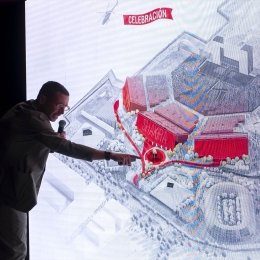
The restrictions will be applied during the concert days and may be modified depending on the attendance. The Municipal Police may extend both the street closures and their hours if circumstances require it.

Which streets will be closed due to Shakira's concerts

The main impact will occur on Laguna Dalga, one of the streets that delimit the venue. The section between the Real de Pinto avenue and San Erasmo will remain closed during the hours of the event, except for authorized vehicles and emergency services.

Also, Laguna de Cameros will be closed during the concert hours, with the same exceptions.

In the section of Laguna Dalga between San Erasmo and San Eustaquio, closures may also be established depending on the circumstances and the volume of the public.

The device also contemplates possible restrictions on San Eustaquio, between San Norberto and Resina; Laguna del Marquesado, between San Erasmo and the Real de Pinto avenue; and Resina, between San Erasmo and the Real de Pinto avenue.

Restrictions on the Real de Pinto avenue

Another of the roads especially affected will be the Real de Pinto avenue, one of the main accesses to this area of Villaverde.

The City Council warns that the section between the Lozares roundabout and the M-45 may experience closures depending on the intensity of traffic and pedestrian attendance.

The greatest difficulties are expected during the peak hours of entry and exit of the public. Regular public transport from the EMT and emergency vehicles will be able to continue circulating. There may also be restrictions on Valle de Tobalina, between the Lozares roundabout and Acebeda street, and on Acebeda, between Domingo Párraga and El Berrueco.

Closures on the M-45 for those arriving from Getafe

The device will also affect the roundabout located under the M-45 that connects Villaverde Alto with Getafe. The City Council plans the total closure of access from Getafe to the M-45 East, as well as the closure of access from the M-45 East to the Real de Pinto avenue. The access for vehicles entering from the M-45 West through Getafe will also be closed for changing direction.

It is planned to keep the exit from the Real de Pinto avenue to the M-45 West open, as well as the entrance from the M-45 West to Getafe without going around the roundabout. From Getafe, access to the M-45 will also be possible by going around the roundabout via the inner lane to merge onto the M-45 West.

Parking prohibited from 3:00 PM

The cuts will not be the only restriction. In several of the surrounding streets, it will be prohibited to park from 3:00 PM each concert day until the end of the device.

The prohibition will affect Laguna Dalga, Laguna de Cameros, and various sections of San Eustaquio, Laguna del Marquesado, Resina, and Acebeda.

The parking possibilities within the venue itself are also limited. The organization has 648 regular spaces and 22 spaces for people with reduced mobility, but they are exclusively linked to certain types of tickets or accreditations.

The cuts may change according to attendance

The hours announced by the City Council are indicative. The police commanders responsible for the device may modify the opening and closing hours of the streets and even extend the restrictions to other nearby roads if the situation requires it.

The concerts are scheduled between 9:00 PM and 11:00 PM, but the exit of the public will be gradual and will extend until 1:00 AM.

With around 57,000 attendees expected each day, the City Council recommends avoiding private vehicles in the entire area of Villaverde affected by the device. For long-distance travel, it advises using the M-30 and M-40, while for attending the concerts, it recommends using public transport.

More key points, information and questions with FREN

AI-GENERATED CONTENT

What powers does the Madrid City Council have regarding traffic regulation during mass events?

The Madrid City Council has very broad powers to order and manage traffic and mobility on the urban roads within its municipal area, including during mass events (demonstrations, races, concerts, institutional visits, etc.). However, this power is framed within a context where the State (through the Government Delegation and the DGT) and the Community of Madrid retain their own functions in matters of citizen security, roads, and public transport.

1. General framework of municipal powers

Law 7/1985, Regulating the Bases of the Local Regime, grants municipalities their own powers in traffic regulation on urban roads and local mobility management, later developed by traffic and road safety regulations (consolidated text approved by Royal Legislative Decree 6/2015). This state regulation:

  • Defines the distribution of functions among the General State Administration, autonomous communities, and local entities in matters of traffic, circulation, and road safety.
  • Explicitly provides that when activities or events that occupy all or part of the road, or generate an abnormally high number of trips, are held, organizers must notify the competent authority (state, regional, or local) in road safety so that it can establish specific regulation, ordering, management, and traffic surveillance.

On this basis, city councils can approve mobility ordinances and issue specific resolutions (for example, for particular events) that restrict, channel, or reorganize traffic on the streets under their jurisdiction.

2. What the Madrid City Council can do in practice

Based on official information from the City Council itself, it is evident that Madrid exercises its powers through various instruments:

  • Sustainable Mobility Ordinance and regulatory development: this is the municipal regulation that structures mobility policy (low emission zones, parking regulation, access conditions, etc.) and serves as a basis for specific measures in high-impact events.
  • Mobility Management Center (CGM): according to the note “The Madrid Mobility Management Center, a national benchmark in traffic management,” this center:
    • Manages traffic on the urban roads of the capital and the M-30, coordinated with the DGT at the access points.
    • Operates 24/7 adjusting traffic light regulation and activating Mobility Agents and Municipal Police in case of incidents or large events.
    • Supervises the mobility plans of mass events approved by the Directorate General of Traffic Management and Surveillance, being able to make real-time decisions on closures, detours, and prioritization of emergency lanes.
  • Mobility Agents and Municipal Police: Mobility Agents are “traffic authority” within the M-30, and the Municipal Police act inside and outside the M-30 managing traffic incidents and serving as a liaison with the Government Delegation on public security matters (for example, demonstrations).
  • Mobility plans and specific devices: for MADO (Pride), San Silvestre, marathons, NFL games, or major visits (such as the Pope’s), the City Council:
    • Designs mobility plans with traffic closures, detours, parking closures, and EMT reinforcements.
    • Can limit the circulation of certain vehicles (for example, temporary prohibition of heavy vehicles around processions or mass religious events).
    • Imposes conditions on promoters of large events: presentation and compliance with a mobility plan coordinated with municipal services.

In summary, within the scope of urban roads, the City Council can: close or divert streets, modify traffic light programming, restrict access, regulate parking, define emergency lanes, set provisional signage, and deploy police and Mobility Agent devices to manage flows of vehicles and pedestrians.

3. What remains in the hands of the Government Delegation and the Community of Madrid

Municipal powers are not absolute and are coordinated with other levels:

  • Government Delegation (State):
    • Authorizes demonstrations and gatherings that affect the right of assembly in public roads; municipal notes on agricultural gatherings indicate that these are “demonstrations authorized by the Government Delegation.”
    • Holds primary responsibility for citizen security and public order, directing the National Police and Civil Guard; the Municipal Police cooperates and acts as liaison but does not replace the State Security Forces and Corps.
    • Through the DGT and the Traffic Group, regulates and can close or restrict state roads and interurban access, as well as authorize certain sporting events that take place on them.
  • Community of Madrid:
    • Has powers over regional roads and control of road transport at the regional level, coordinating with the Civil Guard and local police.
    • Manages the Regional Transport Consortium (Metro, interurban buses, Cercanías in coordination with the State) and approves mobility plans for large events at the regional level.
    • Sets general frameworks (for example, local police regulations or transport inspection plans) within which municipal action operates.

In practice, during a mass event in Madrid city, the City Council leads the ordering of traffic and mobility on urban streets and the M-30, but does so coordinated with the Government Delegation (citizen security and demonstrations, state devices) and with the Community of Madrid (regional public transport and regional roads). This coordination conditions the design of mobility plans and the specific limits of restrictions that the council can adopt.

What are the legal requirements for a large-scale musical event to restrict circulation on public roads in Madrid?

For a large-scale musical event to involve road closures or significant circulation restrictions on public roads in the city of Madrid, three regulatory levels combine: the state traffic and road safety law, the regional regulations on public shows, and the municipal ordinances on circulation and public space use. On this basis, the Madrid City Council can only authorize street closures when justified by reasons of safety, mobility, and coexistence, and the organizer must provide a series of technical and liability guarantees.

1. State framework: traffic and road safety

The Royal Legislative Decree 6/2015, which approves the consolidated text of the Law on Traffic, Motor Vehicle Circulation, and Road Safety (BOE-A-2015-11722), establishes the distribution of powers:

  • Recognizes the municipalities the competence for regulation, ordering, management, surveillance, and discipline of traffic on the urban roads under their ownership.
  • Enables them to approve circulation ordinances that regulate the uses of urban roads and reconcile vehicular traffic with pedestrian use.
  • Explicitly grants them the power to agree on the closure of urban roads when necessary and the restriction of circulation to certain vehicles on urban roads.

This means that the Madrid City Council is competent to authorize street closures for a musical event, but always within the limits of road safety and other applicable regulations.

2. Regional framework: public shows and recreational activities

In the Community of Madrid, Law 17/1997, on Public Shows and Recreational Activities (BOE-A-1998-9648), amended by subsequent regulations, applies. Its general regime entails several key requirements for large-scale events:

  • Shows and recreational activities must guarantee the safety of the public, workers, and performers, the solidity of structures and installations, and risk prevention (fires, stampedes, etc.).
  • Conditions of health, hygiene, and acoustics are required, including measures to avoid disturbances to third parties (relevant for noise and schedules in public roads).
  • Premises and establishments (and, by extension, temporary installations) must have civil liability insurance for damages to attendees and third parties, with the amount determined by regulation.
  • They must have an emergency plan in accordance with basic self-protection regulations.
  • The law delegates to City Councils the granting of operating licenses and other necessary authorizations, after verifying compliance with technical safety, environmental, and urban conditions.

Additionally, the Community can regulate which shows, due to their capacity or impact on coexistence, require reinforced surveillance measures or special conditions.

3. Municipal scope: street closures and public space use

Based on the state traffic law and Law 17/1997, the Madrid City Council regulates, through its ordinances and decrees, the specific conditions to authorize musical events on public roads that affect circulation. In summary, the usual scheme is:

  • Specific municipal authorization for public road occupation and for the event, processed before the competent area (usually mobility/circulation and citizen security), with reports from the Municipal Police and emergency services.
  • Possibility to impose conditions on street closures, detours, and parking restrictions, which the organizer must respect and adequately signal.
4. Documentation and guarantees usually required

Although details are in municipal ordinances and protocols, the cited regulations imply, at minimum, the following material requirements for a large-scale musical event on public roads:

  • Basic event project: description of the activity, exact location on the public road, schedule and timetable, estimated capacity, and pedestrian access points.
  • Safety and emergency/self-protection plan: risk analysis, evacuation routes, access control, audience sectorization, coordination with health and emergency services, and guarantee of emergency vehicle access even if general traffic is closed.
  • Mobility plan: forecast of traffic impact, proposal of alternative routes, parking management, and, if applicable, measures to promote the use of public transport.
  • Valid civil liability insurance covering damages to attendees and third parties, including effects on public property.
  • Acoustic measures: sound configuration and limitation of emission schedules to comply with noise regulations and neighborhood coexistence requirements.
  • Proof of necessary licenses or notifications regarding recreational/show activity, when the event is legally equated to a public show regulated by Law 17/1997.
5. Substantive criteria to authorize circulation restrictions

The municipal administration must weigh, based on this documentation, whether the closure or circulation restriction is justified by:

  • Road safety and the safety of attendees.
  • Maintaining emergency access to homes and essential services.
  • Respect for neighborhood coexistence (noise, schedules, prior information to affected residents and businesses).
  • The existence of reasonable alternative routes for traffic and, if applicable, coordination with public transport.

In short, in Madrid a large-scale musical event can only justify street closures if it has the express authorization of the City Council, based on the powers granted by the Traffic Law and the regional show regulations, and if the organizer provides sufficient safety, mobility, emergency, and liability plans to guarantee safety and minimize the impact on the city.

What specific administrative steps would a promoter have to follow to request street closures from the Madrid City Council for a music festival? How do the Municipal Police, SAMUR, and EMT coordinate in practice when a large musical event is authorized on public roads in Madrid? What noise and schedule limits typically apply to outdoor concerts in Madrid according to regional and municipal regulations?

Which other Spanish cities have adopted similar traffic devices for mass concerts in recent years?

In recent years, numerous Spanish city councils and administrations have deployed special traffic and mobility devices very similar to manage concerts and mass festivals. This is not an isolated practice of a single city but a fairly widespread pattern that combines traffic closures, reinforcement of public transport, and restrictions on private vehicles in sensitive areas.

Among the clearest examples of cities that have implemented these devices are:

Madrid and its metropolitan area

The Community and the Madrid City Council have generalized specific mobility plans for large events. According to the Community itself, in 2024 121 mobility plans were authorized for mass events, including festivals and major concerts such as Mad Cool or performances by Metallica, Luis Miguel, Karol G, or Bruce Springsteen (Community of Madrid note). These devices have combined:

  • Reinforcement of multiple Metro and EMT lines, with extended night schedules.
  • Special shuttle bus services and night services dedicated to entry and exit from venues.
  • Traffic closures and detours at access points to venues (for example, the Ciudad del Rock in Arganda del Rey during the Summer Story festival, with detours on A-3 and N-III and specific signage on variable message panels, DGT note).
  • Campaigns recommending not to use private cars and to plan trips in advance.

Besides festivals, the Community also highlights that these plans are activated for one-off macro concerts and other festive events with large attendance.

Bilbao

Bilbao is one of the most established cases. For the Bilbao BBK Live festival, the City Council activates each year a broad coordinated operation of security, health control, cleaning, and especially mobility (BBK Live 2024 operation and 20th edition). The main lines are:

  • Prohibition of private vehicle access to Kobetamendi, allowing only authorized vehicles, public transport, and accredited residents.
  • Network of shuttle buses (with reservation and free) from points such as San Mamés and the BEC, operating almost 24 hours.
  • Prolonged street closures at access points (Kobetabidea, accesses via Altamira, Monte Caramelo, etc.) and removal of parking spaces in key areas.
  • Reinforcement of Metro Bilbao all night for staggered evacuation of the public.
Las Palmas de Gran Canaria

The Las Palmas de Gran Canaria City Council has implemented very similar devices for events such as the Granca Live Fest. Around the Gran Canaria Stadium, they activate: traffic closures on streets like Fondos de Segura and strong reinforcement of lines 26 and 91, as well as special bus terminals in Hoya de la Gallina and specific evacuation lines to the Port, the Theater, and the Auditorium (municipal note and Guaguas plan).

Barcelona

Barcelona has opted for a structural regulation around the Parc del Fòrum, where festivals like Primavera Sound or Cruïlla are held. The festival plan at the Fòrum requires promoters to present a sustainable mobility plan that includes:

  • Measures to manage pedestrian flows and connection with public transport (metro, TRAM, shuttles, agreements with parking lots).
  • Specific routes to avoid crowding in residential areas.
  • Reduced prices for some motorcycle parking and special shuttle services on weekdays.
Seville

In Seville, large-scale concerts at the Olympic Stadium (for example, those by AC/DC) have been linked to a mobility device with:

  • Traffic closures on the SE-20 and avenues accessing the stadium, regulated by the Local Police.
  • Reinforcement and extension of schedules of the circular lines C1 and C2 of Tussam, and a free shuttle between the stadium and La Barqueta.
  • Specific zones for taxis, motorcycles, and people with reduced mobility (Seville City Council note).
Other local examples

On a smaller scale, cities like Móstoles have deployed similar devices for festivals such as the Summer Fest Móstoles, with 21 access control points to residential neighborhoods, traffic limited only to residents and services, explicit recommendation to use public transport (Cercanías, MetroSur, and interurban buses), and specifically signposted parking lots (Móstoles City Council note).

Overall, the common trend in all these cities is clear: faced with mass concerts and festivals, private vehicle use is restricted or discouraged, key streets are pedestrianized or temporarily closed, collective modes (metro, bus, shuttles) are heavily reinforced, and parking and taxi or VTC zones are very controlled, aiming to guarantee safety and avoid traffic collapse.

Play

Test your knowledge with FREN!

How much do you know about this topic? Answer the following 3 questions.

How many daily attendees does the Madrid City Council expect for Shakira's concerts in Villaverde?

Question 1 of 3

Which streets will be mainly affected by traffic closures during Shakira's concerts?

Question 2 of 3

From what time will parking be prohibited on several streets in the area during the concert days?

Question 3 of 3