Granada has trembled again and the movement has traveled a good part of Andalusia. The earthquake, registered at 1:04 hours this Saturday with an epicenter northwest of Alhendín, reached a magnitude of 5 according to the review of the National Geographic Institute (IGN) and caused material damage in various points of the Granada metropolitan area. The Junta activated operational situation 1 of the Emergency Plan for Seismic Risk after the 112 received more than 200 alerts.
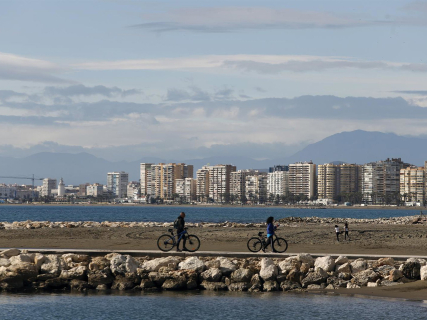
Outside of Granada, Málaga has been one of the provinces where the earthquake has been perceived more clearly. The tremor was felt in numerous municipalities, from the capital to towns on the Costa del Sol and Axarquía. Fuengirola, Torremolinos, Mijas, Estepona, Torrox, Algarrobo, Rincón de la Victoria and other points in the province registered the shake during the early morning.
The intensity with which it was felt in Málaga has a geographical and geological explanation. The epicenter was located in the Vega de Granada, one of the areas of greatest seismic activity in the Peninsula, and the movement occurred at a relatively shallow depth. The energy released could propagate a considerable distance and become perceptible in wide areas of southeastern Andalusia.
Cádiz presents a different situation. The province appears within the seismic context of the southern peninsula, but the first emergency data do not record alerts from Cádiz regarding the earthquake of this morning. The Junta has reported that alerts came from practically all of Andalusia with the exception of Cádiz and Huelva. Therefore, it cannot be stated that the earthquake had the same impact in the Cádiz province as it did in Málaga.
This does not mean that Cádiz is left out of the seismic map. In fact, the southwest of Málaga and the southeast of Cádiz have recorded an important series of earthquakes this year. The IGN counted 576 movements between February 3 and March 11 in the area between the Sierra de Grazalema and the coast of Estepona. Most were of a magnitude less than 3 and the largest reached 4.0.
Málaga and Cádiz were already under seismic surveillance this year
That sequence began in early February and affected an area that geologically connects the environment of the Serranía de Ronda with the southeast of Cádiz. The IGN recorded 105 earthquakes in the first days, with very variable depths, and some of them were felt by the population of nearby municipalities in Málaga and Cádiz.
The episode led the National Geographic Institute to reinforce the monitoring of the activity. The series does not mean that there is a direct connection between those movements and the earthquake recorded now in Alhendín. They are different seismic areas within a broader tectonic context, and scientific organizations have not established that the Granada earthquake is a consequence of that activity.
What they do share is the same geological scenario: the south of the Peninsula is crossed by numerous active fault systems.
There is not a single fault that explains all of the south
The image of a large crack running through Andalusia from Granada to Cádiz and Málaga would oversimplify reality. The Betic Cordillera presents a network of tectonic structures and faults that have formed due to the convergence between the African and Eurasian plates and that continue to accumulate and release tension.
The IGN explains that the seismicity of the Betic Cordilleras is largely controlled by active fault systems associated with the intramontane basins. In Granada, these systems affect the basin itself and the Vega, where numerous seismic sequences have occurred over the last decades.
The Vega of Granada already featured a significant seismic episode between 2020 and 2021. At that time, a swarm of thousands of earthquakes occurred in the vicinity of Atarfe and Santa Fe. The Geological and Mining Institute of Spain pointed out during that crisis that the faults of the Vega could remain in periods of high activity for weeks or months and warned that it was not possible to predict whether the subsequent movements would be greater or lesser than those recorded up to that point. (IGME)
The earthquake in Alhendín again places that area at the center of seismic monitoring. The IGN must now determine how the sequence evolves and whether the subsequent movements respond to the usual pattern of aftershocks.
Can another shake occur?
Yes, there can be aftershocks and movements have already been recorded following the main earthquake. During the following hours, several earthquakes of lesser magnitude were detected in municipalities around Granada, including Gójar, Ogíjares, Otura, and La Zubia. The Junta also reported a succession of aftershocks while maintaining monitoring alongside scientific organizations.
The existence of aftershocks after an earthquake does not allow for anticipating on its own that another of greater magnitude will occur. It is usual for the subsequent movements to be of lesser intensity and for their frequency to decrease, although seismology does not allow for precise predictions of when a specific aftershock will occur or what its magnitude will be.
That is why monitoring during the next few hours is especially important. Scientific teams analyze the location, depth, and magnitude of each new movement to determine whether the activity is subsiding or if it maintains a pattern different from what was expected.
In Granada, moreover, material damages require special caution in buildings that have suffered collapses, cracks, or damage to facades. The earthquake has caused falls of elements from roofs and facades, collapses, and other damages, and a building in Las Gabias was evacuated preventively.
The memory of Lisbon returns to Cádiz
The presence of Cádiz on the historical map of the great earthquakes of Andalusia inevitably leads to the Lisbon earthquake of 1755. But the Granada earthquake and that great seismic event do not originate from the same seismic structure.
The Lisbon earthquake of November 1, 1755 originated in the Atlantic, off the Portuguese coast, and reached an estimated magnitude of around 8.5. Its dimension was completely different from that of the movement recorded now in Granada. The Atlantic earthquake also generated a tsunami that reached the southwestern coasts of the Peninsula. The IGN keeps specific documentation on the effects that event produced in Spain.
Cádiz was one of the Spanish territories most affected by that episode. The seismic waves were felt with enormous intensity and, subsequently, the tsunami waves struck the Cádiz coastline. Studies on the effects of the 1755 tsunami particularly document its impact on the coast of Cádiz, including the area around Conil de la Frontera.
The comparison serves, therefore, to remind of the historical vulnerability of the southwestern peninsula to large Atlantic earthquakes, but not to establish a relationship between the movement of this Saturday and the one that occurred 271 years ago. There is no evidence that the Alhendín earthquake is a sign of a new Lisbon earthquake nor that both events are connected.
A seismic map that does not end in Granada
The earthquake this morning again puts the focus on a geological reality that affects a good part of the southern peninsula. Granada concentrates one of the areas of greatest seismic activity, while Málaga and the southeast of Cádiz have also recorded recent episodes that have forced the IGN to study their evolution.
For Málaga, the Alhendín earthquake represents a new perceptible episode after the activity recorded during the year in the Serranía de Ronda and its surroundings. For Cádiz, the Granada episode has not generated, according to the first official assessments, a comparable impact, but the province is part of a territory with documented seismic activity and with a memory especially marked by the earthquake and tsunami of 1755.
The immediate situation is now in Granada, where emergency services continue to assess damage and seismologists are following the sequence of subsequent movements. The scientific question is not whether Andalusia can register earthquakes again —its seismic activity is well documented— but how the sequence that began this morning will evolve and what information the upcoming aftershocks will provide about the structure that has released the accumulated tension.