Draws for today Friday, September 11: schedules of Bonoloto, Euromillones, Eurojackpot, and Cuponazo

This Friday, four major draws are held, with 111 million euros in Euromillions, 40 million in Eurojackpot, and up to 6 million in the Cuponazo of the ONCE.

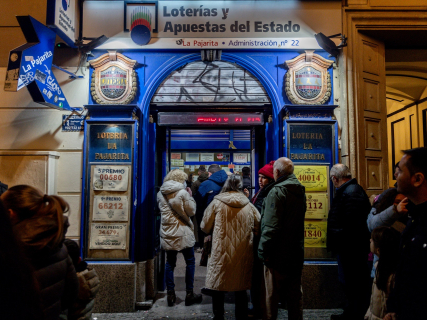
EuropaPress 7190192 gente comprando loteria sorteo extraordinario nino 29 diciembre 2029 madrid

EuropaPress 7190192 gente comprando loteria sorteo extraordinario nino 29 diciembre 2029 madrid

Add DEMÓCRATA to Google

Ask FREN

Published

Last updated

1 minute

Most read

This Friday, September 11, 2026, the Bonoloto, Euromillions, Eurojackpot, and the Cuponazo of the ONCE are celebrated. The four draws take place during the afternoon and evening, and the results will be known after each draw.

Euromillions has a jackpot of 111 million euros, and Eurojackpot reaches 40 million. The Cuponazo of the ONCE offers a prize of up to 6 million euros, while Bonoloto celebrates one of its daily draws.

These are the times for each draw, the main prizes, and when the official results can be consulted.

What draws are there today, Friday, September 11

  • Eurojackpot: 20:00 hours.
  • Euromillions: 20:30 hours.
  • Bonoloto: 21:00 hours.
  • Cuponazo of the ONCE: 21:25 hours.

What time is Eurojackpot today

Eurojackpot celebrates its draw this Friday at 20:00 hours. The expected jackpot for this day is 40 million euros. To opt for the first category prize, you must match five numbers and two stars. :contentReference[oaicite:1]{index=1}

What time is Euromillions today

Euromillions celebrates one of its two weekly draws at 20:30 hours. The jackpot this Friday amounts to 111 million euros. 

What time is Bonoloto today

Bonoloto celebrates its daily draw this Friday at 21:00 hours. The result will include the winning combination, the complementary number, and the refund.

What time is the Cuponazo ONCE today

The Cuponazo is celebrated this Friday at 21:25 hours. The first prize reaches 6 million euros for the five digits and the winning series.

When will the results be available

The results will be published after the celebration of each draw on the official channels of State Lotteries and Bets and JuegosONCE.

More key points, information and questions with FREN

AI-GENERATED CONTENT

What legal requirements must lottery draws like Bonoloto and Euromillions comply with in Spain?

State lotteries such as Bonoloto and Euromillions are heavily regulated in Spain. Their basic framework is found in the Law 13/2011, on the regulation of gambling (BOE), complemented by specific lottery regulations and the tax regulation of prizes (among others, Law 16/2012, which introduces a special tax on prizes from certain lotteries and bets).

Activity reservation and authorized operators

Law 13/2011 reserves statewide lotteries to operators designated by law. In practice, games like Bonoloto and Euromillions can only be operated by:

  • The State Society of Lotteries and State Bets (SELAE), for state-owned lotteries.
  • The National Organization of Spanish Blind People (ONCE), with a special regime for its games, according to the additional provisions of Law 13/2011 and its specific resolutions.

Other private entities cannot organize lotteries of this type: the activity is reserved and subject to strict public control to prevent fraud, money laundering, and harmful effects on consumers.

Authorization and regulation of games

The law requires a licensing title (licenses and authorizations) to operate any state-level game. Specifically for lotteries:

  • It corresponds to the holder of the then Ministry of Economy and Finance (now through the state authority competent in gambling matters) to authorize the marketing of state lotteries.
  • This authorization sets, among other aspects:
    • The minimum and maximum percentage of revenue allocated to prizes.
    • The conditions and requirements for holding the draws and their number.
    • The rights of participants and complaint procedures.
    • The conditions for advertising and sponsorship.
    • The measures to protect minors and vulnerable persons and to prevent fraud and money laundering.
  • Law 13/2011 empowers the ministry to issue the basic regulation of each game. For Euromillions, for example, the rules approved by the Resolution of February 6, 2004, and consolidated and modified, among others, by the Resolution of January 21, 2009, of Lotteries and State Bets (BOE) apply.
Requirements for operators and public control

Operators running games must demonstrate technical, economic, and financial solvency. Law 13/2011 regulates:

  • The need for licensing titles to organize, operate, and advertise games.
  • A system of activity control, with technical requirements for gaming systems, records, and traceability of operations.
  • The creation of a General Register of Gambling Access Prohibitions, to prevent those prohibited or self-excluded from playing.
  • The obligation to cooperate with the State in the fight against illegal gambling, fraud, and crime, and in the prevention of money laundering and terrorist financing, in relation to Law 10/2010.
  • The preparation by operators of responsible gaming measures plans, specifying additional commitments to protect and repair negative effects of gambling.
Protection of consumers and minors

The law expressly prohibits the participation of minors and certain persons linked to operators in the games they manage. It also imposes:

  • Requirements to prevent access by minors and incapacitated persons to games, especially by electronic means.
  • Objective prohibitions: games that attack dignity, children's rights, or are based on criminal conduct cannot be authorized.
  • Obligation that the offer and advertising comply with social responsibility criteria and do not trivialize gambling risks or present it as an economic solution.
Advertising and commercial communications

Gambling regulations, in connection with the General Advertising Law and the Information Society Services Law, establish that:

  • Advertising of games of chance and operators without a licensing title and specific authorization to advertise is prohibited.
  • Licensing titles set the limits and conditions of advertising (media, supports, content, electronic communications, sponsorship, etc.).
  • Specific content prohibitions in commercial communications are detailed (e.g., messages associating gambling with social success, downplaying effort versus luck, targeting minors, including certain sexual content, etc.).
  • Media, agencies, and platforms that disseminate gambling advertising must verify that the operator has the corresponding licensing title.
Basic taxation of prizes

Prizes from lotteries like Bonoloto and Euromillions are subject, in addition to general taxation, to a special tax on prizes from certain lotteries and bets, introduced by Law 16/2012, which modifies the regulations of the Personal Income Tax and Non-Resident Income Tax. This tax is managed through withholding at the time of collection, with specific declaration models (Order HAP/70/2013 and subsequent development rules), and applies to prizes above the thresholds and rates set by current tax legislation.

What are the competencies of ONCE in organizing draws and what regulations govern its activities?

ONCE is one of the two operators of state-level lotteries and acts as a public law corporation of a social nature. Its competencies in organizing draws (coupon, active game, instant lottery, etc.) are defined by a set of rules that combine the state reservation of lotteries, specific ONCE regulations, and administrative control exercised by the State.

1. Basic regulatory framework governing ONCE

The key rules are, in summary, the following:

  • Royal Decree 358/1991, of March 15, which reorganizes ONCE (text in BOE). It configures ONCE as a public law corporation of a social nature, with its own legal personality, full capacity to act and self-organization, subject to the State protectorate. It regulates its social purposes, financing through authorized games, and especially creates and defines the Protectorate Council, which exercises public control, especially in gambling matters. It has been amended by several royal decrees (RD 1200/1999, RD 1359/2005, RD 1146/2012, RD 3/2013, RD 1152/2015, and RD 369/2021).
  • Royal Decree 1336/2005, of November 11, authorizing ONCE to operate an instant or pre-drawn lottery (BOE). It grants ONCE the direction, organization, and operation of the instant lottery, setting price limits, prize percentages, and annual issuance and sales caps, as well as the Protectorate Council's control over this modality.
  • Law 13/2011, of May 27, on the regulation of gambling (BOE), amended by Law 23/2022, of November 2. It declares that state lotteries are reserved to operators designated by law and, in its first additional provision, reserves this activity to the State Society of Lotteries and State Bets (SELAE) and ONCE. The second additional provision recognizes ONCE's special regime: regarding the lotteries it operates, it continues to be governed by the twentieth additional provision of Law 46/1985, the General Government–ONCE Agreement, and RD 358/1991, under strict public control.
  • Law 5/2011, of March 29, on Social Economy. Its third additional provision declares ONCE as a singular social economy organization, reinforcing its social character and the linking of gaming income to general interest purposes.
  • Law 46/1985, of December 27, on the General State Budgets for 1986, twentieth additional provision. It establishes the legal basis for the reservation of lotteries and gaming authorizations in favor of ONCE, later developed by Law 13/2011.
  • Order SCB/1240/2019, of December 18, publishing the consolidated text of ONCE's Statutes (BOE). The Statutes detail its nature, purposes, and internal structure, and reiterate that it is a public gaming operator of recognized prestige, holder of several reserved lottery modalities, whose operation finances its social purposes under intense public control.
  • Specific regulations of its lottery products, approved and published by State resolutions, such as:
    • Resolution of April 4, 2023, on the new Regulation of the “ONCE Coupon” (BOE-A-2023-9031).
    • Resolution of April 4, 2023, on the new Regulation of “ONCE Active Game” (BOE-A-2023-9032).
    These regulations specify draw conditions, prize structure, marketing, etc.
  • Royal Decree 369/2021 and Royal Decree 1127/2021 amend RD 358/1991 and RD 1336/2005 to adapt the powers of the Protectorate Council and update ONCE's lottery conditions, in line with the 2022–2031 General Agreement.
2. ONCE's own competencies in organizing draws

Based on these rules, ONCE has, in summary, the following competencies:

  • Direction, organization, and operation of the lottery modalities it has reserved (coupon, active game, instant lottery, and other approved products), throughout the national territory.
  • Design of products and draw programs: game characteristics, prize structure, draw frequency, series and issues, always within set limits (minimum and maximum percentage allocated to prizes, issuance and sales caps, etc.).
  • Price determination of tickets or shares, respecting caps such as the maximum price linked to the coupon, according to RD 1336/2005 and its amendments.
  • Commercial management and sales channels, including staff sellers and, with caution, electronic or telematic channels, ensuring that digitalization does not lead to job loss among its sales agents.
  • Internal self-government to approve its Statutes and gaming regulations, which are developed within ONCE's General Council.
  • Application of net income to its social purposes: personal autonomy, inclusion, employment, and services for blind or severely visually impaired persons, as well as its solidarity commitment with other disabilities through Fundación ONCE and the ONCE Social Group.
3. Functions of the State Administration and public control

At the same time, the General State Administration retains several essential functions:

  • Protectorate over ONCE, exercised by the Ministry competent in social rights through the Protectorate Council (regulated in art. 8 of RD 358/1991). This body:
    • Approves ONCE's Statutes and their amendments and orders their publication in the BOE.
    • Verifies that gaming regulations and their changes comply with the law, the General Agreement, and authorizations.
    • Controls the management of different lottery modalities (including instant), being able to request all necessary economic and gaming information: volume of issues, revenue, prizes paid and expired, income destination, etc.
  • Reservation and authorization of lotteries: the State decides which lottery modalities ONCE can operate, under what conditions, and sets issuance limits, prize percentages, and other economic variables, using Law 13/2011, RD 1336/2005, successive reforms, and the 2022–2031 Government–ONCE General Agreement as instruments.
  • Supervision of responsible gaming policy and advertising: ONCE's activity must adapt to the general regime of gambling commercial communications, which the legal system assigns to the gambling regulatory authority, with the particularity that, for ONCE's lottery modalities, many of these competencies are exercised through the Protectorate Council.
  • Control of the social destination of income: it is required that net lottery resources be allocated to the social purposes defined in RD 358/1991 and its Statutes, and serious and repeated non-compliance with these obligations may lead to review or withdrawal of authorizations.
  • Tax and Social Security regime related to ONCE, including the treatment of its contracts with persons with disabilities, regulated, for example, in Royal Decree-Law 18/2011, of November 18.

Overall, ONCE enjoys broad autonomy to design and operate its draws, but always within a framework of state reservation and strong administrative oversight: the State defines the general rules of the game, authorizes the modalities, sets limits, and controls both the protection of players and the social destination of profits.

What differences exist between Euromillions and Eurojackpot draws compared to other European countries?

Euromillions and Eurojackpot are pan-European lotteries with common basic rules in all participating countries, but each State introduces its own nuances in price, associated games, regulation, and especially taxation. Based on the sources consulted, several relevant differences between Spain and other European countries can be highlighted.

Euromillions: common rules and national particularities

According to various Euromillions result reports in Spain (for example, those from the newspaper Demócrata, such as the draw on July 31, 2026, available at this link), the game is organized in a coordinated manner among national operators:

  • Spain: Lotteries and State Bets.
  • France: Française des Jeux.
  • United Kingdom: The National Lottery.
  • Portugal: Jogos Santa Casa.
  • Belgium and Luxembourg: Loterie Nationale.
  • Ireland: The National Lottery.
  • Austria: Österreichische Lotterien.
  • Switzerland: Swisslos.

The game mechanism (5 numbers + 2 stars), the basic prize category structure, and the holding of two weekly draws (Tuesday and Friday) are common to all these countries.

However, there are differences in:

  • Bet price: Demócrata reports indicate a standard cost of about €2.50 in most eurozone countries and 3.50 Swiss francs in Switzerland. In the UK, it is sold in pounds. This price is a national decision within the common game framework.
  • Associated games: in Spain, Euromillions bets automatically participate in the additional game El Millón, which awards €1 million to a code among tickets validated in the country (described, for example, in this article). This complementary game is specific to the Spanish market and does not exist as such in other States.
  • Operator and public oversight: in Spain, Euromillions is managed by the public company SELAE under state supervision; in France, operation is carried out by FDJ, whose exclusive license has been validated by the European Commission for State aid purposes (Commission press release).

Eurojackpot: ONCE's role in Spain and European coordination

Eurojackpot is another multinational game, with draws also on Tuesdays and Fridays and centralized extraction in Helsinki by the Finnish state operator Veikkaus OY, according to BOE resolutions approving ONCE's calendars (for example, that of July 16, 2024, BOE-A-2024-15421).

Recent journalistic information from Demócrata on Eurojackpot results (for example, report of August 11, 2026) describes:

  • Common mechanics in Europe: 5 numbers from 1 to 50 and 2 “suns” from 1 to 12.
  • Bet price in Spain: €2 per simple combination.
  • Minimum jackpot of 10 million and cap up to 120 million euros, with accumulation if there are no first-category winners.
  • 12 prize categories shared by all participating countries.

The main Spanish difference compared to other States is not in the game design, which is common, but in the operator and internal regulation:

  • In Spain, Eurojackpot is marketed through ONCE as a “product marketed with other operators authorized to operate in third countries,” with its calendar and characteristics approved by the State Secretariat for Social Rights and published in the BOE.
  • In other participating States (e.g., Germany, Italy, Netherlands, Nordic countries), the game is offered through their respective monopolies or national lottery operators, under their own regulatory authorities. Decisions on number of draws, in-person/virtual format, or schedules are made country by country, always within the consortium's common agreements.

Prize taxation: Spain versus other countries

For Spain, taxation is well defined in official and informative documents. A Demócrata report on lottery taxes by autonomous communities (tax analysis) and the Treasury notes on the 2023 Income campaign (official presentation) summarize the applicable regime to Euromillions, Eurojackpot, and other authorized draws as follows:

  • The first €40,000 of any prize are exempt from the special tax.
  • A 20% withholding applies on the portion of the prize exceeding that amount.
  • This regime is identical in all autonomous communities and applies to prizes from SELAE, ONCE, Red Cross, and regional lotteries included in the regulation.
  • The prize is not taxed again as such in the Personal Income Tax, but the income it generates (interest, rents, capital gains, etc.) is taxed.

In other European countries, lottery taxation is governed by their own national laws. The consulted documentation indicates that:

  • The European Commission mainly controls that public monopolies and special tax regimes do not constitute incompatible State aid (case of FDJ in France or German public casinos), but does not impose a single prize taxation model.
  • Each State decides whether to tax prizes and under what conditions; the analyzed sources do not detail specific thresholds for other countries participating in Euromillions or Eurojackpot.

Summary of differences

In summary, the game rules (how numbers are chosen, draw frequency, prize categories, and minimum/maximum jackpots) are practically identical in all countries participating in Euromillions and Eurojackpot. The real differences between Spain and other European States focus on:

  • The national operator (SELAE versus FDJ, The National Lottery, Veikkaus OY, etc.).
  • The associated games unique to each country (such as El Millón in Spain for Euromillions).
  • The local bet price (€2.50 in most euro countries for Euromillions, €2 for Eurojackpot in Spain, other currencies where applicable).
  • The taxation of prizes, where Spain applies a clear scheme of €40,000 exempt and 20% on the remainder, while other countries adjust their own models within the general EU law framework.

Play

Test your knowledge with FREN!

How much do you know about this topic? Answer the following 3 questions.

What is the expected jackpot for the Euromillions draw this Friday?

Question 1 of 3

At what time is the ONCE Cuponazo draw held this Friday?

Question 2 of 3

Where will the official results of this Friday's draws be published?

Question 3 of 3