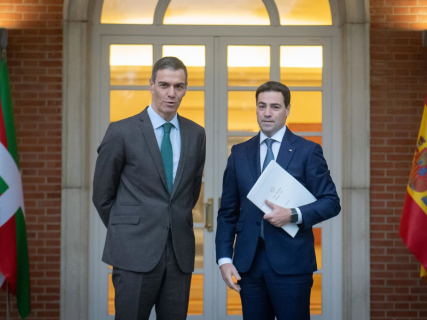

The Basque and central Executives continue to refine a definitive document to formalize the co-management of Euskadi's airports, on the eve of the Bilateral Cooperation Commission to be held this Friday in Madrid, chaired by Pedro Sánchez and the Lehendakari, Imanol Pradales.
In the meeting they held on January 27, it was agreed that at the next Bilateral Commission, scheduled for the end of March, the transfer of new state-owned competencies, including that related to Airports, would be discussed, among other matters.
Since then, the two governments have tried to close a formula for airport co-management. After an initial offer from the central Executive that did not satisfy the Basque Government, whose aspiration is to have "a voice" and "decision-making capacity," the Minister of Governance, Digital Administration and Self-Government, Maria Ubarretxena, announced on the 16th that a preliminary agreement had been reached, still pending drafting in a final text for its eventual ratification in the Bilateral Commission.
Throughout this week, that document has continued to be refined and, according to sources familiar with the dialogue, have indicated to Europa Press, conversations are continuing until the last moment, one day before the meeting that Imanol Pradales and Pedro Sánchez will lead, with the aim of finalizing it.
Impact of the war, migration, and medical strike
In addition to the airport issue, other key issues for Euskadi will be examined at this third session of the bilateral forum, such as the repercussions of the war in Iran on the business fabric and Basque citizens, the migration situation and the insistent request for Euskadi to be recognized as the "Northern border," as well as the impact of the doctors' strike demanding its own framework statute.
In this context, the Lehendakari sent a letter to the President of the Spanish Government this month proposing ten measures to mitigate the effect of the war in the Middle East on Basque companies and families, a decálogo that will also be reviewed at the meeting.
Imanol Pradales will also convey to Pedro Sánchez the concern about the medical strikes, in response to which the Basque Government considers that the Minister of Health, Mónica García, is not offering an adequate response. The strikes are reflected in the increase in waiting lists in Osakidetza.
Another point on the agenda will be immigration policy and the demand for Euskadi to be declared the "Northern Border". In the January meeting, Pradales already asked Sánchez to facilitate cooperation between the Ertzaintza and the State Security Forces and Corps on matters of immigration, in order to participate in the expulsion procedures of convicted offenders.
In the area of security, the Lehendakari will also demand more forceful measures against repeat offending and will request a tightening of the arms carrying regulations, a competence of the central government, to ban the use of bladed weapons in nightlife areas, public transport and their access points, as well as in public or festive spaces with large concentrations of people.
Pradales will also take advantage of the Bilateral Commission to reiterate the Basque Executive's request to restructure the debt of Tubos Reunidos, in order to attract partners that ensure the company's continuity. The Government of Euskadi has put forward an "extraordinary" formula that would allow "opening a legal avenue" for the state company SEPI to undertake this restructuring.
Third meeting of the Sánchez-Pradales Bilateral Commission
Friday's meeting will be the third Bilateral Commission chaired by Sánchez and Pradales. It was initially scheduled to be held at the end of December, after several matters were concluded in the Mixed Transfer Commission, but a series of disagreements before the conclusion of that work forced its postponement to January 16.
On that day, the Minister of Territorial Policy and Democratic Memory, Ángel Víctor Torres, and the Basque Minister of Governance, Digital Administration and Self-government, Maria Ubarretxena, led the Mixed Transfer Commission, in which five transfers were finalized in areas such as Maritime Rescue, Occupational Safety and Health, Unemployment Benefits, Family Benefits, and School Insurance.
Subsequently, on January 27, Pedro Sánchez and Imanol Pradales met again and announced that before Easter the Bilateral Commission would be convened to transfer new matters to Euskadi, including airports. They also committed to addressing Euskadi's own capabilities in immigration policy and the aspiration for it to be declared a "Northern Border" in the short term.
Since Pradales' arrival at the Lehendakaritza, a little over a year and a half ago, Euskadi has received 10 new transfers and 45 agreements have been closed in the fiscal and financial field.