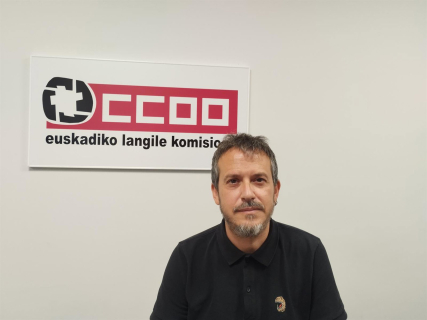

The general secretary of CCOO Euskadi, Santi Martínez, has emphasized that his union supports the Basque language, but rejects the "disproportionate demand for linguistic profiles," and has blamed ELA for "muddying the linguistic policy" and for placing CCOO "as the enemy to be defeated." In his opinion, with the reform of the Public Employment Law, PNV and EH Bildu are not valuing Lehendakari Agirre, but rather Sabino Arana and a "identity supremacism" linked to the Basque language.
In an interview with Europa Press, Martínez has denounced that unions like ELA are generating a "kind of post-truth around the Basque language" and shifting the debate "to the emotional and identity," which, he said, leads to "reactionary and worrying" discourses towards organizations like CCOO. He has emphasized that the union has stated "actively and passively" that it does not oppose either the Basque language or its promotion, but will not give up defending those who believe their labor rights have been violated by that "disproportionate demand for linguistic profiles."
Martínez has insisted that CCOO will maintain that role and that "other union organizations will have to explain why they are organizing protests against rulings that save jobs." Regarding ELA's proposal to negotiate agreements in Basque, he has defended that it should be addressed "normally," since there are precedents and translation services. In his view, ELA "has wanted to seek a headline for something that can be worked on and treated normally in the field of CRL and that we will work on in that field to assume it normally."
The leader of CCOO has described ELA as "an echo chamber to muddy the ground of linguistic policy and permanently position CCOO as the enemy to be defeated," and has warned that this claim could cause "a delay in certain important negotiations." In this context, he has suggested that "we will have to ask the working people what they think about ELA putting the homeland above salary or the homeland above the material conditions of the people again."
Criticism of PNV and EH Bildu for the Public Employment Law
Beyond the union conflict, Martínez has placed the debate in a political framework in which, according to what he has said, PNV and EH Bildu play "a leading role that is concerning" by promoting a modification of the Public Employment Law that "destroys the mandatory compliance indices, which were the ones that served to anchor the requirement of profiles to the sociolinguistic reality of the country." He has recalled that those indices not only adjusted the linguistic demand to the social reality but also supported "a consensus of more than 40 years" that, in his opinion, both formations "have destroyed."
In this line, he has reproached that those who claim to advocate for Lehendakari Agirre "are fundamentally advocating for Sabino Arana and this kind of reactionary identity supremacism around Euskera and anything that falls outside the margins." He has explained that CCOO is positioned "outside those margins" because it has maintained a "different and critical position, not regarding Euskera, but towards the administrations that have systematically ignored a Basque law that established those mandatory compliance indices."
As he has detailed, the reform of the law allows "each administration to decide how many positions to profile and what profile to set," something he considers "concerning." He has demanded, in line with the message of Lehendakari, Imanol Pradales, a collective reflection on the model of country that is being built "with these attitudes of some organizations" that "point them out" and that, in his view, "are blind to the country of the future," recalling that in 2045 between 20% and 25% of the working population of Euskadi will be of migrant origin.
The leader of CCOO has warned that this "blindness" could lead to a future Euskadi "where there is employment for privileged individuals who have had the opportunity to know and certify knowledge of Euskera and less privileged employment for the rest." He has emphasized that "we are not in that scheme, we are in a scheme where linguistic and labor rights coexist," and has placed the shift in linguistic policy in the figure of Markel Olano, "who is the one directing the linguistic policy of the PNV, decided that it was time to accelerate."
Martínez has claimed that the great speeches should be accompanied by "a coherent practical application" and has considered that the narrative of the Lehendakari is "very good but in the practical application there is a distortion that they should clarify." He has emphasized that this is a public employment law backed only by the nationalist sphere "and that is neither building consensus nor coexistence."
He has warned that if the "absolute discretion" of the administrations when defining public positions translates into 100% of public jobs being reserved "for the 20% of the population that is able to prove an adequate profile to access those positions," that situation "if it is not a national priority, resembles it a lot."
Transfers and pension system
Regarding the negotiation of the pending transfers, Martínez has recalled that the Statute of Gernika is an organic law that "must be complied with." However, he has admitted his concern about how the transfers of Fogasa and the economic regime of Social Security materialize, as they are areas with "an important socio-labor component" that affect workers "in vulnerable circumstances."
For this reason, he has demanded that these competencies be addressed "with transparency and providing many certainties." He has emphasized that "I do not think these are transfers that can be made in any way due to the importance of these matters as they are matters that occur in moments of vulnerability for working people," and has defended that they must be executed "with a minimum of certainty generation for the workers."
He has pointed out that "what concerns us fundamentally is not so much the transfer itself, which an agreement can be reached that protects people and protects the common fund of social security, but that a narrative is going to be established by the PNV that first defends a better management of this competence in Euskadi and that overlooks that Basque workers receive a pension thanks to the contributions of Spanish workers."
After warning that a future pension system of its own in Euskadi would be "deficit," he has pointed out that the PNV "would have to explain how it is going to complement a deficit system only with contributions from Basque workers." He has insisted that "what concerns us fundamentally is that discourse about a future Basque pension system that is neither real nor feasible."
Political scenario and risks for coexistence
Regarding the upcoming electoral cycle, Martínez has stated that it would not be "good news for generating spaces of coexistence" that the plurality of Euskadi was not reflected in the municipal and regional elections and that there was "a feedback of the most nationalist spaces of the country." He has warned that "I believe that the situation, especially in Spain with a possible rise of the right and the far right, can bring here effects of increases in nationalist sentiment."
Finally, he has said he hopes for "generosity and maturity" in "the left to the left of the PSOE," considering that the possibility of a right and far-right government is at stake "that could target trade union organizations, labor rights, and feminism."