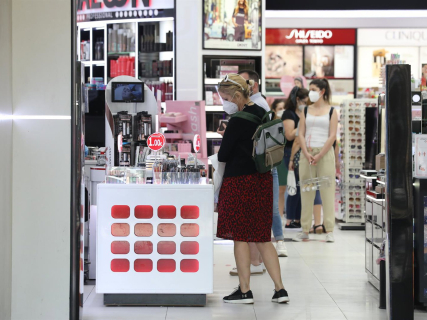

The Spanish cosmetics and perfume industry closed 2025 with a turnover of 11.8 billion euros, a historic high that implies an advance of 5.8% compared to 2024, according to the "Radiography of the sector in Spain 2025" prepared by the National Association of Perfumery and Cosmetics (Stanpa).
This business has grown in the last year at a rate higher than GDP and ahead of other key branches of domestic consumption, such as fashion or restaurants, consolidating itself as one of the most dynamic sectors of the economy.
In the last five years, the sector has chained together increases until accumulating a rise of 44.3%, which has allowed its weight in the Gross Domestic Product to be raised from 0.9% to 1.03%, reinforcing its role as a strategic activity.
The CEO of Stanpa, Val Díez, has warned about the impact of imitations and counterfeits, as well as certain products known as "dupes", which take advantage of the notoriety of established brands and generate confusion among consumers.
"We are very concerned, we must denounce that counterfeits are a scourge, that they put health at risk. 'What they call 'dupes' that they say is 'cool' is a pure and simple imitation and does not have the development, besides being an exploitation of the brand. A society that is tolerant of copies is a worse society', he has reiterated, while demanding 'adequate regulation so that products can continue to innovate without so many burdens'.
Exports exceed 10 billion and reinforce leadership
The Spanish cosmetics, perfume, and essential oils sector once again boosted its foreign sales in 2025, exceeding the 10,000 million euro barrier for the first time in an international environment marked by geopolitical instability.
Specifically, exports climbed to a maximum of 10,124 million euros, 5.58% more, consolidating Spain as the second largest exporter of perfumes worldwide and the fourth most important market within the European Union. Imports, for their part, rebounded by 8.19%, to 6,275 million euros.
By product lines, foreign sales of perfumes and cosmetics increased by 5.24%, while those of essential oils did so by 9.85%. Hair care items stood out, with a rebound of 11.38%, followed by those for skin care (10.26%), color cosmetics (5.31%), perfume (3.58%), and personal care (2.14%). Perfume continues as the star category, concentrating 51% of exports, with more than 4.7 billion euros.
Díez has underlined that the geopolitical scenario is "very complex" and is already noticeable in the sector's external activity. The tariffs promoted by Donald Trump have meant a loss of 100 million euros, with a decrease of 13% in exports to the USA, down to 750 million euros. He has also pointed to the conflict in the Middle East as a focus of "great concern", given that the area accounts for purchases of 480 million euros and constitutes a key destination, especially for perfume.
As a consequence, the industry begins to suffer direct effects on its international operations: higher logistics costs, longer transport times, complications in risk coverage and changes in orders. At the same time, the sector works to take advantage of the opportunities that the EU-Mercosur agreement may open.
The CEO of ICEX, Elisa Carbonell, has recalled that Spanish companies face a "complex and difficult context". "This situation makes us suffer a lot, but this industry has the elements to continue being an exporting power and it is a pride to have companies from this sector that do wonders for the world," she has pointed out.
The sector also strengthens its position as an employment generator, with more than 50,200 direct jobs and more than 300,000 indirect jobs in Spain. Its labor footprint extends throughout all the Autonomous Communities thanks to the presence of SMEs, which represent 84% of the business fabric, and its weight in total employment has gone from 1.2% to 1.44%.
Online channel falls while mass consumption and selective perfumery soar
The study shows that the mass consumption channel (supermarkets, hypermarkets, and department stores) grew by 6.2%, driven by the pull of sun protection products, which advanced by 11.8%, and by the good performance of hair care (8.1%), perfume (8.3%), personal care (4.4%), and color cosmetics (2.3%).
The selective or specialized channel was the one that pushed the business the most, with an increase of 8.9%, thanks to the strong growth of selective perfumes. Women's advanced by 10.8% and men's by 12.6%. The pharmacy, as a point of sale for cosmetics, moderated its evolution in 2025, with a rise of 3.8%.
In contrast, the "online" channel closed 2025 with a decrease of 4.7%, with a similar trajectory both in the "online pure player", which fell by 3.2%, and in "online" commerce with a physical store, which plunged by 6.1%. Internet sales in the sector stand at 895 million euros, generated by 9.2 million buyers, which keeps this channel at around 8% of total consumption.
The professional hairdressing showed a somewhat more dynamic behavior than the market as a whole, with a rebound of 6.1%. Within this activity, hair treatment stood out, which soared by 18%, compared to the practical stability of professional color, which barely grew by 1%.