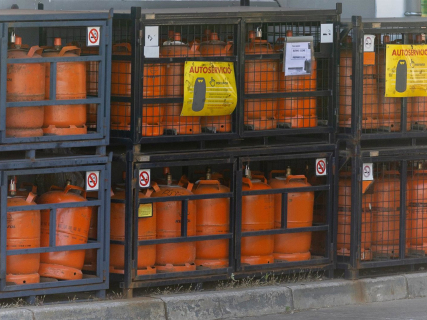

The price of the butane cylinder faces a new increase in September. The Organization of Consumers and Users (OCU) expects that the next bimonthly review will apply the maximum allowed increase, 5%, after the regulated price already rose practically that percentage in July.
The traditional cylinder of 12.5 kilos currently costs 17.83 euros, a price in effect since July 21. If the increase finally reaches the 5% anticipated by OCU, its price would be around 18.72 euros, although we will have to wait for the official resolution from the Ministry for Ecological Transition to know the final figure.
The next update must come into effect on Tuesday, September 15, as the regulations establish reviews every two months that take effect from the third Tuesday of the corresponding month.
OCU practically considers another 5% increase a done deal
The organization's forecast is particularly forceful. OCU maintains that in September there will again be a 5% increase, the maximum allowed in a single review, even if the international tension that has pressured energy markets were to relax immediately.
The explanation lies in the so-called deficit or tariff mismatch accumulated in previous reviews.
The regulated system prevents the price of the cylinder from rising or falling sharply from one update to another. When the formula determines that it should increase more than the allowed limit, the part that cannot be immediately passed on to the consumer remains pending for future reviews.
Specifically, the resolution of July left a positive mismatch of 29.1263 cents per kilo for the next update, which continues to exert upward pressure on the price.
From 17.83 to around 18.72 euros
The last review came into effect on July 21, 2026. At that time, the traditional cylinder increased to 17.83 euros, about 84 cents more and a 4.94%, practically the maximum authorized.
The increase also coincided with the disappearance of some of the fiscal measures that had temporarily reduced energy costs.
If in September a 5% increase were to be applied again, the calculation based on the current 17.83 euros would place the cylinder around 18.72 euros, again close to the barrier of 19 euros.
However, 18.72 euros is an estimate, not the official price. The final amount will depend on the parameters used by the Ministry and must be published in the Official State Bulletin.
Not all butane cylinders have a regulated price
This is one of the points that generates the most confusion among consumers.
The state regulation does not set the price of any gas bottle that can be found at a service station. It generally applies to commercial butane sold in containers with a load equal to or greater than 8 kilos and less than 20 kilos and whose tare —the weight of the empty bottle— is greater than 9 kilos.
The most well-known example is the traditional orange cylinder of 12.5 kilos, which is precisely the one used as a reference when the new price of butane is announced every two months.
OCU estimates that this format continues to be the majority: around 53 million of the 68 million cylinders consumed in Spain correspond to the traditional definition of 12.5 kilos of load and more than 9 kilos of weight when empty.
Light cylinders can have free pricing
The fundamental difference is not only in the kilos of gas they contain but also in the weight of the container itself.
The BOE establishes that, as a general rule, cylinders whose tare is equal to or less than 9 kilos are excluded from the maximum price. This is precisely where many of the so-called light cylinders marketed by different companies fit.
These bottles can be more manageable because they weigh less when empty, but their price is liberalized. The company can set it commercially and, therefore, it does not have to match the current 17.83 euros of the traditional cylinder nor the new price that will be established in September.
That is why two cylinders containing a similar amount of gas can have different prices.
Which cylinders fall under the maximum price
The regulation establishes three basic requirements to enter, generally, into the regulated system: that it is commercial butane, that the container contains between 8 kilos —included— and less than 20 kilos of product, and that the tare of the bottle is greater than 9 kilos.
There is an exception for certain operators required to provide home supply who do not have containers with a tare greater than those 9 kilos in their territory.
For the consumer, the simplest reference remains the classic cylinder: 12.5 kilos of butane and a traditional heavy container.
The packaged propane does not have this same regulated price
Another common mistake is to think that the review published for butane also automatically affects propane cylinders.
It is not so.
The resolution of the Ministry expressly states that commercial packaged propane is outside this maximum price system.
Therefore, an announced increase for the traditional butane cylinder does not necessarily mean that a propane bottle will increase in the same proportion or will have the same final price.
Also excluded are the containers of gas mixtures intended to be used as fuel.
Why the price changes every two months
The regulated price is not set arbitrarily. The formula takes into account different international and national variables.
Among them are the quotation of raw materials, the cost of freight, the exchange rate between the euro and the dollar, marketing costs, and the contribution to the National Energy Efficiency Fund.
The July review showed, for example, a sharp drop in the international quotation compared to the previous two-month period, but a significant increase in freight costs. This was compounded by the accumulated imbalance from previous reviews, which ultimately tilted the update upwards.
This mechanism tries to avoid abrupt changes, but it has a consequence: an increase that cannot be fully transferred today may reappear in the next review.
The 5% limit softens increases, but does not eliminate them
The bimonthly variation of the maximum price is limited. That is, although the formula indicates that the cylinder should become much more expensive, the increase applied in a review cannot exceed 5%.
This protects the consumer from a sudden jump, although it does not mean that the difference disappears.
The pending amount can be incorporated later through the imbalance mechanism. Hence, OCU considers it very difficult for the price to drop in September despite the evolution of some international costs.
The organization already warned in July that the accumulated deficit would continue pushing the price upwards during the following reviews.
The price may be different in the Canary Islands, Ceuta, and Melilla
The state price does not have to be identical throughout the territory.
The regulations allow the Canary Islands, Ceuta, and Melilla to introduce certain variations in marketing costs to take into account their territorial particularities.
In the Canary Islands, for example, the regional government set a maximum price of 17.95 euros for the regulated domestic cylinder, taking into account its tax regime and the specific marketing costs.
That is why, when the usual price of the 12.5-kilo cylinder is announced, it is advisable to also check if there are particularities in these territories.
How to know if a cylinder has a regulated price
For a consumer who is unsure between several formats, the fundamental thing is to check what gas is purchased, how much load the bottle contains, and what the tare of the container is.
The traditional 12.5-kilo cylinder with more than 9 kilos of tare is regulated. Many lightweight bottles, although they have a similar capacity, have free pricing and can cost more or less depending on the company and the point of sale.
The price of the content should not be confused with possible services or products that are outside the regulated system.
On Tuesday, the new price will be known
The next key date will be September 15. Starting from that third Tuesday of the month, the new bimonthly review of the maximum price must be applied.
Until then, the general reference for the traditional cylinder remains 17.83 euros. OCU anticipates that the government will again apply practically all the available margin and that the price will increase by around 5%.
If that forecast is fulfilled, the classic cylinder will approach 18.72 euros. But the change will only affect the containers that are within the regulated system. Lightweight cylinders with liberalized pricing and propane bottles will follow their own rates, an important difference before comparing prices at service stations or requesting home delivery.