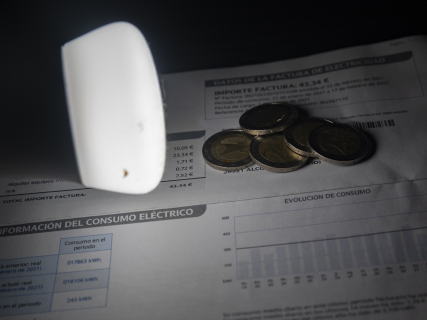
Price of electricity today, October 14: the most expensive hour will be from 20:00 to 21:00 and the cheapest from 14:00 to 15:00

The price of electricity will drop to 0.052 €/kWh in the afternoon and will reach 0.4171 €/kWh in the most expensive range of the night.

EuropaPress 4165629 lampara refleja importe factura dia precio luz marcado minimo primera vez

EuropaPress 4165629 lampara refleja importe factura dia precio luz marcado minimo primera vez

Add DEMÓCRATA to Google

Ask FREN

Published

Last updated

2 minutes

Most read

Elecciones 29N · Encuestas

La media de las encuestas

Media a 19 de noviembre de 2026 · 17 institutos

  • PP31,3 %
  • PSOE27,5 %
  • Vox19,0 %
  • Frente Amplio6,2 %
  • ERC2,5 %
01020304050ene 2024jul 2024ene 2025jul 2025ene 2026jul 2026

Media del último estudio de cada instituto en 30 días y su evolución semanal desde el 23J. Partidos con al menos un 2 %.

Todas las encuestas

Elecciones generales del 29 de noviembre · Demócrata

The price of electricity today, Wednesday, October 14, 2026, will have its cheapest hour between 14:00 and 15:00 hours, with a cost of 0.052 €/kWh. The most expensive hour will be between 20:00 and 21:00 hours, when the price will reach 0.4171 €/kWh.

The day will start with prices close to 0.18 €/kWh and will experience a rise during the morning. The cost will reach 0.3486 €/kWh between 08:00 and 09:00, before decreasing during the central hours of the day and reaching its minimum values in the afternoon.

What is the cheapest hour of electricity today?

The cheapest hour will be from 14:00 to 15:00, with a price of 0.052 €/kWh.

The following time slots will also maintain reduced prices. Between 15:00 and 16:00 the cost will be 0.0526 €/kWh and between 16:00 and 17:00 it will be 0.0882 €/kWh.

What is the most expensive hour?

The daily maximum will be recorded between 20:00 and 21:00 hours, with 0.4171 €/kWh.

The rise will begin from 18:00 hours, when the price will be 0.3437 €/kWh. Between 19:00 and 20:00 it will reach 0.4056 €/kWh and will hit the maximum in the next time slot. Between 21:00 and 22:00 the cost will remain high, at 0.3665 €/kWh.

The average price of electricity this Wednesday

The average of the 24 hourly prices of the day is approximately 0.2248 €/kWh.

The difference between the minimum and maximum price will be 0.3651 €/kWh. The central hours of the afternoon will concentrate the lowest costs, while the highest prices will be recorded during the morning and, especially, at night.

Hour Price
00-01h 0.186 €/kWh
01-02h 0.1799 €/kWh
02-03h 0.1761 €/kWh
03-04h 0.1767 €/kWh
04-05h 0.1873 €/kWh
05-06h 0.1928 €/kWh
06-07h 0.2059 €/kWh
07-08h 0.2825 €/kWh
08-09h 0.3486 €/kWh
09-10h 0.2809 €/kWh
10-11h 0.2531 €/kWh
11-12h 0.1647 €/kWh
12-13h 0.124 €/kWh
13-14h 0.1217 €/kWh
14-15h 0.052 €/kWh
15-16h 0.0526 €/kWh
16-17h 0.0882 €/kWh
17-18h 0.1611 €/kWh
18-19h 0.3437 €/kWh
19-20h 0.4056 €/kWh
20-21h 0.4171 €/kWh
21-22h 0.3665 €/kWh
22-23h 0.2795 €/kWh
23-24h 0.2661 €/kWh

When is it advisable to run appliances

The most favorable hours to concentrate the consumption of high-power appliances will be between 14:00 and 17:00 hours, especially between 14:00 and 15:00, when the daily minimum will be reached.

On the contrary, the highest costs will be concentrated between 18:00 and 22:00 hours. The maximum will be recorded between 20:00 and 21:00, at 0.4171 €/kWh.

More key points, information and questions with FREN

AI-GENERATED CONTENT

How is the hourly electricity price determined in the Spanish wholesale market?

In the Spanish wholesale market (the “pool” managed by OMIE), the hourly electricity price is determined through a marginal matching mechanism. That is, for each hour of the day, sale offers from generators and purchase offers from retailers and large consumers are matched, and all matched energy units are paid (or pay) the same price: that of the last offer needed to cover the demand for that hour.

1. What is auctioned and who participates

Each day a “day-ahead” auction (daily market) is held for the 24 hours of the following day. In it:

  • Generators offer to sell: hydroelectric plants, nuclear, combined cycle gas, wind, solar, cogeneration, etc.
  • Retailers (both free and regulated), some large consumers, and other agents offer to buy.

The typical negotiation unit is the MWh (megawatt-hour), and each agent can submit multiple offers at different prices and quantities for each hour.

2. Sale offers: merit order

Plants submit sale offers based on their variable costs and strategy:

  • Nuclear and part of the “base” hydroelectric usually offer at very low or near-zero prices because their variable costs are low and they want to operate many hours.
  • Renewables with investment premiums or regulated remuneration can offer low because they already recover part of their costs through other mechanisms.
  • Combined cycle gas and coal plants offer at higher prices, as their variable costs depend on fuel prices and CO₂ rights.
  • Regulation hydroelectric can offer more expensively in predictably expensive hours, optimizing the use of stored water.

With all these offers, the operator orders the supply curve from lowest to highest price for each hour: this is called the merit curve.

3. Purchase offers: expected demand

In parallel, retailers and large consumers send their purchase curves, indicating how much energy they want to buy at different maximum prices. This builds a demand curve for each hour, reflecting the energy the system is willing to buy according to price.

4. The crossing: marginal price

The hourly price is determined at the crossing point between the supply curve and the demand curve:

  • Sale offers are “accepted” starting from the cheapest until the quantity of demand offered at equal or higher prices is covered.
  • The last accepted generation offer (the most expensive needed to satisfy all matched demand) sets the marginal price for that hour.
  • All matched energy in that hour, from any technology, is remunerated at the same marginal price, regardless of the price at which each plant offered.

For example, if for a given hour the demand is 30,000 MWh and the last necessary plant is a combined cycle that offered at €120/MWh, that will be the market price for all matched MWh in that hour.

5. Subsequent adjustments: intraday and balancing services

After the daily market, there are several intraday and balancing service markets where deviations between forecast and actual are corrected (for example, changes in renewable production or demand). These markets do not redefine the marginal price of the daily market but do generate additional payments or costs that influence the final supply cost.

6. From wholesale price to the bill

The hourly price in the wholesale market is only one component of the final consumer price:

  • In the regulated tariff (PVPC), the energy price directly reflects the hourly pool prices (plus other adjustments).
  • In the free market, retailers can offer fixed or indexed prices, but internally they remain exposed to price formation in the wholesale market.

To this component are added access tolls, regulated charges, taxes, and commercial margins to form the final bill.

7. Why gas influences so much

In marginalist systems like the Spanish one, the price is usually determined by the marginal technology each hour. When combined cycles (gas) are the last needed to cover demand, their high variable costs, linked to fuel and CO₂, end up setting the price for the entire market, even for cheaper technologies like nuclear or renewables.

Can you explain with a numerical example how the hourly price is formed in a specific hour? What role do interconnections with France and Portugal play in the formation of the wholesale price? How is the wholesale market price passed on to the regulated PVPC tariff and to free market offers?

What legal requirements must retailers meet to inform consumers about changes in electricity prices?

The information obligations of retailers regarding changes in electricity prices derive from three major regulatory blocks: the Law 24/2013, of the Electricity Sector, the General Regulation of Supply, Marketing, and Aggregation of Electric Energy (Royal Decree 88/2026), and general consumer regulations, especially the Consolidated Text of the General Law for the Defense of Consumers and Users (TRLGDCU, Royal Legislative Decree 1/2007).

1. Advance notice and form of communication

Regarding the timing and manner of notification:

  • Minimum one-month advance notice: Law 24/2013 grants consumers the right to be “properly informed” of any intention to modify contract conditions and to be directly notified of any price revision derived from the stipulated conditions, at least one month in advance before its application.
  • Written communication separate from the bill: the new General Supply Regulation requires that the notice be made in writing and “separately from the bill”; a notice hidden within the bill itself is not sufficient.
  • Durable medium: the TRLGDCU requires providing pre-contractual information and modifications on a durable medium (paper, email, downloadable customer area, etc.) and in clear and understandable terms.

2. Minimum content of information about the price change

The sector regulation specifies what this communication must include. Based on Law 24/2013 and its regulatory development:

  • Detail of prices before and after: the retailer must expressly indicate:
    • The current price (power term, energy term, and, if applicable, other charged concepts).
    • The new price to be applied after the modification.
  • Estimation of impact on the bill: an estimate of the annual supply cost under the new conditions and its comparison with the previous annual cost must be provided. The goal is for the consumer to assess the real impact of the change beyond a simple variation in cents/kWh.
  • Reason and contractual basis for the revision: the clause or formula in the contract allowing the price revision (indices, references, tariff structure changes, etc.) must be explained in accessible language.
  • Effective date: the notification must indicate the exact date from which the new prices will apply.

The General Supply Regulation adds that when the price change derives from a modification of conditions or a new contract, there is an obligation to deliver before the change takes effect an independent document from the contract that clearly summarizes the effects of the change on the bill and contains a comparative price table.

3. Associated rights: contract cancellation

Law 24/2013 and its recent reforms elevate two key guarantees to legal rank:

  • Right to terminate the contract without penalty: when communicating a modification of conditions, the retailer must inform that the consumer has the right to rescind the contract at no cost upon receiving the notice. This right is especially clear in domestic and SME supply contracts, reinforced by the General Supply Regulation.
  • Limits on fixed-price contracts: in fixed-price contracts, the price cannot be unilaterally modified during the agreed validity period, except in very specific cases. Generic clauses allowing to pass on “market situation” without an objective and transparent basis are incompatible with the clear information principle of the TRLGDCU.

4. Channels and marketing practices

Royal Decree 88/2026 introduces additional obligations to protect the consumer:

  • General prohibition of unsolicited commercial calls: telephone calls for advertising or contracting are prohibited if the consumer has not expressly requested them previously and specifically. The CNMC has clarified that a generic consent obtained by accepting clauses on third-party websites is not valid.
  • Clear pre-contractual summary: before signing a new contract or modifying the existing one, the retailer must deliver a summary of conditions separate from the contract, including price, duration, commitments, added services, and complaint channels.

5. Consequences of non-compliance

Failure to comply with these obligations may constitute a serious infringement under Law 24/2013, punishable with fines of up to several million euros. Additionally:

  • The consumer can claim before the company’s customer service and demand the application of the previous price if there was no proper notice.
  • If unresolved, they can go to regional consumer authorities, alternative dispute resolution mechanisms, and, regarding marketing practices and transparency, to the CNMC.

In summary, retailers must inform one month in advance, in writing and on a durable medium, clearly explaining the before and after of the price, the estimated impact on the bill, and the consumer’s right to leave without penalty if they do not accept the change.

Can you detail which specific articles of Law 24/2013 and the General Supply Regulation include these information obligations about price changes? What differences exist between the information obligations of a reference retailer (PVPC) and those of a free market retailer? How should a retailer structure the independent document summarizing the impact of the price change to comply with regulations?

What are the competencies of the National Commission on Markets and Competition (CNMC) in supervising the electricity market?

The National Commission on Markets and Competition (CNMC) is the independent regulatory authority that supervises the functioning of the electricity market in Spain. Its competencies are mainly defined in Law 3/2013, creating the CNMC, developed in Law 24/2013, of the Electricity Sector, and fit within the European internal electricity market framework (Regulation (EU) 2019/943, Directive (EU) 2019/944, and REMIT Regulation, among others).

1. Legal framework and role as national energy regulator

Article 1 of Law 3/2013 establishes that the CNMC must guarantee, preserve, and promote the correct functioning, transparency, and effective competition in all markets, for the benefit of consumers and users. Article 7 assigns the CNMC specific supervision and control functions in the electricity and gas sectors, as the national energy regulatory authority required by EU legislation.

Following Royal Decree-law 1/2019, this law adapts to European directives on common rules for the internal electricity and gas market, reinforcing that the CNMC:

  • Acts independently from the Government and regulated agents.
  • Cooperates with other European regulators and with ACER in applying internal market rules.
  • Has the capacity to issue regulatory circulars on key energy matters.
2. Supervision of the electricity market (wholesale and retail)

In the electricity field, the CNMC supervises the functioning of the wholesale market (including the Iberian Electricity Market) and the retail market, as well as the system operator’s (Red Eléctrica) and retailers’ actions. According to Article 7 of Law 3/2013 and the Electricity Sector Law, its functions include:

  • Continuous monitoring of electricity markets: prices, offers, margins, and liquidity, to detect incidents and possible anomalies in price formation (as recalled in press releases from Moncloa and the CNMC itself).
  • Competition oversight and detection of restrictive practices: abuse of dominant position, price manipulation, collusive agreements, etc., with sanctioning power under competition and sectoral legislation.
  • Supervision of consumer relations: contracts, pre-contractual information, retailer changes, complex or market-indexed offers, and compliance with transparency obligations in bills and conditions.
  • Preparation of periodic reports and indicators on the electricity market (market shares, supply quality, retailer behavior, system settlements, etc.).
3. Economic regulation, networks, and access

Law 24/2013, of the Electricity Sector, entrusts the CNMC with key economic regulation functions under the Government’s energy policy guidelines. In developing these functions, and according to Article 7 of Law 3/2013, the CNMC:

  • Approves, through circulars, the remuneration methodology for:
    • The electricity system operator (Circular 4/2019 and subsequent resolutions on the “regulatory account”).
    • Distribution companies (Circular 6/2019 and annual remuneration resolutions published in the BOE).
  • Defines methodologies for setting tolls and charges for transmission and distribution networks.
  • Details access and connection conditions to distribution and transmission networks, including firm access capacities for demand and generation and, where applicable, international interconnections.
  • Controls the functional and accounting separation of regulated activities and ensures that transporters and distributors act objectively, transparently, and non-discriminatorily.
  • Resolves certain access, connection, and economic operation conflicts of the system foreseen in the regulations.
4. Integrity, transparency, and REMIT

In application of Regulation (EU) No 1227/2011 (REMIT), the CNMC is the authority responsible for supervising the integrity and transparency of wholesale electricity and gas markets. This involves:

  • Preventing and pursuing insider trading and market manipulation.
  • Analyzing transaction and position data sent by agents and trading platforms.
  • Cooperating with ACER and other regulators to investigate suspicious behaviors and, if applicable, sanction them.
5. Circulars, regulatory development, and European coordination

According to Law 3/2013 and the European framework (Regulation 2019/943 and network codes), the CNMC:

  • Issues regulatory circulars that develop technical and economic aspects of the electricity market: operation procedures, day-ahead and intraday market rules, demand participation conditions, etc. (CNMC, electricity market).
  • Participates in approving and applying European methodologies on capacity allocation, congestion management, balancing services, or intraday markets.
  • Collaborates with the Ministry and other European regulators to harmonize the Spanish market design with the EU framework.
6. Consumer protection and guarantees of origin

In the retail market, the CNMC strengthens consumer protection by supervising:

  • The clarity and sufficiency of information about offers, risks, and costs, especially in contracts indexed to the daily market.
  • Electric companies’ commercial practices, sanctioning misleading or aggressive conduct.
  • The operation of its official electricity and gas offer comparator.

Additionally, it manages the guarantees of origin system for renewable electricity and high-efficiency cogeneration, which allows accrediting and labeling the origin of supplied energy.

7. Limits of its competencies

Although its role is central in supervising the electricity market, the CNMC does not set basic energy policy nor the major energy transition objectives, which correspond to the Government and the competent ministry. The Commission applies and develops the legal framework, monitors compliance, and guarantees competition and transparency, but does not independently decide regulated tariffs, subsidies, or the overall energy mix design.

Can you detail which specific articles of Law 3/2013 regulate the CNMC’s functions in the electricity sector? How does the CNMC coordinate its supervision of the electricity market with the Ministry for Ecological Transition and with Red Eléctrica? What types of sanctions can the CNMC impose on electric companies and on what legal basis?

Play

Test your knowledge with FREN!

How much do you know about this topic? Answer the following 3 questions.

What is the cheapest time to consume electricity on October 14, 2026?

Question 1 of 3

What will be the maximum electricity price on October 14, 2026?

Question 2 of 3

During which time slot is it recommended to concentrate the use of high-power appliances to save on the bill?

Question 3 of 3