
Spain becomes more expensive compared to Europe: its inflation is above the average and erodes purchasing power
The CPI has climbed to 3.6% in the month of July, its highest rate since May 2024, while the HICP reaches 3.9%, one point above the eurozone. The rise in prices increases the cost of pensions, reduces purchasing power, and decreases the competitiveness of Spanish companies
Inflation is gaining ground again in Spain. This Thursday, the INE reported how the CPI stood at 3.6% year-on-year in July, four tenths above the rate recorded in June and at its highest level since May 2024. Core inflation also increased by one tenth, to 3%.
The Spanish figure is above that recorded in the eurozone as a whole. To compare both territories, the HICP, the harmonized indicator used by Eurostat, must be utilized. In July, the Spanish HICP reached 3.9%, compared to 2.9% in the eurozone. The differential, therefore, stands at one percentage point.
The distance is also relevant regarding the target of the European Central Bank, set at 2%. The general Spanish CPI is 1.6 points above that reference, and the HICP, used for European comparison, is 1.9 points above. Core inflation, moreover, remains at 3%, indicating that price pressures are not limited to the energy component.
The Government raises the diesel discount to 20 cents
The increase in fuel prices has forced the Government to activate the safeguard clause included in its latest package of measures. Diesel prices increased by 15.7% year-on-year in July, while gasoline rose by 7.3%. The increase in the former above the established threshold allows for raising the tax reduction on hydrocarbons to 20 cents per liter in September.
Transport increased its annual rate to 6.2%, mainly due to the behavior of fuels and lubricants for personal vehicles. Housing recorded an annual rate of 5.7%, one point more than in June, mainly due to the evolution of electricity prices.
The measure on diesel may contain part of the rise in fuel prices, but it does not change the behavior of the rest of the consumption basket. Inflation, moreover, has a characteristic that explains much of its impact on households: prices do not return to the starting point when the inflation rate moderates.
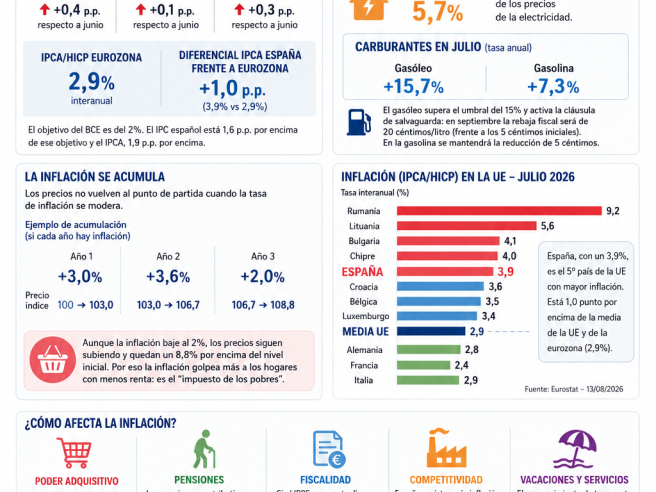
Inflation accumulates on already higher prices
A rise in the CPI of 3.6% means that prices are, on average, 3.6% higher than a year before. But that percentage is applied to a price level that already incorporates the increases from previous years.
Inflation does not work like a counter that resets to zero every year. If prices increase by 3% and the following year they rise again by 3.6%, the second increase is applied to the prices that have already been raised during the first year. Therefore, a future decrease in inflation does not mean that the shopping basket will recover previous prices: if it goes from 3.6% to 2%, prices will continue to rise, albeit at a slower pace.
This is one of the reasons why inflation has a particularly relevant impact on households with lower income. The expression “tax on the poor” is used to describe this effect because those who allocate a larger proportion of their income to food, housing, energy, and transportation have less margin to absorb the increases.
Pensions rise, but their cost also increases
Inflation also has a direct effect on pensions because their evolution is linked to prices. Contributory pensions increased by 2.7% in 2026, according to Social Security.
The mechanism aims to preserve the purchasing power of pensioners, but maintaining the purchasing capacity from one year to the next does not mean that the pensioner can buy with their benefit the same as they could several years ago. If prices have accumulated over several years, the pension is updated on a base that has also changed.
Inflation also affects public accounts. When pensions are revalued, the new amounts are incorporated into the benefits and serve as a reference for subsequent updates. The monthly payroll of contributory pensions exceeded 14.25 billion euros in January 2026, with more than 10.4 million benefits paid.
More salary does not necessarily mean more purchasing power
The same mechanism affects workers. If a salary increases by 3% while prices rise by 3.6%, the worker receives more euros, but can buy fewer goods and services in real terms.
The underlying inflation of 3% shows, moreover, that the pressures on prices are not concentrated exclusively on energy. Funcas places its average inflation forecast for 2026 at 3.2% and for 2027 at 2.3%, which points to a gradual moderation, but still with rates above the ECB's target.
The difference between inflation and wages is especially important for households that do not have automatic adjustment mechanisms. A rise in income equivalent to the CPI allows approximately to maintain purchasing power; a lower one implies a loss of purchasing power and a higher one allows to increase it.
The effect on personal income tax: when raising the salary is not enough
Inflation can also affect taxpayers through what is called cold progression. If wages increase nominally to compensate for the rise in prices but the brackets of the personal income tax are not updated in the same proportion, part of that increase may be subject to a higher effective taxation.
The problem is that the worker may not have really improved their economic capacity. A salary increase equivalent to inflation allows maintaining purchasing power, but if the nominal increase in income causes a higher tax bill, disposable income may grow less than the salary.
The deflation of personal income tax allows adapting the brackets and certain parameters of the tax to the evolution of prices. Without that update, inflation can raise the collection on nominal income increases that do not represent an equivalent improvement in real economic capacity.
Spain becomes more expensive than its main partners
The differential with Europe introduces a second issue: competitiveness. In July, Spain recorded a HICP of 3.9%, compared to 2.9% in the eurozone. Among the large economies, Germany stood at 2.8%, France at 2.4%, and Italy at 2.9%.
This is not a minor difference if it is maintained over time. Spain shares currency with a good part of its main trading partners, so it cannot resort to a devaluation of its currency to regain competitiveness against them. If Spanish costs systematically grow more than those of other countries, companies may be forced to reduce margins or pass on the increases to their prices.
Eurostat data of the IPCA/HICP for the month of July
Inflation in July 2026 — IPCA/HICP
-
Romania: 9.2%
-
Lithuania: 5.6%
-
Bulgaria: 4.1%
-
Cyprus: 4.0%
-
Spain: 3.9%
-
Croatia: 3.6%
-
Belgium: 3.5%
-
Luxembourg: 3.4%
-
Ireland: 3.1%
-
Portugal: 3.1%
-
Poland: 3.0%
-
Slovenia: 3.0%
-
Slovakia: 3.0%
-
Italy: 2.9%
-
Netherlands: 2.9%
-
Germany: 2.8%
-
Greece: 2.7%
-
Austria: 2.6%
-
Finland: 2.6%
-
Latvia: 2.5%
-
France: 2.4%
-
Hungary: 2.1%
-
Malta: 2.1%
-
Estonia: 2.0%
-
Denmark: 1.8%
-
Czech Republic: 1.1%
-
Sweden: 1.0%
The source that compiles the data from Eurostat also places the average of the European Union at 2.9% and that of the eurozone also at 2.9%.
Spain, with 3.9%, would be the fifth country in the EU with the highest inflation in July, only behind Romania, Lithuania, Bulgaria, and Cyprus. It is one point above the European average of 2.9% and also one point above the eurozone.
In addition, Spain surpasses the four major economies of the eurozone:
-
Spain: 3.9%
-
Italy: 2.9%
-
Germany: 2.8%
-
France: 2.4%
Rafael Pampillón:“When prices rise more than our salaries, our money buys less”
Rafael Pampillón, professor of Applied Economics at CEU-San Pablo University and professor at IE Business School, argues that “inflation has an effect that anyone understands: when prices rise more than our salaries, our money buys fewer things.”
In recent months —he explains to DEMÓCRATA—, “salaries have grown around 3%, below inflation. So workers are losing purchasing power. But there is another less visible and perhaps more dangerous effect in the medium term: if in Spain prices rise faster than in the countries we compete with, our companies lose competitiveness.”
“That is what the annual data for July warns again —he highlights—: the Harmonized Index of Consumer Prices (IPCA), which allows comparing European countries with the same criteria, placed its year-on-year rate in Spain at 3.9%, compared to 2.9% in the eurozone. The distance is one point. One year does not decide the competitiveness of a country. The problem arises when the difference is repeated and accumulates.”
“Let’s think of a Spanish company that sells abroad —he points out—. If for years its costs and prices increase more than those of a German, French, or Italian company, it only has two paths: reduce its margins or compensate for the difference by producing better and cheaper. If it doesn’t achieve the latter, it ends up losing ground. At the same time —he specifies—, for Spaniards it is relatively more attractive to buy foreign products that have increased less in price: our imports increase.”
“So —points out the author of The Spanish Technological Deficit— we need more competition where regulation, entry barriers, or supply shortages facilitate price increases. And, above all, we need productivity. Producing more value for each hour worked allows for better wages without continuously passing that cost onto prices.”
“And the conclusion is simple —points out the professor—. Having one point more of inflation than Europe may seem like a small thing. If it happens one year, it probably is. But if it becomes customary, it stops being so, because the difference accumulates and Spain becomes more expensive silently. In a common currency, we cannot erase that difference later by devaluing. That’s why the best competitiveness policy starts long before exports fall, because it starts by preventing our costs and prices from systematically running higher than those of our competitors and, above all, by ensuring that our productivity runs faster than theirs.”
Daniel Lacalle: “Prices show that Spain is above the average of the euro area”
For Daniel Lacalle, chief economist of Tressis, the data that should be analyzed alongside the general CPI is the IPCA, “because it is the one used throughout the EU.” In his view, the data shows that “the CPI in Spain is already much higher than the average of the euro area” and one of the fundamental reasons is the price of housing, which rises by 5.7% annually.
“Moreover —he elaborates—, electricity prices have risen much more than in the same month of 2025. Transportation has skyrocketed. All the data indicate that in Spain the annual inflation rate, in this case of core inflation, is also much higher. That is, the inflation that is supposed to be more stable and less related to external aspects is at 3%, one-tenth higher than the previous month.”
In Spain —he adds—, "the Government has been unable to implement policies that would facilitate competition, the free market, which would thereby facilitate the reduction of prices or, at least, greater access to goods and services and, with that, a lower inflationary impact".
Furthermore, he adds, "real net wages are not rising, but falling. Net employees, moreover, are falling compared to the average of the EU and the Eurozone. And this means impoverishing the middle class".
Lacalle also links the evolution of inflation with the cost of pensions: "As happens with pensions, where the Government, of course, will say that it is going to raise pensions with the CPI, but in doing so, they will pull from debt, which is what they do, so that, in this way, what is done is to pass more taxes and more inflation and greater pressure to the private sector in the future".
Ultimately —he points out—, "all these factors generate a less competitive economy", and he argues that inflation also affects the reading of certain economic ratios, such as debt over GDP, by raising the denominator through the growth of nominal GDP.
Javier Santacruz Cano:“Spain has been facing persistent inflation for five years”
In the opinion of economist Javier Santacruz, "Spain has been facing a phenomenon of persistent inflation for five years, especially pressured by energy, food, and certain services".
And given that in recent years some indexing mechanisms to inflation have been recovered such as collective agreements, pensions, or rental contracts —he explains—, each increase in the inflation rate represents a cost that becomes permanent in the pockets of citizens.
Therefore —he points out—, “indexing wages, pensions, rents, etc. to inflation is always https://www.ceoe.es/esa bad idea because it generates vicious circles that make inflation persistent. However, the only positive thing that should be indexed, which is taxes (correcting taxes for the effect of inflation), is precisely what is not done".
The average gross salary has risen by 5,531 euros since 2018. Discounting inflation and what is taken by the IRPF and contributions, the average worker is left today with 105 euros less per year than then.
— Santiago Calvo (@SantiCalvo_Eco) August 12, 2026
That is to say, the average gross salary has grown by 3.1% in six years, but that… pic.twitter.com/BBAkB6qX7e
Holidays and more expensive services
The summer adds another visible effect. The increase in prices of services linked to leisure, transportation, restaurants, and accommodations raises the cost of vacations for households. For a family, the result is paying more to maintain a similar level of consumption.
The effect also has a business reading. If Spanish prices increase more than those of other European destinations, Spanish tourism may lose part of the price advantage that has contributed to sustaining its international competitiveness.
A specific reduction against accumulated inflation
The tax reduction on diesel can reduce the impact of fuels in September, but it does not reverse the accumulated increases of the overall prices. The Government has activated the clause that raises the reduction of the hydrocarbon tax up to 20 cents per liter after diesel increased by 15.7% year-on-year.
The snapshot left by the July data is, therefore, broader than a simple 3.6%. Spain registers a CPI of 3.6%, a core inflation of 3%, and an HICP of 3.9%, compared to 2.9% in the eurozone.
For households, the difference between earning more and being able to buy more is once again conditioned by inflation. For the taxpayer, the updating or not of the fiscal parameters determines the effect of cold progressivity. And for companies, maintaining a higher inflation than their European competitors for years can ultimately translate into higher costs and lower competitiveness.
CEOE warns of the risk that the war with Iran continues to raise inflation
The CEOE warns that the prolongation of the conflict with Iran is increasing the upward risks on inflation, after the CPI in July rose four tenths, to 3.6%, driven by energy products. The organization maintains for now its forecast of an average inflation of 3.1% for 2026, although conditioned on a gradual normalization of maritime traffic in the Strait of Hormuz, which continues to be complicated.
The Government's measures to contain the impact of the war in the Middle East have mostly been withdrawn. According to the CEOE, if they had been completely eliminated in July, inflation would have reached 4.1%. The increase in diesel prices above 15% has also activated the safeguard clause that will allow raising the tax cut in September to 20 cents per liter, compared to the five initially planned. In gasoline, the five cents will be maintained.
The evolution of energy adds pressure to an inflation differential that already places Spain above its European partners. The Spanish HICP rose to 3.9% in July, compared to 2.9% in the monetary union, while Brent, which averaged $83.76 per barrel in July, has continued to rise in August to $89.33. In parallel, unprocessed foods moderated their inflation to 2.3%, chaining five consecutive months of declines.