Europe needs strong governments and Europeans create weak governments.

In democracy, voting occurs when it is appropriate or when a Government decides to ask for the trust of the citizens again. The problem is that Europe cannot afford that luxury.

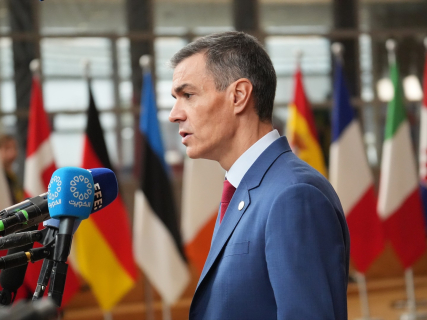
EuropaPress 7048509 presidente gobierno pedro sanchez atiende medios llegada reunion consejo

EuropaPress 7048509 presidente gobierno pedro sanchez atiende medios llegada reunion consejo

Add DEMÓCRATA to Google

Ask FREN

Published

8 minutes

Most read

Elecciones 29N · Encuestas

La media de las encuestas

Media a 8 de noviembre de 2026 · 11 institutos

  • PP30,8 %
  • PSOE26,2 %
  • Vox19,5 %
  • Frente Amplio6,8 %
  • ERC2,6 %
  • Podemos2,0 %
01020304050ene 2024jul 2024ene 2025jul 2025ene 2026jul 2026

Media del último estudio de cada instituto en 30 días y su evolución semanal desde el 23J. Partidos con al menos un 2 %.

Todas las encuestas

Elecciones generales del 29 de noviembre · Demócrata

There is a paradox that Europe has been trying to turn into a political system for some time: the more complicated the world becomes, the harder it is for us Europeans to form governments capable of governing it.

This is not just a Spanish phenomenon, but Spain has just contributed a new chapter. On November 29 we will return to the polls, after Pedro Sánchez brought forward the elections following Congress's rejection of his proposals on housing and a legislature sustained by fragile majorities. Nothing extraordinary: in a democracy, voting occurs when it is due or when a Government decides to ask for the citizens' trust again.

The problem is that Europe cannot afford that luxury. It has to decide how much to spend on defense, support Ukraine, compete with the United States and China, reduce its energy and technological dependence, manage immigration, and finance everything without increasing the debt. All quite simple. There is just one small inconvenience: to do this, governments are needed that decide and, above all, can maintain what has been decided.

In a democracy, voting occurs when it is due or when a Government decides to ask for the citizens' trust again. The problem is that Europe cannot afford that luxury

It is worth clarifying from the outset what I mean by “strong”: not a Government with extraordinary or authoritarian powers, but one capable of making decisions and implementing them. In that sense, both national governments and what occupies their place in Europe are today “weak,” but for different reasons. In the States, due to political fragmentation and the disappearance of a certain culture of compromise. In the Union, due to institutional construction.

The continent of difficult majorities

Let’s look around. France has been trapped in fragmentation for months, to the point that approving a budget has become a feat. The markets have also taken note: last week the extra cost that France pays compared to Germany for financing itself over ten years exceeded 150 basis points, the highest level since the euro crisis. In 2027, presidential elections are coming, with the prospect that the center will fare worse than the extremes.

In Germany, the Government of Friedrich Merz has a majority, but not comfort: the poor regional results, the retreat of the moderate left, and the rise of the AfD tighten the coalition. Italy is the opposite case, and that is why it is instructive: Giorgia Meloni has achieved an unusual stability in her country, but stability does not necessarily mean room for maneuver, with increased defense spending and accounts under scrutiny.

And Spain arrives at the polls with two blocks that resemble each other more than they admit. On the left, a “Progressive Block”: a solemn name for a sum of parties that agree on voting and little more. On the right, a probable pact of the PP with Vox, with evident differences in immigration, climate, or Europe. Two cohesion labels for two survival arithmetics.

It is not a universal plague either. Belgium and the Netherlands are famous for their long negotiations, and the Nordic countries have been governing with coalitions and minorities for decades without the system being affected. Fragmentation is not a democratic anomaly: it reflects more plural societies. The difference lies in the culture of agreement. Where legislative agreements are negotiated with fine print and respected, the coalition works; where each partner treats them as a revocable contract, it does not.

The world does not wait for us to approve the act

Democracy needs time: debate, negotiation, controls, opposition, agreements. That is a virtue, not a defect. But geopolitics has the bad habit of not respecting parliamentary procedures.

Vladimir Putin does not wait for the Twenty-Seven to reach an agreement. China does not postpone its investments because the Commission has to consult the Member States. The United States does not stop changing its trade policy because in Europe we are still negotiating a joint declaration. And the markets, even less so.

Brussels talks about strategic autonomy and resilience, and its program for 2026 places them at the center. But a power needs something more than good documents: it needs the capacity to decide.

The Union of 27 and the Government of nobody

The European Union has an added difficulty: it does not have a Government in the classical sense. It has a Commission, European Council, Council of the Union, Parliament, qualified majorities, unanimities, vetoes, and shared competences. A magnificent architecture so that no one commands too much, and less magnificent when someone has to command quickly.

It was designed based on a very reasonable idea: no State should impose its will on others again. The result is a sophisticated machinery for everyone to participate in the decision and, sometimes, for no one to be able to make it. It was manageable while the Union discussed markets, fishing, or technical standards. Now the agenda includes missiles, drones, artificial intelligence, critical raw materials, and hybrid warfare. It does not seem like the best time to govern with the handbrake on.

The result is a sophisticated machinery for everyone to participate in the decision and, sometimes, for no one to be able to make it

Do the two weaknesses feed each other?

History suggests that they do, although not in the obvious way. Strong national governments do not guarantee a strong Union: De Gaulle blocked the Community with the empty chair crisis of 1965 and the Luxembourg compromise of 1966 effectively enshrined the veto. The great leaps - the single market, Maastricht, the euro - coincided, on the other hand, with solid leaders who shared an idea of Europe, such as Kohl, Mitterrand, or González, with Delors at the head of the Commission. Thus, strong governments are not enough: leaders are needed, and moreover, they must want the same thing.

Today the opposite occurs. The European Council is made up of leaders without leadership who need to respond to fragile majorities and who, after each summit, return to their internal politics: national weakness amplifies institutional weakness. Governments arrive in Brussels with little margin and Brussels ends up having even less.

What I understand by a weak government

It is worth clarifying. A strong government is not one that has an absolute majority, nor is a weak one necessarily bad: Europe has governed with coalitions for decades. The weakness that concerns me is that of the government that is so focused on its survival that every strategic decision becomes a short-term negotiation, and whose policies are born with an expiration date.

A strong government is not one that has an absolute majority, nor is a weak one necessarily bad

A reform lasts as long as the majority that approved it. A European compromise depends on the government that signed it. Energy policy changes with the next minister and defense strategy is renegotiated every year. And there are things that cannot accommodate that pace: a missile is not manufactured in one legislature, a high-speed network is not built in four years, and competitiveness is not regained with a press conference.

And then the citizen appears

When citizens see that governments discuss a lot and resolve little, trust erodes. The risk is not the debate, but the feeling that politics is a permanent negotiation between parties while problems wait at the door. Housing is the Spanish example: much easier to diagnose than to resolve. With immigration, energy, pensions, or taxation, the same happens: the solutions are known in their broad lines; what does not exist is one that pleases everyone at the same time.

Perhaps the weakness is not only a matter of politicians. Europe wants a generous welfare state, lower taxes, more defense, less debt, cheap energy, rapid ecological transition, and secure borders, all at once and, if possible, without anyone paying the bill. That would indeed be a European miracle. We want more security and less spending, more pensions and less taxes, more protected housing and less construction in our neighborhood, more strategic autonomy and less military budget, more Europe and less Brussels. In reality, we want the Government to make difficult decisions, as long as the consequences are paid by someone else.

When a Government tries to solve one thing, it discovers that the other half of the electorate thinks the opposite. And the most comfortable way to stay in power is to do nothing.

Behind the list, there is something deeper: each one defends their part (nations, sectors, associations, pressure groups) and no one seems to represent the whole. Weak governments are also weak in front of those particular interests.

And what do we do?

Diagnosing is easy; the difficult part is prescribing without falling into authoritarian temptation. There is no magic formula, and reinforcing the capacity to decide has a cost in counterweights that should be assumed with eyes wide open. But there are ways at three levels.

At the national level, state pacts that last longer than a legislature in matters that cannot change every four years: defense, energy, pensions, housing, or foreign policy. And detailed and public coalition agreements like those in Germany or the Netherlands, which force partners to say in advance what they will do and what they will not.

In Europe, expanding the qualified majority where unanimity currently prevails, resorting to reinforced cooperations and “coalitions of volunteers” when some States do not want to advance, and jointly financing what is a common good, such as defense or energy networks. None of this is simple: it requires States to cede sovereignty just when their electorates are less willing. The paradox, once again.

There is no magic formula, and strengthening the capacity to decide has a cost in counterweights

And in the citizen sphere, something less technical and more uncomfortable: telling the truth about the accounts. A policy only lasts if it is explained what it costs, who pays for it, and what we are willing to sacrifice to achieve it. That part does not depend on any regulation.

The final paradox

Europe faces one of the most demanding moments in its recent history. Competitiveness, energy, defense, Ukraine, migration, and strategic autonomy are at the center of the agenda. We do not need less democracy, but democracies capable of deciding. We do not need authoritarian governments or eternal majorities, but governments that can adopt a policy, explain it, assume its cost, and maintain it long enough to see if it works.

Perhaps Europe has to learn something uncomfortable: stability does not consist of having no political conflict, but in ensuring that the conflict does not prevent governance.

In the end, it all comes down to an uncomfortable question: are we still capable of thinking about something akin to the general interest?

Meanwhile, Spain returns to the polls, France tries to balance politics and budget, Germany maintains its course with an increasingly fragmented political system, Italy balances between debt, growth, and defense, and Brussels observes while trying to build a power. The situation has a tragicomic aspect: Europe needs strong governments and Europeans have specialized in manufacturing governments that have to ask for permission to govern. And perhaps that is the real problem: we want someone to decide, but we still prefer that the decision does not force us to choose.

More key points, information and questions with FREN

AI-GENERATED CONTENT

What are the parliamentary procedures required to advance general elections in Spain?

In Spain, advancing general elections requires following a strictly regulated process by the Constitution and the LOREG. It is not a decision of Parliament, but of the Prime Minister, with the intervention of the Council of Ministers and the King, and with a very limited role for the Cortes and the Permanent Deputation once dissolved.

1. Who can decide the early election
  • Only the Prime Minister can propose the early dissolution of the Congress, the Senate, or both Chambers. Neither the Boards, parliamentary groups, nor the King on their own initiative can do so.
  • The dissolution is adopted by Royal decree, but always at the proposal of the Prime Minister and after deliberation by the Council of Ministers. The King acts in a regulated manner: he does not decide whether there is an early election or not, he only formalizes the government proposal in a decree.
2. Internal procedure within the Government
  • The Prime Minister presents to the Council of Ministers his intention to dissolve the Cortes and call elections.
  • After the deliberation of the Council of Ministers, the proposal for dissolution and the draft decree of dissolution and call are submitted to the King, which is a single act: the Chambers are dissolved and the elections are simultaneously called.

This is a strictly governmental procedure: the Cortes Generales do not vote or “authorize” the early election; they are limited to formally receiving the decision when the decree is published.

3. Decree of dissolution and call
  • The King signs the decree, which must be countersigned by the Prime Minister.
  • The decree is published in the Official State Gazette (BOE); that day the electoral calendar begins to run.
  • The decree itself sets the date of the vote, according to the time limits established by the LOREG.

According to electoral regulation, the vote must be held within a specific range of days from the call; the decree places the election day within that margin, and from there the deadlines for submission of candidacies, proclamation, electoral campaign, and reflection day are scheduled.

4. Limits and restrictions on the early election

The Constitution imposes several safeguards on this power:

  • Minimum time limit: after a dissolution, a certain period must elapse before another early dissolution can occur. This limit prevents abusive use of the tool.
  • States of constitutional crisis: dissolution cannot be agreed upon during the validity of states of exception or siege, nor in certain situations provided for in the regulation of states of alarm, exception, and siege (Article 116 of the Constitution).
  • Relation with the motion of censure: the power to dissolve is coordinated with the mechanisms of political responsibility of the Government (motion of censure and vote of confidence), to prevent dissolution from being used to avoid an imminent censure.

Additionally, the Constitution provides for a case of automatic dissolution different from the “voluntary” early election: if a president is not invested within the established period, both Chambers are dissolved and new elections are called. This is not a politically decided early election, but an automatic effect of the failure of the investiture.

5. Role of the Boards of the Congress and the Senate

The Boards of both Chambers do not intervene in the decision to advance the elections: they do not inform, authorize, or vote on the dissolution. Their role is limited to:

  • Officially receiving the communication of the dissolution.
  • Ordering the filing or orderly closure of pending procedures, according to the Regulations.
  • Promoting the constitution and functioning of the Permanent Deputation.
6. What happens with the Permanent Deputation

Once the Cortes are dissolved, parliamentary activity does not completely disappear. Article 78 of the Constitution establishes that:

  • The Permanent Deputation of the Congress (and that of the Senate) assumes certain functions while the Chambers are dissolved or their mandate has expired.
  • Among these functions are those related to:
    • Validating or repealing decree-laws approved by the Government (Article 86 of the Constitution), which must be subject to parliamentary control within a maximum period of 30 days.
    • Exercising the Congress's powers regarding states of alarm, exception, and siege if these situations occur while the Cortes are dissolved (Article 116 of the Constitution).
  • Once the new Chambers are constituted, the Permanent Deputation must report to the Plenary on the decisions made during the dissolution period.
7. Setting the election date (LOREG)

The Organic Law of the General Electoral Regime (LOREG) specifies the temporal aspect:

  • The decree of dissolution and call sets the day of the vote within the margin established by the electoral law.
  • From the publication in the BOE, the complete electoral calendar is triggered: submission and proclamation of candidacies, campaign, reflection day, and general scrutiny.

In summary, advancing general elections is a power of the Prime Minister that is articulated through a Royal decree, with clear constitutional limits and with the guarantee that, while the Cortes are dissolved, the Permanent Deputation maintains an essential core of control and response to urgent situations.

What are the differences between a “voluntary” early election decided by the Government and the automatic dissolution after an investiture deadlock? What specific functions does the acting Government maintain from dissolution until the investiture of a new president? How does the LOREG exactly regulate the deadlines (call, campaign, scrutiny) after the early dissolution of the Cortes?

What powers does the European Council have within the European Union according to the Treaties?

The European Council is one of the central institutions of the European Union and its powers are mainly defined in the Treaty on European Union (TEU), especially in Article 15, as well as in some complementary provisions of other articles. It does not exercise ordinary legislative functions, but it does set the overall political direction and strategic drive of the European project.

1. General definition and institutional role

According to the Treaties, the European Council:

  • Gives the Union the necessary impulses for its development and defines its general political orientations and priorities (Art. 15.1 TEU).
  • Does not exercise legislative functions (Art. 15.1 TEU), that is, it does not adopt regulations, directives, or ordinary legislative decisions, which correspond to the European Parliament and the Council of the EU (Council of Ministers).

It is essentially the highest-level political steering body: it sets the course and major political agreements, which are then concretized through proposals from the Commission and legislative acts of the Council of the EU and the Parliament.

2. Composition and decisions

The Treaties also specify its composition:

  • Heads of State or Government of the Member States.
  • Its own president.
  • The President of the European Commission.
  • The High Representative of the Union for Foreign Affairs and Security Policy, who participates in its work.

Unless otherwise provided by the Treaties, it acts by consensus, that is, without a formal majority vote, seeking unanimous agreements of the national leaders (Art. 15.4 TEU). Only when the Treaties expressly provide does it decide by qualified majority or simple majority.

3. Strategic and political impulse functions

Its main powers can be grouped as follows:

  • Define priorities and general orientations: it agrees on the main lines of integration (for example, priorities in ecological transition, digitalization, migration policy, or economic policy) and adopts “conclusions” that guide the action of the other institutions.
  • Management of major crises and strategic issues: the Treaties assign it the role of political forum where economic crises, international conflicts, exits or accessions of States, and other highly sensitive matters are addressed.
  • Promotion of revisions and evolutions of the institutional framework: it can urge the revision of the Treaties, convene conventions or intergovernmental conferences when appropriate, following the revision procedures established in the TEU.

4. Competences in institutional matters and appointments

The Treaties assign the European Council several very relevant decision-making powers in the configuration of the institutions:

  • Election of its own president by qualified majority, for a term of two and a half years, renewable once (Art. 15.5 TEU).
  • Proposal to the European Parliament of the candidate for President of the Commission, taking into account the result of the European elections and after holding appropriate consultations (Art. 17.7 TEU).
  • Formal appointment of the High Representative for Foreign Affairs and Security Policy, by qualified majority, with the approval of the President of the Commission (Art. 18 TEU).
  • Decisions on the composition of the European Parliament, including setting the number of seats allocated among the Member States within the maximum limit established by the Treaties.

5. Competences in foreign and security policy

In the area of the Common Foreign and Security Policy (CFSP), the European Council has a central role:

  • Defines the strategic orientations of the CFSP and the security and defense policy, setting the major objectives and lines of action of the Union on the international stage.
  • It can decide the launch of missions and operations within the framework of the Common Security and Defense Policy, when provided for by the Treaties and derived acts.

6. Other specific competences

Additionally, the Treaties assign it other specific functions, for example:

  • Decisions in economic and euro governance matters, in coordination with the Council and the Eurogroup, especially in crisis situations or reforms of economic governance.
  • Intervention in some procedures for suspending the rights of a Member State (Art. 7 TEU), ultimately determining the existence of a serious and persistent violation of EU values.

In summary, the European Council is the body that sets the political course of the Union, makes key decisions on institutional architecture, and sets the strategy in foreign policy and major internal issues. Its power lies less in legislating and more in guiding, agreeing on compromises among States, and unlocking decisions that are then concretized within the legislative and executive framework of the Union.

What requirements must a party meet to be part of a governing coalition in the Spanish parliamentary system?

In the Spanish parliamentary system, there is no “coalition law” that sets specific legal requirements for a party to be part of a coalition government. What does exist is a constitutional and regulatory framework on investiture, Government responsibility, and parliamentary control, within which parties freely negotiate their political agreements.

The first requirement, strictly legal, is not “joining the coalition,” but achieving a majority for investiture. According to Article 99 of the Constitution, the Congress grants or denies confidence to a candidate for the Presidency of the Government:

  • An absolute majority of the Congress is required in the first vote.
  • If not achieved, a second vote is held 48 hours later, in which a simple majority (more yes than no votes) suffices.

Therefore, the “requirement” for any party intending to be in the Government is to contribute votes to that investiture majority, either from within the coalition (with ministers) or from outside (external parliamentary support).

The second element is who is constitutionally in the Government. The Constitution and the Government Law establish that the Government is formed by the President, the vice presidents (if any), and the ministers. Only these positions are part of the Government, with joint political responsibility before the Congress (Article 108 CE). Thus, for a party to “be part” of the coalition, in the strict sense, it must:

  • Have one or more of its members appointed as ministers or vice presidents.
  • Accept that those ministers are collectively responsible for the action of the entire Government.

The appointment and dismissal of ministers is the competence of the King at the exclusive proposal of the President of the Government (Article 100 CE). Legally, therefore, the only formal act necessary for a party to enter or leave the Government is that the President proposes the appointment or dismissal of its ministers and these take or leave office.

Everything else are political agreements, of great practical importance but not predetermined by the Constitution:

  • Distribution of portfolios: which ministries each party will occupy, whether there will be vice presidencies, what competencies each department will have.
  • Government program: a more or less detailed document that sets legislative, budgetary, and public policy priorities.
  • Internal coordination mechanisms: coalition monitoring committees, collegiality rules, how disagreements are managed.
  • Parliamentary discipline: commitments to vote together in investiture, budgets, decree-laws, motions of censure, etc.

These pacts have a political nature (or, if applicable, private contractual nature) and lie outside strict public law: their compliance is guaranteed by the balance of forces and reciprocal incentives, not by an administrative court.

Once formed, the coalition is subject to the same parliamentary control as any other Government. The Congress and the Senate can:

  • Submit oral and written questions, interpellations, and motions.
  • Summon ministers and senior officials to appear, create investigative commissions, and request information and documentation.
  • Use extreme responsibility mechanisms: motion of censure (absolute majority and alternative candidate) and vote of confidence proposed by the President.

Regarding the breakup of the coalition, there is also no specific constitutional procedure. Typical scenarios are:

  • Unilateral exit of a partner: the President proposes to the King the dismissal of the ministers of that party and appoints replacements. The political coalition ceases to exist, although the Government may continue with other support.
  • Loss of parliamentary majority: the departing partner withdraws its support and the Government may become a minority. This opens the door to a motion of censure or for the President to propose a vote of confidence.
  • Resignation of the President: if the crisis makes the Government unviable, the President may resign and a new investiture process begins.

At the regional level, the scheme is similar: each Statute of Autonomy and parliamentary regulation specifies the investiture procedure of the regional President (generally first vote by absolute majority and second by simple majority) and parliamentary control, but coalitions are formed and broken through political agreements between parties, not through additional formal requirements.

In summary, to be part of a governing coalition in Spain no special legal requirement is demanded other than the general ones of the parliamentary system: to contribute votes to a successful investiture, accept the collective responsibility of the Council of Ministers, and articulate, through political agreement, the distribution of power and the functioning of the coalition.

Play

Test your knowledge with FREN!

How much do you know about this topic? Answer the following 3 questions.

What reason led Pedro Sánchez to call early elections in Spain?

Question 1 of 3

What is one of the main problems of the European Union's institutional structure according to the article?

Question 2 of 3

What difference is highlighted in the article between countries like Belgium or the Netherlands and other European countries regarding political fragmentation?

Question 3 of 3