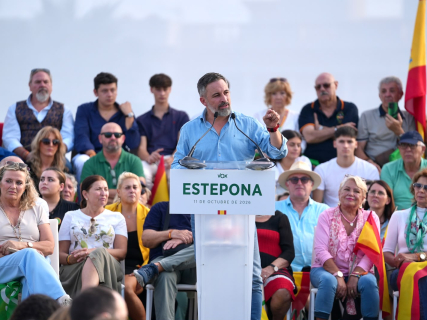
Abascal asks to vote on November 29 to stop the "traps" of the PSOE and promises to pay pensions "by any means."

The leader of Vox sets November 29 as a key date and raises the clash with the PSOE with a message focused on pensions

WhatsApp Image 2026 10 11 at 19.36.27 (3)

WhatsApp Image 2026 10 11 at 19.36.27 (3)

Add DEMÓCRATA to Google

Ask FREN

Published

Last updated

7 minutes

Most read

Elecciones 29N · Encuestas

La media de las encuestas

Media a 12 de noviembre de 2026 · 15 institutos

  • PP31,5 %
  • PSOE26,7 %
  • Vox19,1 %
  • Frente Amplio6,2 %
  • ERC2,4 %
01020304050ene 2024jul 2024ene 2025jul 2025ene 2026jul 2026

Media del último estudio de cada instituto en 30 días y su evolución semanal desde el 23J. Partidos con al menos un 2 %.

Todas las encuestas

Elecciones generales del 29 de noviembre · Demócrata

The leader of VOX has gathered this Sunday more than 1,500 people in Estepona at the first major rally of his pre-campaign, with Ceuta as the axis of his speech and national priority, re-emigration, and deregulation as commitments for a potential Government

Santiago Abascal has asked his supporters this Sunday not to take for granted the general elections on November 29 and to go vote to prevent the PSOE from, as he has denounced, resorting to "tricks, lies, and violence" during the campaign. "Less than four years ago we had the opportunity to vote, we saw the polls that said we were going to win and people got complacent. It cannot happen again," warned the president of VOX before more than 1,500 people gathered at the Sol Marbella Estepona Atalaya Park hotel, in Málaga, of whom he said, have come on their own to the event and not on the buses provided by the PSOE for the event of Pedro Sánchez in Dos Hermanas.

The leader of VOX took advantage of his first major rally of the pre-campaign -followed live by DEMÓCRATA- to present the main commitments of his party and to place immigration, housing, security, and pensions among the central issues of the call. Abascal dedicated a good part of his speech to Ceuta, a city he will visit this Monday, Hispanidad Day, and defended that the next Government must prioritize Spaniards in access to public resources.

"Do not trust a single poll"

The electoral message has combined criticism of Pedro Sánchez's Executive with a call to mobilize his own voters. "Those polls that predict an extraordinary growth of VOX are our main enemy. Do not trust a single poll," he insisted. Abascal recalled the electoral expectations of 2023 and demanded that this time citizens do not stay at home trusting the forecasts.

The president of VOX extended that warning to the development of the electoral process. "«We expect any kind of trick. We have the dirtiest Government in the history of Spain", he stated, before asking his supporters to remain calm and not to fall into provocations. He also demanded in-person voting and linked his suspicions with the Government's management and with the procedures related to the Law of Democratic Memory.

"The traps, lies, and violence are going to be there. But if we all go to vote, there is no one who can stop this time of change", he summarized. Abascal has presented the call as "the last opportunity for all Spaniards"  and has urged his supporters to convey his message to family and friends in the coming weeks.
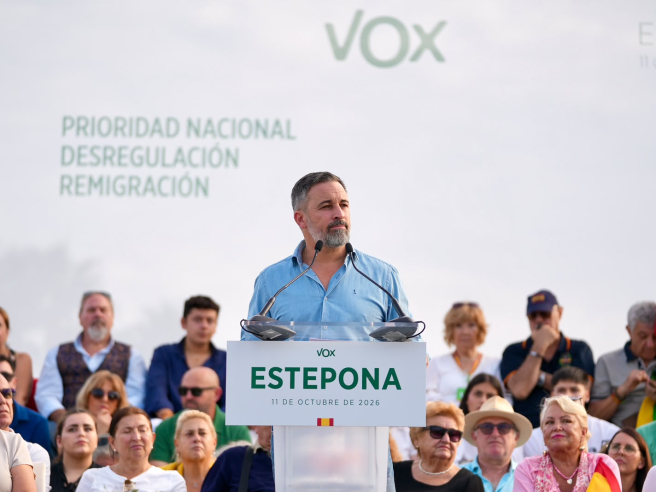
WhatsApp Image 2026 10 11 at 19.36.27 (1)
Santiago Abascal, at his first campaign event held in Estepona (Málaga). Photo: DEMÓCRATA.

Pensions, a commitment "at any cost and in any way"

One of the most notable passages of the rally came when Abascal addressed pensions, after accusing the Government of deteriorating the purchasing power of citizens and failing to guarantee public services in line with the taxes they pay. The leader of VOX has directly responded to the criticisms he attributes to the PSOE regarding a possible privatization of the system.

“The PSOE has said that VOX is going to privatize pensions. And I say that, with VOX, pensions will be paid at any cost and in any way, and the future of young people, likewise, and housing will also be improved in any way”, he stated.

Abascal has placed this promise in a broader speech about the cost of living, wages, and the difficulties young people face in accessing housing. He has denounced that, despite the increases in pensions, the elderly continue to lose purchasing power and has linked that situation to the rising costs of basic products and deficiencies in public services.

The leader has extended his criticisms to rail transport, roads, and healthcare, in addition to questioning the fiscal policy of the Executive. "We have a situation where we pay more than ever and receive less than ever," he maintained.

Housing has also occupied a relevant place in his speech. Abascal has cited the rising costs of apartments and rents and has attributed part of the pressure on the market to the increase in population and the lack of construction. According to his argument, the combination of a shortage of supply, taxes, and regulation makes it difficult for Spaniards to access a home.

National priority, re-emigration, and deregulation

The president of VOX has specified three principles that his party proposes as the axes of its program for the 29N: national priority, remigration and deregulation. The three concepts, which Abascal had already presented as conditions to guide a possible Government, have articulated a good part of his speech in Estepona. 

The national priority has been the first and the one that has connected most directly with its references to Ceuta. Abascal has defended that resources and public investments must be primarily allocated to Spaniards and has rejected that the expression be interpreted as a fascist claim. "It means that we do not want to be displaced in our own home", he explained.

The leader of VOX has related this principle to immigration policy and the distribution of public resources. "National priority is that investments are made in Spain and not in Morocco. We need funds to be dedicated to Spaniards and Europeans," he stated. He has also argued that citizens who work, comply with the laws, respect Spanish culture, and pay taxes must be defended, regardless of their origin.

The second axis, remigration, has focused on the departure from Spain of those who are in an irregular situation or, according to Abascal's formulation, have come to commit crimes or receive social aid. "It is not because we like people from outside. No, it is because we want those from within," he assured. The president of VOX has defended repatriations and has rejected the extraordinary regularization of immigrants promoted by the Government.

The third commitment, deregulation, aims to reduce the rules and procedures that, in the party's view, hinder economic activity. Abascal has criticized the bureaucratic burden that companies, self-employed individuals, and farmers bear and has defended that regulations he considers excessive be eliminated. He has also proposed reducing public spending allocated to subsidies and aid abroad as a way to relieve tax pressure.

With these three principles, VOX seeks to link its immigration policy with the management of public resources and with its economic proposal. Abascal has defended that the next Government must act quickly and make decisions he considers necessary to recover security, facilitate access to housing, and improve the living conditions of Spaniards.
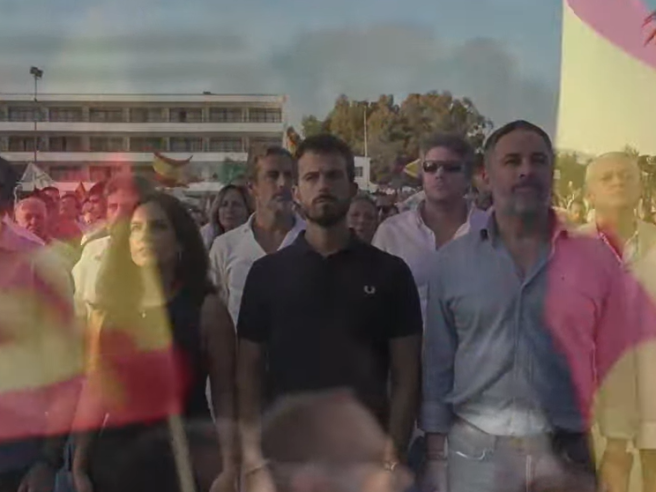
Captura de pantalla 2026 10 11 190656
Santiago Abascal with some of his leaders, listening silently and standing to the anthem of Spain. Photo: DEMÓCRATA.

Ceuta, at the center of the pre-campaign

The choice of Estepona as the setting for the first major rally of VOX has not separated the event from the next stage of Abascal's journey. The leader explained that the Málaga city was next to his "lands in Africa" and dedicated a good part of his speech to the situation in Ceuta, where he plans to spend October 12 alongside the French leader Jordan Bardella, instead of attending the official events of the National Day in Madrid. 

"We did not choose Estepona to start this campaign. It was just on the way from our lands in Africa, next to Ceuta, next to the invaded Spain," he stated. Abascal defended that Ceuta is Spanish territory "for centuries" and assured that it will continue to be so.

The president of VOX has criticized the Government's actions regarding the migratory situation of the autonomous city and accused Sánchez of leaving its inhabitants unprotected. He also linked his criticisms to the Executive's foreign policy and to Spain's relationship with Morocco.

Housing and immigration have thus been connected in his speech. Abascal pointed out that, while the population increases, housing is not being built at the pace he considers necessary and difficulties persist in finding available land. In his view, Spaniards are forced to compete for a limited supply with people of different income levels.

The leader also took advantage of the references to Ceuta to question the Government's management in other episodes, such as the flood and the train accident in Adamuz, and to accuse Sánchez of prioritizing his political interests over the safety of citizens. 

Gavira and Quero complete the event

The Vice President of the Junta de Andalucía, Manuel Gavira, intervened before Abascal with a speech focused on the corruption he attributes to the PSOE, housing, and the situation in Ceuta. Gavira also mentioned the flood and the accident in Adamuz and defended that November 29 must open a new political stage. "All Spaniards are going to send all socialists to unemployment, and Santiago Abascal is going to be the president," he stated.

For his part, Carlos H. Quero has focused his intervention on access to housing and the daily difficulties of young people. To do this, he has resorted to the story of a fictional young man, Rubén, who continues to live with his parents, cannot buy a house, suffers delays in Cercanías, and faces a chain of work and family problems. The narrative has served to present housing, transportation, healthcare, and job opportunities as symptoms of generational discomfort.

Abascal has picked up that argument when addressing the young people present at the event and relating their difficulties to the lack of purchasing power and the rising cost of housing. The leader of VOX closed the rally with a new call to mobilization: "They are capable of everything, lies, attempts at cheating, attempts at intimidation. But do not engage in provocations."

The event in Estepona has thus served VOX to launch its pre-campaign with a message aimed at both its usual voters and those who, according to the party, suffer from the difficulties of access to housing, the loss of purchasing power, and insecurity. Abascal's warning about the polls and his request to go to the polls marked the conclusion of an intervention in which Ceuta, immigration, and pensions occupied a central place.


More key points, information and questions with FREN

AI-GENERATED CONTENT

What is the current status of the parliamentary processing of the Democratic Memory Law and what are the next planned steps?

As of today, the Democratic Memory Law is no longer in the parliamentary processing phase as a new law: its basic text was approved and published in 2022 as Law 20/2022, of October 19, and it is fully in force. What is currently underway in the General Courts is a partial reform of that law, arising from Royal Decree-Law 6/2026, of March 3, currently being processed as a bill.

Status of the basic law (Law 20/2022)

The Government sent to the Congress the Democratic Memory Bill, which was processed in the XIV Legislature with file number 121/000064. It passed the committee work (with reports published in February and March 2023) and the successive debates and votes in the Congress and the Senate, until its final approval.

The text was published as Law 20/2022, of October 19, on Democratic Memory in the Official State Gazette (BOE) on October 20, 2022, and came into force according to the law itself. Since then, it is the framework regulation governing state policies on democratic memory.

In parallel, related initiatives have been processed (for example, constitutional challenges against the law and regional or municipal agreements on democratic memory), but these routes do not reopen the ordinary legislative processing of the law; rather, they are channeled through constitutional control or political impetus initiatives.

Ongoing reform: Royal Decree-Law 6/2026 and Bill 121/000090

The element that is currently in parliamentary processing is the compensation reform linked to the law. The Government approved Royal Decree-Law 6/2026, of March 3, which modifies Law 20/2022 to:

  • extend the recognition period for victims of repression until December 29, 1978,
  • and update and specify the compensations for deceased persons or those with disabling injuries “due to their activity in defense and claim of democracy.”

The decree was published in the BOE on March 4 (BOE-A-2026-5060) and is in force. The Plenary of the Congress ratified it on March 26, 2026 by 173 votes in favor, 170 against, and 7 abstentions, and in that same session agreed on its processing as a bill by urgent procedure, allowing the submission of amendments to the text approved by decree-law. This ratification and the processing agreement are recorded in the official note of the Congress (press release of 03/26/2026).

From there, the initiative is registered in the XV Legislature as Bill modifying Law 20/2022…, with file number 121/000090, originating from Royal Decree-Law 6/2026. According to the official Congress file (121/000090), the Congress has:

  • published the text of the bill in the Chamber Bulletin,
  • opened the period for amendments to the articles,
  • and agreed on successive extensions of that period until, at least, October 7, 2026.

Until that date, groups could continue submitting amendments, indicating that the procedure is still in the amendments and preparatory work phase; there is no record of an approved committee report nor of the text being sent to the Senate.

Expected next parliamentary steps

Once the amendment phase is completed, the standard steps remaining for the reform bill of the Democratic Memory Law are:

  • Committee and subcommittee in the Congress. The competent committee (Territorial Policy and Democratic Memory or another designated) must appoint a subcommittee, which will prepare a report integrating, if applicable, the accepted amendments. Based on that, the committee will approve a report.
  • Debate and vote in the Congress. The report will be debated and voted on in Plenary or, if full legislative competence is maintained, in the committee itself, including the defense of amendments that groups keep alive.
  • Referral to the Senate. Once approved in the Congress, it will go to the Senate, which will have an abbreviated period due to the urgent procedure. The Senate may approve the text, introduce amendments, or issue a veto.
  • Return to the Congress, if applicable. If there are amendments or vetoes, the Congress will decide whether to accept those modifications or override the veto with the required majorities.
  • Final publication. The resulting text will be sent for sanction, promulgation, and publication in the BOE, at which point the reform will be stably incorporated into Law 20/2022.

In summary: the basic democratic memory law has been fully approved and in force since 2022. What remains open in the Courts is the urgent processing of bill 121/000090, which develops and corrects, especially regarding compensations and victim recognition, the content of Law 20/2022 based on Royal Decree-Law 6/2026.

What are the main powers and functions of the President of the Government according to the Spanish Constitution?

The President of the Government is the central figure of the executive power in the Spanish constitutional system. The 1978 Constitution assigns him a set of powers that can be grouped into four main blocks: direction of the Government and political action, appointment and dismissal of ministers, relations with the General Courts, and role in the headship of State and defense.

1. Direction of Government action

Article 97 of the Constitution establishes that the Government directs domestic and foreign policy, the civil and military administration, and the defense of the State, and that it exercises executive function and regulatory power. Within that Government, the president holds a preeminent position:

  • Directs the Government's action, setting the major political and programmatic guidelines.
  • Coordinates the functions of the other members of the Government, that is, the vice presidents and ministers, ensuring coherence of governmental action.
  • Represents the Government before the General Courts, other State institutions, and, in practice, internationally, although the headship of State corresponds to the King.

This political primacy makes the President of the Government the true decision-making center of the executive power, ultimately responsible before Parliament for the general line of the Cabinet.

2. Appointment, dismissal, and organization of the Government

The Constitution grants the president broad capacity to configure the Government itself:

  • Proposes the appointment and dismissal of ministers to the King (art. 100 CE). Although formally the King appoints and removes them, he always does so at the president's proposal.
  • Can propose the existence of vice presidencies and the delimitation of ministerial departments, thus determining the political structure of the executive.
  • Can reshape the Government (entries, exits, and portfolio changes) during the legislature, without the need for a new investiture, unless he loses the confidence of the Congress by other means.

In practice, this power allows the president to adjust the team and governmental organization to his political priorities and the evolution of the legislature.

3. Relations with the General Courts

Since the system is parliamentary, a crucial part of the president's functions is developed in his relationship with the Congress and the Senate:

  • Political responsibility before the Congress: the Government as a whole, and particularly the president, is politically accountable before the Congress of Deputies, which can demand responsibility through a motion of censure (art. 113 CE).
  • Vote of confidence: the president can submit to the Congress a vote of confidence linked to his program or a general policy statement (art. 112 CE). If lost, he must resign.
  • Power to propose the dissolution of the Chambers: he can propose to the King the dissolution of the Congress, the Senate, or both Chambers and the calling of elections (art. 115 CE), within the temporal limits set by the Constitution.
  • Intervention in consultative referendums: it corresponds to the president to propose to the King the calling of a consultative referendum on political issues of special importance (art. 92 CE), with prior authorization from the Congress.

These powers give him the ability to manage political timing, submit his project to parliamentary endorsement, and, if necessary, appeal to the electorate.

4. Role in defense and headship of State

Although the King is the Head of State and holds supreme command of the Armed Forces (art. 62 h) CE), the President of the Government:

  • Directs defense policy as part of the direction of the general policy of the State.
  • Presides over the Government in the Councils of Ministers where key decisions on security, defense, and foreign policy are made.

Additionally, the president acts as the main political interlocutor of the King in Government matters: he submits appointment proposals, proposes dissolutions and referendums, and answers before the Courts for the joint action of the Executive and, politically, for the ordinary functioning of the Crown within the constitutional framework.

5. Responsibility and limits

All these powers are exercised within clear limits: respect for the Constitution and laws, parliamentary control, political responsibility before the Congress, and judicial control of Government acts. The president is not a head of State but the head of the executive power in a parliamentary regime, whose legitimacy derives from the trust granted and maintained by the Congress of Deputies.

How is the President of the Government chosen and appointed according to the Constitution, and what is the investiture procedure? What constitutional differences exist between the functions of the President of the Government and those of the King as Head of State? What is a motion of censure and how does it affect the President of the Government according to the Spanish Constitution?

What has been Santiago Abascal's political trajectory and professional history before leading VOX?

Santiago Abascal Conde (Bilbao, April 14, 1976) holds a degree in Sociology from the University of Deusto and developed most of his previous political career within the People's Party (PP), first in the Basque Country and later in the Community of Madrid. Before assuming the presidency of VOX in 2014, he had held local and regional elected positions, organizational responsibilities in the Basque PP, leadership of the DENAES Foundation, and politically appointed positions in the Madrid administration.

Early steps in the Basque People's Party

Abascal joined the People's Party at a very young age, around 18 years old, in the mid-1990s. He quickly integrated into the structure of the PP of Álava and the Basque PP, holding positions in its internal bodies. In that context, he was shaped as a young figure associated with the most combative wing against Basque nationalism.

His first major springboard was the youth organization:

  • New Generations of the PP in the Basque Country: he presided over the Basque youth branch between 2000 and 2005, which positioned him as one of the emerging leaders of the party in the community.

In parallel, he began to chain representative positions in his home territory.

Elected positions in the Basque Country

Abascal's institutional career began in the local and provincial sphere of Álava:

  • Councilor in Llodio (Álava): he was elected PP councilor in the Llodio City Council in the 1999 municipal elections and held the seat until 2007. It was a municipality with a strong presence of the abertzale left, which marked his later narrative about Basque politics and violence.
  • Procurator in the General Assemblies of Álava: between 2003 and 2004 he served as a juntero, which gave him projection in Álava's territorial politics.
  • Member of the Basque Parliament: he was a regional parliamentarian for Álava for the PP between 2004 and 2009, in two successive terms. During this stage, according to journalistic and political biographies, he focused his discourse on the defense of Spain's unity, support for victims of terrorism, and opposition to Basque nationalism.

Besides these positions, he was part of the Basque PP leadership and performed functions in sectoral areas such as Education. Some journalistic sources mention other minor institutional duties, but the core of his Basque trajectory before VOX is those three levels: city council, General Assemblies, and Basque Parliament.

DENAES Foundation: civic and ideological platform

In 2006 Abascal promoted the Foundation for the Defense of the Spanish Nation (DENAES), conceived as a civic entity with marked Spanish nationalism, aimed at defending the idea of Spain as a single nation and combating the advance of separatist projects.

He presided over DENAES approximately from its creation until 2014. The foundation became a space for activism and cultural intervention that amplified his profile beyond the Basque PP and allowed him to build networks with conservative intellectual and media sectors throughout Spain. Much of the discourse that later crystallized in VOX — criticism of the “autonomic consensus,” denunciation of concessions to nationalism, and emphasis on national unity — was articulated in that environment.

Move to the Madrid political environment

After leaving the front line of Basque politics, Abascal made the jump to the Community of Madrid, where he held politically appointed positions during Esperanza Aguirre's government. According to the biographies consulted, his main positions were:

  • Director of the Data Protection Agency of the Community of Madrid (2010–2012): an autonomous body responsible for ensuring compliance with data protection regulations in the Madrid area.
  • Director or head of the Foundation for Patronage and Social Sponsorship (2012–2013): a public sector entity in Madrid aimed at promoting patronage and public-private collaboration in the social field.

These were administrative positions of political trust, not elective posts. There is no extensive documented trajectory in the private sector: since the late 1990s, his professional activity appears almost continuously linked to politics, foundations, and public administration.

Break with the PP and formation of VOX

At the beginning of the 2010s, his disagreements with the national leadership of the PP intensified, especially regarding territorial policy, response to separatism, and assessment of the fight against ETA. In 2013 he formally left the People's Party.

That same year he joined the founding core of a new formation, alongside figures such as José Antonio Ortega Lara and other former militants or sympathizers of the PP. The project materialized in VOX, publicly presented at the end of 2013 and early 2014.

In the initial phase of the party, Abascal held top organizational responsibilities (provisional secretary general) and in September 2014 was elected national president of VOX at an internal congress, becoming the visible leader of the organization. From that moment on, a new stage began, already as leader of his own party, which falls outside the temporal framework you proposed: his trajectory “before leading VOX” is characterized, in summary, by a continuous career in the Basque PP, the construction of DENAES as a Spanish nationalist platform, and his passage through the Madrid administration in politically appointed positions.

Can you detail more precisely his specific parliamentary activity in the Basque Country (committees, main initiatives, and topics he defended)? What exact role did the DENAES Foundation play in the Spanish right-wing ecosystem and how did it influence the birth of VOX? How exactly did his break with the PP occur in 2013 and what arguments did he put forward and what did the popular leadership respond?

Play

Test your knowledge with FREN!

How much do you know about this topic? Answer the following 3 questions.

Where did Santiago Abascal hold the first major rally of the pre-campaign for the November 29 elections?

Question 1 of 3

What commitment did Abascal make regarding pensions during his rally?

Question 2 of 3

Which of these topics was NOT one of the main pillars of Abascal's speech in Estepona?

Question 3 of 3