Consult here the list of the PSOE for Seville for the elections of 29N: these are the candidates for Congress and the Senate

Alfonso Rodríguez Gómez de Celis heads the socialist candidacy for Congress in Seville, followed by María del Carmen Castilla and Francisco Toscano. Rosario Andújar occupies the first position on the Senate list. Check all the names and substitutes.

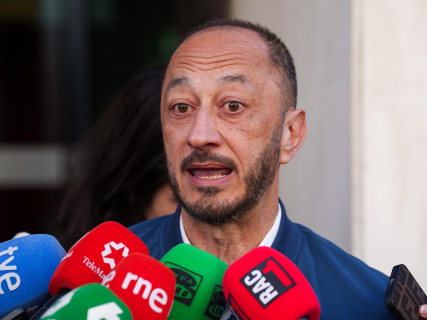
The Secretary of Institutional Policy and Training of the PSOE's CEF, Alfonso Rodríguez Gómez de Celis, offers statements to the media, at the door of the PSOE, on April 7, 2025, in Madrid (Spain). Matias Chiofalo - Europa Press

The Secretary of Institutional Policy and Training of the PSOE's CEF, Alfonso Rodríguez Gómez de Celis, offers statements to the media, at the door of the PSOE, on April 7, 2025, in Madrid (Spain). Matias Chiofalo - Europa Press

Add DEMÓCRATA to Google

Ask FREN

Published

Last updated

2 minutes

Most read

Elecciones 29N · Encuestas

La media de las encuestas

Media a 12 de noviembre de 2026 · 15 institutos

  • PP31,5 %
  • PSOE26,7 %
  • Vox19,1 %
  • Frente Amplio6,2 %
  • ERC2,4 %
01020304050ene 2024jul 2024ene 2025jul 2025ene 2026jul 2026

Media del último estudio de cada instituto en 30 días y su evolución semanal desde el 23J. Partidos con al menos un 2 %.

Todas las encuestas

Elecciones generales del 29 de noviembre · Demócrata

The PSOE of Seville has prepared its candidacy for the Congress of Deputies and the Senate for the general elections on the upcoming November 29. The proposal places Alfonso Rodríguez Gómez de Celis as number one for Congress, followed by María del Carmen Castilla Álvarez and Francisco Toscano Rodero.

The documentation of the candidacy, which Demócrata has accessed, includes 12 main candidates for Congress and three for the Senate, in addition to the corresponding substitutes. The lists are part of the internal process that the PSOE is developing to finalize its candidacies ahead of the electoral advance.

Complete list of PSOE for Congress by Seville

The socialist candidacy for the Congress of Deputies for the province of Seville is made up of the following names, according to the document:

  1. Alfonso Rodríguez Gómez de Celis
  2. María del Carmen Castilla Álvarez
  3. Francisco Toscano Rodero
  4. Trinidad Argota Castro
  5. José María Villalobos Ramos
  6. Carmen Dolores Velasco González
  7. David Pérez Hormigo
  8. Inmaculada Márquez Montes
  9. Casimiro Fernández Linares
  10. Ángela Roldán Bonilla
  11. Miguel Ángel Melero Vargas
  12. Lydia Gómez Torrecillas

As substitutes for Congress are José Luis Bejarano Damas, Gloria Cals Pozo and José Luis Núñez de Fez.

Gómez de Celis, who has served as the first vice president of Congress, is again at the head of the socialist candidacy for Seville. He is accompanied in second place by María del Carmen Castilla, linked to the union representation of UGT Andalucía.

PSOE candidates for the Senate by Seville

The proposal for the Upper House includes three main candidates, each with two substitutes.

Rosario Andújar Torrejón occupies the first position, followed by Antonio Gutiérrez Limones and Eva Patricia Bueno Campanario.

Main candidate First substitute Second substitute
Rosario Andújar Torrejón Myriam Díaz Rodríguez Antonio Valverde Macías
Antonio Gutiérrez Limones Francisco Jesús Mora Mora María Iglesias Domínguez
Eva Patricia Bueno Campanario Juan Carlos Cabrera Valera María Teresa Jiménez Rodríguez

PSOE finalizes its candidacies for 29N

The preparation of the Seville list coincides with the closure of the socialist candidacies in the rest of the constituencies. In Madrid, Pedro Sánchez will lead the proposal for Congress, with Margarita Robles in second place and Félix Bolaños in third.

The organic calendar contemplates that the Federal List Commission reviews the candidacies on Friday, October 16 and that the Federal Committee ratifies them on Saturday 17 in Fuenlabrada.

Therefore, the names collected in the document correspond to the PSOE's candidacy proposal for Seville, pending final ratification.

More key points, information and questions with FREN

AI-GENERATED CONTENT

What are the functions and competencies of the first vice president of the Congress of Deputies in Spain?

The first vice president of the Congress of Deputies is one of the four members of the Board who hold a Vice Presidency and, therefore, is part of the core political and administrative leadership of the Chamber. Their position is mainly defined by the Rules of the Congress, which regulate the organization of the Board and the substitution of the Presidency, and is complemented by internal functioning customs and practices.

a) Functions within the Board of the Congress

First of all, the first vice president is, above all, a member of the Board, which the Rules define as the governing body of the Congress and the collegiate representative of the Chamber. In that capacity, they participate in all the competencies that the Rules attribute to the Board as a whole, among others:

  • Organization of work and internal regime: the Board adopts the necessary decisions on the internal regime and governance of the Chamber (resource distribution, organization of services, criteria for the functioning of bodies, etc.). The first vice president intervenes in the deliberation and voting of these agreements.
  • Budget and economic management: the Board prepares the Congress's budget project, controls its execution, and decides on expenses. The first vice president participates in setting budgetary criteria, parliamentary remunerations, and allowances within legal limits.
  • Qualification and admission of writings: it is the Board's responsibility to qualify, according to the Rules, parliamentary writings and initiatives (bills and legislative proposals, questions, non-legislative proposals, requests for appearances, etc.) and decide their admission for processing and the processing channel. The first vice president intervenes in these decisions, which are key to the day-to-day parliamentary activity.
  • Programming and calendar: the Board programs the general lines of action of the Congress, sets the calendar for the Plenary and committees, and coordinates the work of the different bodies, after hearing the Board of Spokespersons. The first vice president participates in defining agendas, session periods, plenary and committee weeks.
  • Resolution of discrepancies: when a deputy or parliamentary group disagrees with the qualification or processing agreed by the Board, they may request reconsideration. The Board must decide with reasons, and the first vice president is part of that collegiate decision.

In summary, as a member of the Board, the first vice president shares with the rest of its members the institutional leadership of the Congress and the responsibility for the correct application of the Rules in the daily management of the Chamber.

b) Functions of substitution of the Presidency

The specific regulation of the Vice Presidencies appears when the Rules establish that the Vice Presidencies, in their order, substitute the Presidency and exercise its functions in case of vacancy, absence, or impossibility of the latter. This implies that:

  • The first vice president is the first substitute of the Presidency of the Congress. If the Presidency cannot exercise its functions (due to official travel, illness, temporary incompatibility, resignation, or dismissal), it corresponds to the first vice president to assume all the functions proper to the Presidency while that situation lasts.
  • Among those Presidency functions that can be assumed are: representing the Congress, ensuring the smooth running of work, directing Plenary debates, maintaining order in sessions, ordering payments, and, in general, complying with and interpreting the Rules and substituting it in case of omission.
  • In parliamentary practice, this translates into presiding over plenary sessions (including setting the order of speakers, time control, calling to order, and directing votes) and institutionally representing the Chamber in events where the Presidency cannot be present.

If the first vice president is also absent or unable, the substitution corresponds to the second vice president, and so on, according to the order of election of the Vice Presidencies.

c) Other representative or organizational functions

Besides these expressly regulated functions, the Rules foresee that the Vice Presidencies, including the first, perform any other functions entrusted to them by the Presidency or the Board itself. On this generic empowerment, a set of additional tasks has been built through practice:

  • Institutional representation: the first vice president usually participates in official acts, receptions, interparliamentary conferences, or meetings with foreign delegations, sometimes together with the Presidency and other times in its place. This contributes to the external projection of the Congress.
  • Political coordination: within the Board and in relation to parliamentary groups, the first vice president intervenes in negotiations about the arrangement of debates, time distribution, composition and functioning of committees, or the organization of extraordinary sessions, according to what the majority of the Board decides.
  • Supervision of internal functioning: although the direction of administrative services formally falls on the Presidency and the General Secretariat, it is common for the Presidency to delegate monitoring or supervision tasks to the Vice Presidencies, including the first vice president, especially in organizational or logistical matters.
  • Relationship with other bodies: in practice, the first vice president can represent the Board before the Board of Spokespersons, the Permanent Deputation, or certain committees, when so agreed, facilitating coordination among the different bodies of the Chamber.

In conclusion, the first vice president of the Congress combines a collegiate function, as a member of the Board that directs the organization and internal regime of the Chamber, with a substitutive function, as the first replacement of the Presidency, and with additional representative and organizational tasks derived both from formal delegations and consolidated parliamentary practice.

Could you compare the functions of the first vice president of the Congress with those of the presidency of the Congress, highlighting similarities and differences? What role has the first vice president played in practice in a recent specific legislature and in which Board decisions have they had the most prominence? How is the first vice president of the Congress elected and what majorities and procedures does the Rules foresee for their election or eventual substitution?

What requirements must a candidacy meet to be ratified by the PSOE Federal Committee?

According to the PSOE Federal Statutes and its Federal Development Regulations, the Federal Committee can only “ratify” a candidacy when it has previously met a set of organic and electoral requirements. Ratification is, therefore, the last link in a chain that goes through endorsements, eligibility control, verification by competent bodies, and, when appropriate, an internal primary process.

1. General requirements for any candidacy

Before reaching the Federal Committee, the person or list must pass some common minimums, which derive from the Statutes and the candidacy preparation regulations:

  • Condition of eligibility: in general, it is required to be a member or direct affiliate of the PSOE with full political rights. For public offices, it is also necessary to meet the condition of eligibility according to applicable electoral legislation (LOREG, regional laws, etc.). This is reflected, for example, in the rules for PSOE-A regional candidacies, which refer both to the Federal Development Regulations and the Andalusian electoral law.[link]
  • Respect for party values: when the candidate is not a member, they must demonstrate a trajectory close to socialist values and the PSOE, as provided by the internal regulations for list preparation.[link]
  • Submission within deadline and form: the candidacy must be registered within the calendar approved by the Federal Committee or the Federal Executive, and following the established procedures (competent bodies, documentation, etc.).
  • Minimum (and maximum) endorsements: the regulations establish a percentage of endorsements from members and direct affiliates for a pre-candidacy to be proclaimed a candidacy. In the most recent federal regulations, for state-level processes, thresholds around 10% of the census as a minimum are handled, with maximum computable ceilings; this has been applied in recent federal primaries.[Federal Statutes]
  • Ethical and disciplinary control: the regulations prohibit being a candidate if certain disciplinary sanctions are being served or if there are causes of organic incompatibility. In territorial processes, the opinion of ethics commissions on the submitted documentation is also integrated.[link]
  • Parity and quotas: lists must comply with gender equality rules, usually with alternating order of men and women, and with representation percentages set by the Statutes and legislation.[link]
2. Specific cases: federal secretary general and candidate for the Presidency of the Government

The Statutes of the 41st Congress set reinforced rules for the Federal General Secretariat and for the candidacy for the Presidency of the Government:

  • Federal General Secretariat: it is elected through organic primaries with two rounds with individual, direct, and secret voting of the membership and direct affiliates. To be a candidate, when there is more than one pre-candidacy, endorsements of around 10% of the federal census are required, with a maximum computable ceiling; this has been applied in processes such as Pedro Sánchez's re-election, who reached the maximum allowed endorsements.[link]
  • Candidate for the Presidency of the Government: the election is articulated as primaries for institutional office. The percentage of endorsements is determined in the Federal Regulations and in the specific bases of the call. In previous regulations, minimums of 5% of the census with a maximum computable of 10% were foreseen; in the most recent regulation disseminated for federal processes, the requirement has been raised to around 10% for state-level offices.[link]

The exact applicable figure always depends on the current version of the Statutes and the Federal Development Regulations and the bases approved by the Federal Committee itself for that specific process.

3. Role of the Federal Committee in ratification

Once these requirements are met, the “ratification” by the Federal Committee is placed at the end of the procedure:

  • In primaries for the General Secretariat or for the candidacy for the Presidency of the Government, the Federal Committee:
    • Calls the process and approves the calendar and the bases (census, endorsements, control bodies, etc.).
    • Receives from the internal electoral bodies the definitive voting result and, if applicable, proceeds to the political ratification of the winner, who is already proclaimed according to the regulations.
  • In electoral candidacies (lists for Congress, regional parliaments, etc.), the Development Regulations establish that the proposals from territorial groups and federations:
    • Are ordered and justified in regional bodies (list commissions, regional committees).
    • Are sent to the Federal List Commission, which can ratify or modify them, even introducing names not proposed, with reasons.[link]
    • The opinion of that Federal List Commission is submitted to the Federal Committee, which approves the definitive candidacies before their registration before the electoral boards.[link]
4. Limits of ratification

The Statutes emphasize that the Federal Committee is the highest body between congresses, but its ratification cannot be used to evade statutory guarantees. In an ordinary election, it can only confirm as general secretary or as federal head of the list whoever has:

  • Gathered the required endorsements and within the fixed limits.
  • Passed the verification of eligibility and internal ethics.
  • Won, when appropriate, the primary process with the required majorities.

Only in expressly foreseen exceptional cases (for example, special rules when the incumbent president seeks re-election and it is decided not to call ordinary primaries) can the Federal Committee adopt different solutions, always within the framework set by the Statutes and the Federal Development Regulations.[link]

Can you break down, article by article, what the PSOE Federal Statutes say about the election of the general secretary? What differences are there between the PSOE primaries for general secretary and the primaries to choose the candidate for the Presidency of the Government? How is a PSOE electoral list prepared and modified from local groups to ratification by the Federal Committee?

How has the electoral evolution of the PSOE been in the province of Seville in the last general elections?

The electoral evolution of the PSOE in the province of Seville in the last general elections (2011–2023) shows a three-phase pattern: a clear decline between 2011 and 2016, a significant recovery in 2019, and a high but slightly below the 2011 peak stabilization in the 2023 general elections.

1. Numerical results 2011–2023

According to official data compiled by media such as El País and the count by RTVE, the series for the PSOE in the Seville constituency (Congress of Deputies) is as follows:

  • November 20, 2011: 443,295 votes, 43.4%, 6 seats (out of 12).
  • December 20, 2015: 367,865 votes, 35.1%, 4 seats.
  • June 26, 2016: 348,001 votes, 33.7%, 4 seats (2016 provincial detail).
  • April 28, 2019: 420,407 votes, 39.7%, 5 seats (28A series).
  • November 10, 2019: 380,385 votes, 36.1%, 5 seats.
  • July 23, 2023: 386,513 votes, 36.6%, 5 seats (RTVE, Seville 23J).

Overall, between 2011 and 2023, the PSOE lost around 56,800 votes and about 7 percentage points, dropping from 43.4% to 36.6%, and reduced its representation from 6 to 5 deputies for Seville. However, much of that decline is concentrated in the 2011–2016 cycle, while from 2019 onwards a recovery and subsequent stabilization is observed.

2. Decline phase: 2011–2016

In 2011, in the last cycle of PSOE majorities in Andalusia, Seville remained a socialist stronghold: more than 443,000 votes, above 43%, and six of the twelve seats in the constituency. It is the best result of the analyzed period.

In 2015, amid the fragmentation of the party system with the emergence of Podemos and Ciudadanos, the PSOE suffered a very sharp decline: it lost around 75,000 votes, dropped more than 8 points in percentage, and ceded two seats, remaining with 4. Seville continued to be one of its strongholds but with much more contested hegemony.

In 2016, the repeat election consolidated that setback. The data from El País for 2016 show 348,001 votes and 33.7%, maintaining 4 deputies. The PSOE barely retained just under a third of the provincial vote, reflecting the national wear of the party before Pedro Sánchez's government stage.

3. Recovery and new ceiling: the two 2019 elections

With Sánchez's arrival at La Moncloa and the political cycle shift, the April 2019 elections marked a turning point. The PSOE in Seville rose to 420,407 votes (almost 72,000 more than in 2016), nearly 40% of the vote, and recovered a seat, reaching 5 deputies. The province responded to the progressive electorate mobilization climate also observed across Andalusia.

In the November 2019 repeat, the PSOE lost around 40,000 votes compared to April and dropped to 36.1%, but maintained the five seats. The constituency remained one of the main socialist strongholds at the state level, although with growing competition from the PP and the consolidation of other forces on the left and right.

4. High stabilization in 2023

In the July 23, 2023 general elections, according to the provincial count by RTVE, the PSOE obtained 386,513 votes, a 36.6% share, and again 5 seats, in a constituency that distributes twelve. It slightly improved in votes and percentage compared to November 2019, despite a national context of strong polarization and PP growth.

Various analyses by local media, such as Diario de Sevilla, highlight that, even with that structural loss compared to 2011, Seville remains a key territory for Andalusian socialism: the PSOE continues as the leading force in the province in 2023 and sustains a level of representation (five seats) consolidated since 2019.

5. Overall reading

Looking at the complete series, the PSOE goes from an almost hegemonic dominance in 2011 to a more competitive scenario, with a high floor around 36–40% of the vote. The minimum is reached in 2016, but since then the party:

  • Recovers more than 70,000 votes between 2016 and April 2019.
  • Maintains stably 5 of the 12 deputies since 2019.
  • Retains the status as the most voted force in 2023 in the province.

In summary, the electoral evolution of the PSOE in Seville combines a long-term wear compared to the years of broad majorities with a remarkable capacity for resistance and consolidation in the latest stage, which keeps the province as one of the main socialist strongholds in Spain.

Play

Test your knowledge with FREN!

How much do you know about this topic? Answer the following 3 questions.

How many main candidates does the PSOE list for Congress in Seville include?

Question 1 of 3

Which PSOE body must definitively ratify the candidacies before the elections?

Question 2 of 3

Who is the person leading the PSOE list for the Senate in Seville?

Question 3 of 3