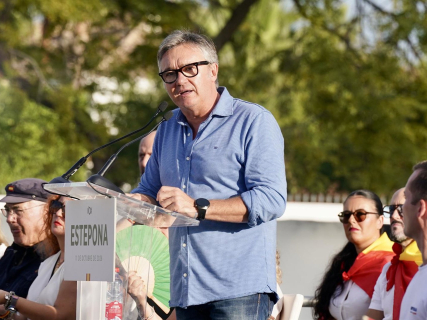
Gavira accuses Mª Jesús Montero of selling SAS properties to vulture funds: "They are the scavengers and thieves."

Manuel Gavira accuses María Jesús Montero of selling SAS buildings to vulture funds and lashes out at the Government and the left ahead of 29N.

fotonoticia 20261011195434 1920

fotonoticia 20261011195434 1920

Add DEMÓCRATA to Google

Ask FREN

Published

Last updated

3 minutes

Most read

Elecciones 29N · Encuestas

La media de las encuestas

Media a 18 de noviembre de 2026 · 17 institutos

  • PP31,4 %
  • PSOE27,4 %
  • Vox19,0 %
  • Frente Amplio6,1 %
  • ERC2,4 %
  • SALF2,0 %
01020304050ene 2024jul 2024ene 2025jul 2025ene 2026jul 2026

Media del último estudio de cada instituto en 30 días y su evolución semanal desde el 23J. Partidos con al menos un 2 %.

Todas las encuestas

Elecciones generales del 29 de noviembre · Demócrata

The Vice President of the Junta de Andalucía and Counselor of Tourism, Justice, Regulation, and Local Administration, Manuel Gavira, accused this Sunday the former Vice President of the Government María Jesús Montero of having alienated, when she held the Ministry of Finance of the Junta, several buildings of the Andalusian Health Service (SAS) to vulture funds. In that context, he emphasized, referring to the PSOE, "that the vultures, the scavengers, and the thieves are them."

During a rally held in Estepona, Gavira recalled that the President of the Government, Pedro Sánchez, has appointed Montero as responsible for the strategy of the electoral campaign of 29N and criticized that she has stated that the general strike "is against the opposition." In his view, with those words she has made clear "what the unions are for" in Spain, "to be on their knees to the socialist government."

"That lady Montero is the one who paid the blackmail to the separatists and that lady, being the Minister of Finance of the Junta de Andalucía, sold SAS buildings to vulture funds. What do you want me to say? That the vultures are them, the scavengers are them, the thieves are them," he asserted.

In his speech, prior to that of the national spokesperson for Housing of Vox, Carlos H. Quero, and that of the party president, Santiago Abascal, Gavira lashed out at the central Executive, which he labeled as "corrupt, traitor, and criminal," and emphasized that in Vox they do not forget "their corruption," referring to "his investigated wife," "his convicted brother," "the buddies of the PSOE in Soto del Real," and "the prosecutor also convicted."

The Andalusian Vice President also referred to the "betrayals to all Spaniards," with explicit mention of Ceuta, and sent a "strong hug" to the "companions and Spaniards of Ceuta." He also assured that they do not forget "what the Spaniards suffer with the compatriots of Valencia due to the dana nor each of the victims of the train accident in Adamuz."

Gavira insisted that November 29 will be the date when citizens are going to "send all the socialists to unemployment" and will achieve that Abascal becomes president, "the president we deserve."

At the same time, he claimed that Vox is already part of the Government of Andalucía, "something that a few years ago seemed 'unthinkable'," and emphasized that on November 29 they aspire to materialize the objective "of having in Spain a patriotic government, proud of the history of Spain, without complexes and brave."

The Andalusian leader of Vox has warned that Spaniards are "tired of the fraud and corruption" of the current left-wing Government, and has pointed out that Spain faces "two fundamental problems: Ceuta and housing." Furthermore, he has stated that "anyone who comes from outside has their housing" and "can form a life project because they group the family and bring them from outside."

Criticism of "those with the wide mouth" and the "separatists" of Adelante Andalucía

Likewise, Gavira has extended his reproaches to what he has called "the rest of the left," explicitly citing Sumar, Izquierda Unida, and Adelante Andalucía. Regarding the first two parties, he has indicated that they are "the ones from the Broad Front or the ones with the wide mouth" because "they eat the filth of the Socialist Party."

He has also attacked "that so-called cheerful left," of which he has said that "they have absolutely nothing cheerful," and has placed it in the same orbit as "the separatist left" and "the left that is friendly to terrorists." In this line, he has accused Adelante Andalucía of having taken advantage of the last few weeks to "bring the heirs of ETA to Andalucía" with the aim of "giving them learning talks," before warning that "all of that is what is going to end on November 29."

Finally, the Andalusian leader of Vox has assured that "there is no Spaniard" who thinks that Santiago Abascal "will hesitate" when it comes to making "the decisions that need to be made." "They will be difficult decisions, but the criterion is very easy: Spaniards first," he concluded.

More key points, information and questions with FREN

AI-GENERATED CONTENT

What is the current status of the investigation into the sale of SAS buildings to vulture funds and what parliamentary steps have been taken in this regard?

With the information available up to October 11, 2026, there is no record of a judicial or oversight body investigation specifically focused on a “sale of SAS buildings to vulture funds”. The expression mainly refers to the controversy over the 2014 asset operation by the Junta de Andalucía (sale of about 70 administrative buildings to an investment fund through a sale and leaseback scheme), but that operation is not currently linked to a specific criminal case nor to a formally approved investigative commission.

What is under investigation and politically intertwined with this narrative is a different matter: the emergency contracts and minor contracts of the SAS with private healthcare during and after the COVID‑19 pandemic, which the opposition presents as part of the same model of privatization and “business” with public healthcare.

1. What is known about the alleged sale of SAS buildings

Media and political references to the “sale of SAS buildings to vulture funds” mainly point to the 2014 operation, when the Junta sold around 70 administrative properties (including headquarters linked to Health) to a foreign investment fund, with an immediate income close to 300 million euros and a long-term lease commitment, valued by critics at about 700 million over twenty years.

Based on the data collected:

  • No specific criminal case has been identified opened for that particular sale (for malfeasance, embezzlement, or fraud).
  • No monographic report from the Andalusian Court of Auditors has been found declaring the sale of those healthcare buildings irregular or quantifying a specific accounting damage.
  • No formal investigation by the Andalusian Office against Fraud and Corruption focused on that 2014 operation is recorded.
  • Nor has a resolution from the Court of Auditors or other state bodies been located that declared the operation illegal or established firm accounting responsibilities.

In other words, the sale has become a subject of political controversy due to its long-term cost and loss of public assets, but it does not currently appear as a case with criminal charges nor with conclusions from oversight bodies specifically about the “sale to vulture funds” of the SAS.

2. Currently active judicial investigations: SAS contracts

At the same time, there are several judicial cases concerning SAS contracting with private clinics, which the opposition discursively links to healthcare privatization:

  • Cases in Seville and Cádiz for massive contract splitting and use of minor contracts to award services to private clinics by direct assignment, with amounts exceeding 200 million annually (reports from the SAS Intervention and proceedings for alleged embezzlement and malfeasance).
  • Preliminary proceedings in a court in Córdoba regarding the contracting of the Healthcare Logistics Platform–Hospital Reina Sofía in 2020–2021, affecting the current SAS manager, Valle García, and which have prompted new requests for investigative commissions.

The Andalusian government (PP) publicly maintains that all this contracting was done “in accordance with the law”, while PSOE, Podemos, and Adelante speak of a “scheme” to divert funds to private healthcare. These cases revolve around contracting healthcare services, not the sale of properties.

3. Parliamentary steps in Andalusia

In the Parliament of Andalusia, the issue has been channeled through two avenues:

  • Control over privatization and assets: debates about the sale and auction of unused public assets, criticisms of outsourcing and the cost of rents for buildings formerly owned by the Junta (including properties linked to healthcare). No specific and closed investigative commission on the sale of SAS buildings has been approved.
  • Commissions and initiatives on SAS contracts: non-legislative proposals against fraud in SAS contracting have been put forward and at least one formal proposal for an investigative commission promoted by Adelante Andalucía on emergency contracts and minor contracts of the SAS during the pandemic, following judicial proceedings in the Reina Sofía case and courts in Seville and Cádiz. According to consulted documentation, previous attempts at commissions on healthcare contracting were rejected by the PP majority.
4. Steps in the national Parliament

In the General Courts, no investigative commission or specific procedure dedicated to the sale of SAS or Junta de Andalucía properties to investment funds has been located. There may have been questions or occasional control initiatives, but the core of the debate and competencies is clearly regional.

In summary, today the issue of the “sale of SAS buildings to vulture funds” is mainly a case of political conflict over asset management and healthcare privatization, without a specific judicial or parliamentary investigation that has advanced to formal conclusions about that particular operation, while the open investigations focus on SAS healthcare contracting with private companies.

What are the specific competencies and functions of the Vice President of the Junta de Andalucía according to the Andalusian Statute of Autonomy?

The Statute of Autonomy for Andalusia, after its reform by Organic Law 2/2007, does not dedicate a specific and autonomous provision to describe the functions of the Vice President or Vice Presidents of the Junta. What it does is integrate this figure within the Council of Government, to which it attributes a set of executive and political competencies that the Vice President exercises as a member of that collegiate body, in addition to those assigned by regional laws and by the Presidency itself.

The key statutory references are mainly the articles on the institutional organization of the Autonomous Community and on the Council of Government:

  • Article 99 places the Junta de Andalucía as the institution in which self-government is politically organized, integrated by Parliament, Presidency, and Council of Government. It is in that Council where the figure of the Vice President is inserted.
  • Article 119.1 defines the composition of the Council of Government: it is composed of the President, the Vice Presidents, if any, and the Councillors. That is, the Vice President is part of the political core that directs the Autonomous Community.
  • Article 119.2 establishes that the Council of Government is the collegiate body that, within its competencies, exercises the political direction of the Autonomous Community, directs the Administration, and develops the executive and administrative functions of the Junta de Andalucía. The Vice President participates in these functions collegially.
  • Article 119.3 adds that, within the scope of the Community's competencies, the Council of Government and each of its members are responsible for the exercise of regulatory power. This means that the Vice President, as a member of the Council, participates both in the approval of regulations by the collegiate body and, where appropriate, in the issuance of regulatory provisions specific to the department assigned.
  • Articles 119.4 and 5 attribute to the Council of Government the filing of appeals of unconstitutionality and conflicts of competence, as well as the possibility of raising jurisdictional conflicts to the courts. The Vice President participates in these collegiate decisions, which are core competencies in the defense of Andalusian self-government.

In addition to these material functions, the Statute configures a common legal status for members of the Council of Government, which also applies to the Vice President:

  • Article 121 refers to a law of the Parliament of Andalusia regulating the legal and administrative regime of the Council of Government and the status of its members (causes of incompatibility, etc.), establishing that the President and Councillors may not engage in any labor, professional, or business activity. This framework equally affects the Vice President.
  • Article 122 regulates the criminal and civil liability of the councillors, indicating that their criminal liability is required before the Criminal Chamber of the Supreme Court or, for crimes committed in Andalusia, before the Superior Court of Justice of Andalusia; and before the latter also the civil liability derived from the exercise of the office. These rules apply to the Vice President as a member of the Council.
  • Article 124 establishes the joint political responsibility of the Council of Government before the Parliament, without prejudice to the direct responsibility of each councillor for their management. The Vice President shares that dual responsibility: joint, for belonging to the body, and individual, for the portfolio or functions assumed.

In sum, from a strictly statutory perspective, the competencies and functions of the Vice President are:

  • To be part of the body that politically directs the Autonomous Community and its Administration (collegiate political and executive direction).
  • To exercise, together with the rest of the Council and in their capacity as a member, the regulatory power within the scope of regional competencies.
  • To participate in decisions on filing appeals of unconstitutionality, conflicts of competence, and jurisdictional conflicts.
  • To be subject to the regime of incompatibilities, criminal, civil, and political liability applicable to members of the Council of Government.

Anything beyond this framework (functions of substitution of the president, coordination of areas, attribution of certain horizontal policies, etc.) is not set by the Statute but by the regional government legislation and the structural decrees of the Junta de Andalucía, as well as the distribution of functions carried out at any given time by the Presidency. From the Statute's point of view, therefore, the Vice President does not have “own” material competencies differentiated, but those derived from their condition as a member of the Council of Government and the internal organization established by Andalusian regulations.

Could you detail what additional functions of the Vice President of the Junta de Andalucía are provided by the specific regional government legislation beyond the Statute? What differences exist between the functions of the President and the Vice President of the Junta de Andalucía according to the Statute and regional laws? How is the substitution of the President of the Junta de Andalucía by the Vice President regulated in cases of absence, vacancy, or illness?

What legal requirements must an autonomous community meet to dispose of public assets such as healthcare buildings?

The disposal (sale or onerous transfer) of healthcare buildings of an autonomous community is strongly conditioned by the legal regime of public assets. There is a common basis throughout the State —the Constitution and Law 33/2003, on the Assets of Public Administrations— and, on top of that, each community has its own asset law (for example, Legislative Decree 1/2002, on the assets of the Generalitat of Catalonia; Law 3/2001, on the assets of the Community of Madrid; Law 6/2006, on the Assets of the Canary Islands, etc.). From that framework, the requirements are usually very similar.

1. Nature of the asset: public domain vs. patrimonial
  • Healthcare buildings effectively intended for the provision of health services are usually classified as public domain (demanial) assets, as they are allocated to an essential public service.
  • Public domain assets are inalienable, imprescriptible, and unseizable. They cannot be sold while they remain allocated to the public service.
  • To be able to dispose of them, the community must convert them into patrimonial assets, which requires a formal act of disaffection.
2. Disaffection from healthcare use
  • The regional asset law requires processing a disaffection file that certifies that the property is no longer necessary for general use nor for healthcare service.
  • Usually:
    • The file is instructed by the department competent in assets or treasury.
    • Reports are obtained from the health department (on care impact) and, if applicable, from urban planning.
    • The competent councillor in assets or the regional government resolves, depending on the importance of the asset.
  • Disaffection usually also involves notifying the municipality of the new situation for urban planning qualification purposes, especially if it was healthcare land use.
3. Competence and, if applicable, parliamentary control
  • Regional asset laws establish who can agree on the disposal of properties:
    • Generally, the Councillor of Treasury/Assets below a certain value.
    • The Council of Government when certain thresholds are exceeded or when dealing with especially relevant operations.
  • Some communities require informing or reporting to the Parliament when the value exceeds a high figure, or when singular properties are disposed of.
  • If the building comes from a transfer from the State with conditions, the reversion clauses or authorizations provided in the transfer royal decree must be respected.
4. Appraisal and justification of the operation
  • Before selling, a expert appraisal of the property is mandatory, with a market study and approval by the competent asset body (a model seen in Law 33/2003 and replicated in regional laws).
  • The file must include:
    • A justificatory report of the opportunity and necessity of the disposal (for example, reorganization of the healthcare network, replacement by a new hospital, rationalization of the real estate portfolio).
    • Legal, economic, and, if applicable, intervention reports.
5. Disposal procedure: auction, tender, and direct award
  • Once the asset is patrimonial:
    • The ordinary procedure is usually a public auction, with a minimum bidding price based on the appraisal.
    • Many regional regulations provide for a public tender when the future use is to be conditioned to certain public policies (for example, maintaining a social-health use).
    • Direct award is only allowed in specified cases: sales to other administrations, non-profit entities, co-owners or neighbors, low-value properties, properties from intestate inheritances intended for social housing, etc.
  • The call must be published at least in the regional official gazette and, if applicable, in provincial bulletins and municipal boards, to ensure publicity and competition.
  • The price cannot be lower, except for very solid reasons, than the approved appraisal.
6. Form of the transaction and protection of public interest
  • As a general rule, the disposal of properties is formalized in a notarial public deed; when the acquirer is another public administration, many laws allow using an administrative document registrable in the Property Registry.
  • The file must provide guarantees for compliance with the purpose if conditions on future use are imposed (resolution of the sale for breach, reversion, etc.).
  • In healthcare buildings, in addition to all the above, the community must ensure continuity and accessibility of the service: either there is already an alternative center, or the operation is accompanied by compensatory investments (new hospital, renovation of another center), which must be reflected in the report and healthcare planning.

In summary, an autonomous community can only sell healthcare buildings when they are no longer necessary for the public service, have been formally disaffected, have valued and justified the operation, follow a disposal procedure with publicity and competition (or a legally specified direct award), and respect, if applicable, parliamentary controls, urban conditions, and those of state transfers.

Can you explain with real examples from any autonomous community operations of sale or reuse of former public hospitals? What leeway does an autonomous community have to impose that the disposed healthcare building maintains a social-health use in private hands? What differences exist between the disposal regime of healthcare buildings of an autonomous community and that of healthcare properties of a municipality?

Play

Test your knowledge with FREN!

How much do you know about this topic? Answer the following 3 questions.

What position did María Jesús Montero hold when, according to Gavira, she sold SAS buildings to vulture funds?

Question 1 of 3

In which town did Manuel Gavira hold the rally where he made his accusations?

Question 2 of 3

What political goal did Vox declare for the November 29 elections, according to Gavira?

Question 3 of 3