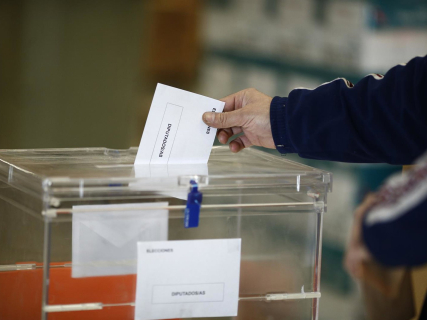

The general elections on the next November 29 could register one of the highest participation levels in recent decades. The estimates suggest that voter turnout will be around 74% of the census, a figure that, if realized, would clearly exceed the 70.38% recorded on July 23, 2023, and would represent an increase of approximately 3.6 percentage points compared to the last general elections. This figure should still be understood as a forecast: the final participation will not be known until the closing and counting of the ballots.
This 74% would also have historical significance. Spain has held 16 general elections since 1977 before the 2026 call, and the average participation of all of them is slightly above 72%. A mobilization of 74% would therefore be nearly two points above that historical reference and would make November 29 the election with the highest participation since March 2004, when 77.24% of the electorate went to vote.
Above 2008 and the two elections of 2019
The comparison with the last twenty years allows for a better appreciation of the dimension of the figure. After the 77.24% of 2004, participation dropped to 73.85% in 2008, to 68.94% in 2011, and to 69.67% in 2015. In the electoral repeat of 2016, it fell even further, to 66.48%, while in April 2019 it rebounded strongly to 71.76%. Just a few months later, in the electoral repeat of November, it fell to 66.23%, the lowest level in the entire democratic series of general elections.
The 23J of 2023 recovered part of that mobilization and ended with a participation of 70.38%. If November 29 finally reaches 74%, it would surpass not only that date but also the elections of 2008 and the two calls of 2019. One would have to go back to the electoral day held three days after the 11-M attacks to find a higher percentage.
The highest participation came in 1982
The record for participation in Spanish general elections still belongs to 1982, when 79.97% of the electorate went to the polls in the elections that first brought Felipe González and the PSOE to government. The first democratic elections, held in 1977, also recorded an extraordinarily high mobilization of 78.83%, while in 1996, when José María Aznar achieved his first electoral victory, 77.38% voted.
Also highlighted are the general elections of 1993, with 76.44%, and those of 2004, with the aforementioned 77.24%. Therefore, talking about a 74% as a return to levels from the time of the Transition requires some nuance: it would be a high figure for the standards of the last two decades and would approach the major mobilization days of Spanish democracy, but it would still be between four and six points below the highs recorded in 1977 and 1982.
Sixteen elections and an average slightly above 72%
The historical evolution shows significant fluctuations. After the 78.83% of 1977, participation fell to 68.04% in 1979 and skyrocketed to 79.97% in 1982. In 1986 it was at 70.49% and in 1989 at 69.74%, before growing again to 76.44% in 1993 and 77.38% in 1996. The year 2000 again left a relatively low participation of 68.71%, and four years later there was another strong increase to 77.24%.
Since then, Spain has not surpassed 74% again. In 2008 it was at 73.85%, in 2011 it dropped to 68.94%, in 2015 it reached 69.67%, in 2016 it fell to 66.48%, in April 2019 it rose to 71.76%, in November of that same year it fell back to 66.23%, and in 2023 it was at 70.38%. The average of those 16 calls is around 72.1%, so a participation close to 74% would clearly be above the historical trend.
A larger census: 38.7 million Spaniards called to vote
The comparison also has a particularity: the electoral roll for 2026 will be larger than that of the last general elections. The Electoral Census Office estimates 38.73 million Spaniards with the right to participate in the elections on November 29, about 1.26 million more than in 2023. Of them, approximately 2.77 million are registered as residents abroad and more than 1.6 million will be able to vote for the first time after reaching adulthood since the previous call.
With that census, each percentage point of participation implies several hundred thousand votes. Therefore, a mobilization close to 74% would mean that more than seven out of ten Spaniards with the right to vote would participate in elections called early for Sunday, November 29. The appointment was formally called through Royal Decree 806/2026, which dissolved the Congress and the Senate elected on July 23, 2023.
From 66.23% to 74% in just seven years
The evolution since 2019 shows the magnitude of the possible change. The electoral repetition of November of that year left the historical minimum of participation in a general election, with 66.23%. The 23J raised the percentage to 70.38% and the 29-N could now add another 3.6 points, placing it around 74%.
If that estimate is confirmed on election day, the 29-N would be the call with the highest electoral mobilization in Spain since 2004, exceeding by almost two points the average of the general elections held since 1977 and would rank among the days of high participation in Spanish democracy. It would not reach the records of the Transition nor the historic 79.97% of 1982, but it would break with two decades in which no general election has managed to reach 74%.