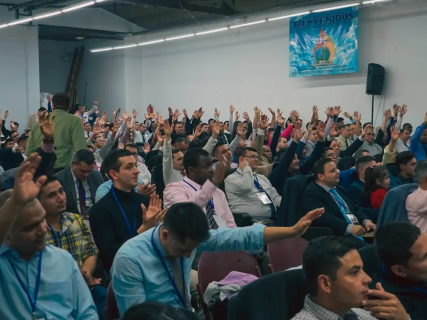

More than 10,000 people gathered last May at the Vistalegre Palace in Madrid to listen to the American preacher Franklin Graham, linked to Donald Trump, who took advantage of his speech to condemn abortion and homosexual relationships. In March 2024, the same venue had brought together about 10,000 people at an event led by the Brazilian pastor Edir Macedo, founder of the Universal Church of the Kingdom of God.
Both meetings show the ability of these churches to gather people in Spain, while some of the organizations and leaders promoting them maintain a close relationship with politics in their countries of origin.
The presence of these churches is growing especially in working-class neighborhoods where Latin American immigration is concentrated, which has contributed to the establishment of Pentecostal congregations linked to churches from their countries of origin, although evangelism already had a minority presence in Spain.
In several Latin American countries, these churches have also gained considerable electoral influence, with evangelical movements that have helped mobilize the right-wing vote, supporting conservative candidates and achieving institutional representation, as happened with support for Jair Bolsonaro in Brazil or with the presidential candidacy of Fabricio Alvarado in Costa Rica.
In Spain, the celebration of large gatherings and the opening of new places of worship reflect the growth of these communities, but that does not mean that their followers predominantly vote for the same parties.
The political interest lies more in the relationships that these churches may maintain with Spanish parties and in the influence of their leaders over the vote, especially when a part of the Latin American population residing in Spain still does not have Spanish nationality and, therefore, cannot participate in the general elections.
From Latin America to Carabanchel
On October 5, the United Pentecostal Church in Europe (IPUE), linked to the United Pentecostal Church of Colombia, organized an evangelistic march through Carabanchel to announce its national convention "And we saw His glory," scheduled from October 16 to 18 at the Vistalegre Palace in Madrid.
The organization began its activity in Spain in 2002, when the missionary Marcos Pabón arrived from Colombia, and since then it has expanded its presence through local congregations, youth camps, and national conventions. Although there are no independent figures on attendance at its main meetings, the organization maintains regular activity that includes national calls directed at believers from different cities.
According to the Observatory of Religious Pluralism in Spain, evangelical places of worship increased from 2,944 in 2011 to 4,763 in September 2025, with an increase of 308 compared to the previous year. Catalonia, with 1,010, Madrid, with 855, and Andalusia, with 744, are among the communities with the greatest presence.
However, Pentecostalism already had a significant presence in Spain before the arrival of new Latin American congregations. The Evangelical Church Philadelphia began to spread among the Roma population during the 1960s and developed a wide network of temples, decades before the expansion of churches of Latin American origin.
From Protestantism to Neopentecostalism
Evangelical churches are part of Protestant Christianity, although they comprise different denominations that share the importance of the Bible and personal faith, but have significant doctrinal and organizational differences. Among them are Baptist, Methodist, and Pentecostal churches, the latter characterized by their emphasis on the action of the Holy Spirit and religious experiences such as healing or what they call "speaking in tongues."
In recent decades, neopentecostal movements have also spread, some of them organized around large congregations and pastors with a significant media presence. Among these currents is the so-called prosperity theology, which links faith with material well-being.
Not all evangelical churches share the same social positions nor maintain a direct relationship with politics. While certain congregations advocate conservative positions on abortion, same-sex marriage, or education, others focus their activity on social assistance, community integration, and religious freedom.
When churches influence the ballot boxes
In Brazil, evangelical churches have gained political influence as their number of faithful and the presence of religious leaders in institutions increased. Jair Bolsonaro found among certain evangelical sectors one of his main electoral supports, with a conservative discourse on family, abortion, and education.
The so-called evangelical bench of the Brazilian Congress brings together parliamentarians related to different denominations who collaborate on certain legislative initiatives, although they maintain differences among themselves. A study published in the International Journal of Sociology, from CSIC, found that Brazilian evangelicals with more conservative sociocultural positions showed a greater propensity to vote for Bolsonaro.
In Costa Rica, the preacher Fabricio Alvarado managed to reach the second round of the 2018 presidential elections, in a campaign marked by the debate on same-sex marriage. Although he lost to Carlos Alvarado, his arrival at the second round placed an evangelical pastor at the doors of the Costa Rican Presidency.
In Colombia, several evangelical leaders participated in the "no" campaign against the peace agreement with the FARC in 2016, particularly critical of issues related to the gender approach. However, the result of the consultation responded to multiple factors and cannot be attributed exclusively to these organizations.
The possible political influence in Spain
Unlike Brazil or Costa Rica, in Spain there are no studies that allow for the identification of an organized evangelical vote around a candidacy, so there is not enough data to assert that these communities are driving a widespread shift of the vote towards the PP or Vox.
The Federation of Evangelical Religious Entities of Spain (FEREDE) represents a good part of these churches before the administrations on issues related to religious freedom, education, and spiritual assistance. This institutional activity does not imply electoral support for any party.
The right to vote is another important difference compared to Latin America, since foreign residents who have not acquired Spanish nationality cannot participate in general elections. Therefore, the growth in the number of temples and attendees at worship does not necessarily imply an equivalent increase in the electorate.
In Brazil, Costa Rica, and Colombia, some evangelical leaders have directly intervened in electoral campaigns or have supported certain candidates, while in Spain a comparable political mobilization has not yet been documented. The evangelical churches already gather thousands of people in Spain, but it remains unknown how many of them share electoral preferences and what relationship their leaders maintain with the parties.