This is the ELECTORAL COMMITTEE of the PP

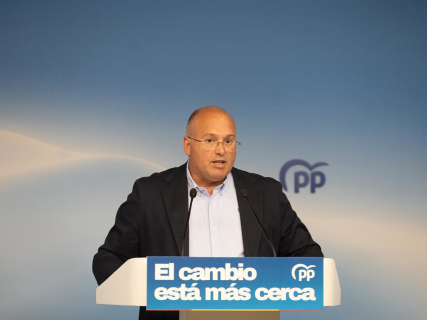
Tellado takes command of the PP campaign for the 29-N with Sémper and Ester Muñoz as spokespersons

fotonoticia 20260919140054 1920

fotonoticia 20260919140054 1920

Add DEMÓCRATA to Google

Ask FREN

Published

Last updated

3 minutes

Most read

Elecciones 29N · Encuestas

La media de las encuestas

Media a 17 de noviembre de 2026 · 17 institutos

  • PP31,4 %
  • PSOE27,2 %
  • Vox18,9 %
  • Frente Amplio6,2 %
  • ERC2,4 %
01020304050ene 2024jul 2024ene 2025jul 2025ene 2026jul 2026

Media del último estudio de cada instituto en 30 días y su evolución semanal desde el 23J. Partidos con al menos un 2 %.

Todas las encuestas

Elecciones generales del 29 de noviembre · Demócrata

Of course. With this data, the news can have interest beyond the simple listing: Miguel Tellado takes command of the PP campaign for the 29-N and the party deploys a very broad structure, with Sémper and Ester Muñoz as spokespersons and Bendodo at the head of studies and demoscopy. The territorial presence also allows to emphasize that Génova incorporates a representative from each community and from Ceuta and Melilla.

Tellado takes command of the PP campaign for the 29-N with Sémper and Ester Muñoz as spokespersons

Génova deploys a committee with specific responsibilities for program, demoscopy, communication, mobilization, and external voting and with representatives from all autonomous communities

The Popular Party has already designed the structure with which it will face the general elections on November 29. The campaign committee will be led by Miguel Tellado, who will assume the direction of the electoral strategy of Alberto Núñez Feijóo, accompanied by Marta Varela as deputy director.

The PP has distributed the main areas of the campaign among leaders with specific responsibilities. Borja Sémper and Ester Muñoz will be the campaign spokespersons, while Alma Ezcurra will be in charge of drafting the electoral program and Elías Bendodo will take on studies and demoscopy.

The structure also incorporates a specific area of parliamentary coordination, which will be directed by Álvaro Pérez, while Mar Sánchez will be responsible for social projection and the coordination of media and message. Political communication will be in the hands of Luis de la Matta and Isabel Figueira will direct the candidate's caravan.

The area of public opinion studies will correspond to María Martín, with Prudencio Pedrosa as deputy responsible. Electoral action will be the responsibility of José Enrique Núñez, while Ángel Luis González will direct territorial organization, accompanied by José Ángel Alonso as deputy responsible.

The committee also reserves specific areas for logistics and electoral mobilization. David Parry will be responsible for events and setups; José María Arribas, for mobilization; and Pilar Alía, for candidate training. The coordination of national leaders will correspond to Eduardo Carazo.

Reinforcement of new voters and external voting

The campaign will also have areas aimed at specific groups and segments of the electorate. Ignacio Dancausa, president of Nuevas Generaciones, will be in charge of the party's youth organization, while Carmen Cervantes will coordinate the area of Nuevos Españoles.

Lucas García-Badell will be the coordinator of agencies.

The PP has also reserved a specific structure for the external vote, which will be directed by Antonio Rodríguez Miranda, with Carlos Floriano as deputy responsible.

The financial direction will fall to Carmen Navarro, accompanied by Ferran Figuerola as deputy. The legal area will be directed by Alberto Durán, with Mariano Pérez-Hickman and Francisco Galeote as deputy responsible.

A representative for each autonomous community

The national leadership has incorporated into the campaign committee a representative from each autonomous community, in addition to Ceuta and Melilla. The objective is to transfer the national campaign to the different territories and maintain direct coordination with the party's autonomous structures.

For the Basque Country, Esther Martínez will be there; for Catalonia, Juan Fernández; for Galicia, Paula Prado; for Andalusia, Antonio Repullo; and for the Principality of Asturias, Beatriz Llaneza.

The representation of Cantabria will correspond to María José González Revuelta; that of La Rioja, to Alfonso Domínguez; that of the Region of Murcia, to José Miguel Luengo; that of the Valencian Community, to Gerardo Camps; and that of Aragon, to Ana Alós.

Also part of the committee will be Carolina Agudo, for Castilla-La Mancha; Ramsés Páez, for Canary Islands; Maribel García Malo, for Navarre; Abel Bautista, for Extremadura; Marga Durán, for Balearic Islands; Alfonso Serrano, for the Community of Madrid; and Isabel Blanco, for Castilla y León.

They are joined by Guillermo Martínez, representing Ceuta, and Miguel Marín, for Melilla.

The Electoral Committee will be chaired by Diego Calvo.

With this organizational chart, the PP formally starts the electoral machinery for the 29-N, with a centralized direction in Tellado and differentiated areas for the program, political strategy, communication, demoscopy, mobilization, territorial organization, and external vote.

More key points, information and questions with FREN

AI-GENERATED CONTENT

What is the status of the processing of the general election call for November 29th, and what steps remain pending until its celebration?

The call for the general elections on Sunday, November 29, 2026 (29‑N) is already fully formalized. The Royal Decree 806/2026, of October 5, dissolving the Congress of Deputies and the Senate and calling elections, was published in the Official State Gazette on October 6, setting the date of the elections and the constitution of the new Chambers on December 23. Since that publication, the XV Legislature Cortes have been dissolved and the electoral calendar provided by the Constitution and the Organic Law of the General Electoral Regime (LOREG) is underway.

1. Current status of the call

According to the Royal Decree 806/2026 and press releases from the Congress and the Senate:

  • Dissolution of the Chambers: the Congress and Senate elected on July 23, 2023, have been dissolved, effective from the publication of the decree.
  • Call for elections: elections are called for both Chambers on Sunday, November 29, 2026.
  • Number of seats per constituency: the decree details the distribution of deputies and senators by provinces and islands according to articles 162 and 165 LOREG; among other adjustments, Madrid gains one deputy (38) and Cádiz loses one (8).
  • Electoral campaign: a campaign of 15 days is set, from 00:00 on Friday, November 13 until 24:00 on Friday, November 27; November 28 will be a reflection day.
  • Constitutive session: the decree establishes that the new Chambers will meet in constitutive session on December 23 at 10:00 a.m., within the maximum period of 25 days set by article 68.6 of the Constitution.

In parallel, the dissolved Cortes are essentially replaced by the Permanent Deputations of the Congress and the Senate, which oversee the powers of the Chambers and can, for example, validate or repeal decree-laws or assume the functions provided for in states of alarm, exception, and siege while the dissolution lasts.

From an operational point of view, the electoral period has already begun: the decree has activated the prohibition of institutional propaganda and inauguration acts, the electoral boards have started to move, and the period to request postal voting has opened, as reflected in the communications from the Postal Service and the information from Demócrata about the remote voting calendar.

2. Pending steps until 29‑N

With the call in force, what remains ahead is the execution of the electoral calendar. In summary, the main milestones are:

  • Electoral bodies: constitution or reactivation of the Central Electoral Board and the provincial and district electoral boards, which organize and supervise the process.
  • Coalitions and candidacies: parties and coalitions finalize their agreements and submit their lists to the Congress and Senate before the provincial electoral boards, within the deadlines set after the publication of the decree. Subsequently, the official proclamation of candidacies is made, which is published in the official gazettes.
  • Electoral census: display of the census lists for consultations and claims during the days enabled after the call. Municipalities such as Alicante have already announced the exhibition of the census between October 12 and 19.
  • Postal voting:
    • Request for postal voting from the entry into force of the decree until November 19, both online and at post offices.
    • Sending of electoral documentation to applicants from November 9.
    • Deposit of postal votes until November 25, four days before election day.
  • Electoral campaign: development of the campaign between November 13 and 27, with the usual LOREG limitations (spending caps, control of advertising, events, and debates).
  • Reflection day: Saturday, November 28, during which vote solicitation is prohibited.
  • Voting day: Sunday, November 29, with general opening of polling stations from 9:00 a.m. to 8:00 p.m., counting at the tables, and dissemination of provisional results the same night.
  • General scrutiny and proclamation: from December 2, the electoral boards carry out the general scrutiny, resolve incidents, and formally proclaim the elected.
  • Constitution of the new Cortes: on December 23, the constitutive sessions of the Congress and Senate are held, the Boards of both Chambers are elected, parliamentary groups are constituted, and from there, the procedure for the investiture of the next president of the Government opens according to article 99 of the Constitution.

In summary, the “processing” of the call as a legal act is already concluded with the publication of Royal Decree 806/2026; the process is now in the phase of deployment of the electoral calendar, in which administrative, party, and logistical steps are chained that will lead from the presentation of candidacies to the voting on 29‑N and the subsequent constitution of the new General Cortes.

Can you detail the exact calendar for the presentation and proclamation of candidacies for 29‑N, including deadlines and competent bodies? What effects does the dissolution of the Cortes have on the bills that were being processed when the elections were called? How will the Government function during this period, especially before and after 29‑N, and what limits will it have as a caretaker government?

What are the competencies and functions of a president of the Electoral Committee in the Popular Party according to the party's statutes?

According to the National Statutes of the Popular Party (updated after the XXI National Congress of 2025), the National Electoral Committee is the body responsible for the direction and coordination of the party's electoral activity, and its president exercises a set of functions that are always understood within that collegiate framework and subordinate to the higher bodies (national president, National Executive Committee, National Board of Directors, etc.).

1. General framework: what is the National Electoral Committee

The Statutes define the National Electoral Committee as the body that:

  • Coordinates the strategy and electoral activity of the Popular Party as a whole.
  • Develops or proposes common criteria on campaigns and electoral processes (messages, general lines, campaign guidelines).
  • Monitors electoral processes and candidacies, supervising their preparation and development.
  • Coordinates territorial electoral committees (regional, provincial, local) to ensure homogeneous action.
  • Assists the party's governing bodies in all matters related to elections and candidacies.
  • Exercises all functions expressly attributed to it by the Statutes, internal regulations, or agreements of the competent bodies.

Additionally, and as explicitly stated in the Statutes, the National Electoral Committee is the body responsible for appointing candidates for:

  • The presidencies of the autonomous governments.
  • The presidencies of provincial councils and analogous positions (such as general deputies).
  • The mayoralties of the capitals of autonomous communities and provinces.
  • Other elective positions of the highest territorial level (councils, island councils, general boards).

2. Functions specific to the president of the Electoral Committee

On that basis, the Statutes assign the president of the National Electoral Committee a set of internal management and representation competencies of the body. In summary, their statutory functions are:

  • Call and preside over meetings of the National Electoral Committee, setting the agenda according to the party's internal rules.
  • Direct debates and organize the committee's work, ensuring that deliberations comply with the Statutes and internal electoral regulations.
  • Coordinate the actions of committee members, distributing tasks, specific assignments, and proposal reports (for example, for candidate selection in a territory or for the design of a specific campaign).
  • Promote the execution of the committee's adopted agreements, ensuring that collegiate decisions (such as candidate designation or adoption of campaign criteria) are effectively transmitted to the organization.
  • Represent the Electoral Committee before other PP bodies when appropriate, especially before the national president, the National Executive Committee, or the National Board of Directors, to whom they submit proposals and report on the body's activity.
  • Submit reports, proposals, or agreements of the committee to the party's competent bodies, both for final approval and for political knowledge.
  • Coordinate with territorial bodies and national leadership on electoral matters, acting as a liaison between the committee and the regional, provincial, and local structures.
  • Exercise additional functions that the Statutes, electoral regulations, or the national president of the PP may expressly entrust.

3. Limits and hierarchical fit of the presidency

Although the National Electoral Committee is formally attributed key competencies such as the designation of candidates for regional presidencies, provincial councils, or mayoralties of capitals, the Statutes make clear that the committee president:

  • Does not decide candidacies alone nor the entirety of the electoral strategy, but always acts within the framework of the collegiate decisions of the committee itself.
  • Is subject to the party's general political leadership, which corresponds to the national president and governing bodies (National Executive Committee, National Board of Directors).
  • Must adjust their actions to the Statutes and internal regulations, without invading competencies of other bodies (for example, regarding congress calls, organizational structure, or general political line).

In summary, according to the Popular Party Statutes, the president of the National Electoral Committee is the top responsible for the internal management and functioning of that body, guarantor of the execution of its agreements, and main interlocutor on electoral matters with the rest of the organization, but always as part of a collegiate body and under the political leadership of the party's top management.

What requirements must a representative meet to be part of the PP's National Electoral Committee?

The current Statutes of the Popular Party (PP) and the available internal documentation do not list a closed set of specific personal requirements to be a member of the National Electoral Committee equivalent to those demanded, for example, of candidates in primaries. The regulation focuses mainly on the composition of the body, its appointment method, incompatibilities, and functions.

That said, a series of general conditions can be identified that, in practice, any representative who is to join the PP's National Electoral Committee must meet.

1. Membership status and full internal capacity
  • The National Electoral Committee is part of the PP's national organic structure. Its members are appointed by the party's national bodies and act on behalf of the organization. Therefore, the status of member is de facto required.
  • The PP Statutes establish that only members who are in full exercise of their rights can participate in internal bodies and organic processes. This implies:
    • Not being suspended from membership.
    • Not being subject to a sanction that limits internal rights.
    • Not being involved in causes of internal organic incompatibility.
  • The PP's congress regulations require, to participate in internal votes (delegates, congress processes, etc.), being up to date with economic obligations to the party. This is a reasonably extrapolable criterion for those assuming relevant organic positions, as is the case here.
2. Appointment by the competent body

Access to the National Electoral Committee does not occur by direct election of the membership, but by internal appointment:

  • The PP Statutes assign to national bodies (Executive Committee, National Board of Directors, etc.) the competence to appoint members of the National Electoral Committee.
  • Consequently, the central requirement is not so much to pass a “selection” or have a specific profile, but to be validly proposed and appointed according to what the Statutes provide and, if applicable, the internal regulation applicable to the specific electoral process.
3. Ethical code, suitability, and honorability

Recent statutory reforms of the PP reinforce the ethical dimension of its organic and public positions:

  • The PP requires the subscription of a declaration of suitability and its Code of Ethics and Conduct from those assuming organic responsibilities or integrating electoral lists. Refusal to sign this declaration may prevent holding the position.
  • This declaration usually includes commitments to honorability, transparency, responsibility, and compliance with internal and external regulations. A member of the National Electoral Committee, due to their role in candidate selection, is expected to meet these standards especially strictly.
4. Incompatibilities and neutrality in electoral processes

Although the Statutes do not exhaustively detail specific incompatibilities of the National Electoral Committee, internal practice and the party's territorial regulations imply several principles:

  • Committee members must guarantee the neutrality of the body in the elaboration and approval of candidacies.
  • It is considered incompatible for a committee member to use their position to personally benefit in the candidacies that the committee itself approves or proposes.
  • Internal regulations emphasize avoiding conflicts of interest and ensuring conditions of equal opportunities among potential candidates.
5. What the Statutes do not expressly require

In the statutory and regulatory documentation consulted from the PP, it does not expressly appear as a general requirement to be a member of the National Electoral Committee:

  • A minimum membership seniority.
  • A specific academic degree (for example, Law).
  • Specific prior experience in campaigns or electoral bodies that is fixed and quantified.
  • Additional numerical requirements beyond the general ones of membership, quotas, and suitability.

Such types of requirements exist in other parties or in statutes of federations and different entities, but they should not be automatically transferred to the PP.

6. Practical conclusion

In practice, for a representative to be part of the PP's National Electoral Committee, they must:

  • Be a party member with full capacity of rights (without sanctions or suspension).
  • Be, if applicable, up to date with their economic obligations to the party.
  • Be appointed by the competent internal body, as provided in the Statutes.
  • Subscribe to the Code of Ethics and the declaration of suitability required by the PP.
  • Respect the incompatibilities and neutrality derived from their arbitral role in candidate selection.

For a specific case (for example, a specific electoral process), the internal or electoral regulation approved ad hoc should also be reviewed, which may add additional organizational criteria without contradicting this general framework.

Play

Test your knowledge with FREN!

How much do you know about this topic? Answer the following 3 questions.

Who is taking over the direction of the PP campaign for November 29?

Question 1 of 3

How many territorial representatives does the PP Electoral Committee include, besides Ceuta and Melilla?

Question 2 of 3

Who will be the spokespersons for the PP campaign for November 29?

Question 3 of 3