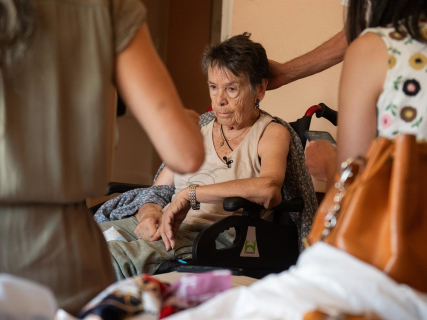

The name of Maricarmen Abascal, protagonist of the housing protests following her recent eviction in Madrid, is linked to a real estate episode that occurred more than two decades earlier. The Official State Gazette of June 13, 2000 published a decree from the Court of First Instance and Instruction number 2 of Collado-Villalba in which a woman named María del Carmen Abascal Martín is listed as the defendant in procedure 117/99, initiated at the request of Banco Zaragozano to claim a mortgage loan. The judicial announcement also set the auction of the property on which the mortgage was placed.
La Razón has identified the defendant in that procedure as the same Maricarmen Abascal whose case has caused extensive mobilization in Madrid in recent weeks. There is also another element that connects the current tenant with Collado Mediano: Urbagestión, owner of the Retiro housing from which she was evicted, stated in September that she had previously been registered in that locality. El País, after consulting her registration certificate, later specified that this administrative residence lasted about four months between July and November 2001 and was related to a job. The decree from the BOE, however, does not contain an ID number or other personal data sufficient to establish that identity on its own.
A chalet in Collado Mediano valued for auction at 20 million pesetas
The property subject to the procedure was a single-family home located in the Reajo del Roble urbanization, number 2, on plot B-2 of Collado Mediano, in the Sierra de Guadarrama. The Property Registry described it at that time as a "under construction" home and the court set the starting bid for the first auction at 20 million pesetas, nominally equivalent to about 120,200 euros after the subsequent conversion of the Spanish currency.
The first bid was scheduled for July 13, 2000. If it remained vacant, the decree contemplated a second auction for September 13, with a starting price equivalent to 75% of the initial, and a third on October 18, no longer subject to a minimum price. The document allows for the verification that Banco Zaragozano went to court to claim the loan and that the mortgaged property was brought to auction, but it does not specify how much money was still owed, how much had been previously amortized, nor what the final result of the bids was.
It also does not allow knowing if Maricarmen actually lived in that house. That the property was registered as "under construction" does not necessarily demonstrate that the works were in that same physical state, as there may be discrepancies between the reality of a property and its registered description. Some information has taken for granted that she never inhabited the chalet, while other sources consider that this extreme cannot be established solely from the edict. What is documented is the existence of a mortgage operation and the subsequent judicial procedure for reclamation.
A different precedent from the old rent apartment in Retiro
The episode of Collado Mediano is legally independent of the conflict that decades later would end with the eviction of Maricarmen from the house on Alcalde Sainz de Baranda street, near Retiro. That apartment was a rented dwelling since 1956 under the old rent regime, initially to her parents. After various subrogations of the contract, Urbagestión argued that Maricarmen's right to remain in it had been extinguished according to the Urban Leasing Law of 1994. The Provincial Court of Madrid declared the contract extinguished and that resolution was subsequently confirmed by the Supreme Court.
The company stated in its communication on September 24 that the second subrogation occurred in 2005 and that the necessary legal exceptions to maintain that contract indefinitely did not apply. The Tenants' Union did not dispute that there was a firm judicial resolution, but questioned the material justice of the eviction and turned the case into a claim to change the legislation on rentals and protection of vulnerable people.
Precisely in that communication, Urbagestión introduced the data of Collado Mediano by stating that Maricarmen had been registered there before 2001. The documentation subsequently consulted by El País clarified the scope of that statement: the absence of the Retiro address would have lasted four months, after which she returned to Madrid. The registration and the mortgage procedure do not prove the same thing by themselves: one certifies an administrative residence, while the other reflects the existence of a financial operation linked to a property.
Maricarmen has already reached an agreement to return to her home
The data from the old mortgage procedure comes to light after the Retiro conflict has taken a new turn. Maricarmen, aged 87 years, was evicted on September 23 after several previous attempts, but a few days later Urbagestión and its representatives reached an agreement, with mediation from the Municipal Housing and Land Company of Madrid, for her to return to the same apartment once she receives hospital discharge. The agreement includes a rental contract of eight years and a rent that will not exceed 30% of her net income.
This agreement does not modify what happened in Collado Mediano nor does it allow for automatic conclusions about her current situation. The document from 2000 shows that a María del Carmen Abascal Martín was involved in an operation to acquire a home through mortgage financing and that Banco Zaragozano ended up claiming that credit judicially. It does not demonstrate, by itself, that she retained real estate assets afterwards, that she came to occupy that chalet, or that the episode has a legal relationship with the old rent contract that has focused the controversy of 2026.
What the BOE allows to affirm and what it does not
The edict does make several facts clear: the judicial procedure existed, was initiated by Banco Zaragozano, was directed against María del Carmen Abascal Martín, affected a single-family home in Collado Mediano, and the court set a first auction for 20 million pesetas.
From there, questions arise that the BOE does not resolve. The outcome of the execution is not listed, it does not state in that document whether the property was awarded, nor does it specify the exact outstanding debt or prove that the home was used as a habitual residence. The precedent thus provides a piece of the real estate history attributed to Maricarmen that has been little known until now, but it must be distinguished from the conflict that ended with her eviction in Retiro and the subsequent agreement that will allow her to return to the home.