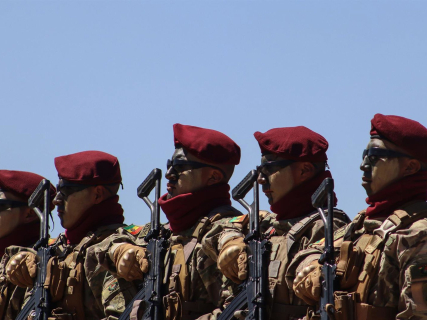

The Supreme Council of Defense of the Plurinational State of Bolivia (COSDEP) has given the green light this Wednesday to four key initiatives to tackle organized crime. Among them are a reinforcement of security capabilities and the creation of a new legal framework that allows the Armed Forces (FFAA) to act against criminal organizations. These projects will be analyzed by the Unit for Analysis of Social and Economic Policies (UDAPE) before being sent to the Legislative Assembly.
The measures aim to provide the State with an "additional tool" against criminal networks, as pointed out by the president of COSDEP and the country, Rodrigo Paz, "they can resort to any illicit source, both narcotics and illegal production in mining or in other instances," according to the Bolivian newspaper 'El Deber'.
In the presentation of the proposals, the Minister of Defense, Ernesto Justiniano, emphasized that the "response of the State" must adapt to the way criminal organizations operate, since "they do not only function by transporting drugs, but they can have logistics, financing, weapons, technology, international routes, and structures capable of exercising violence."
Justiniano detailed that the first initiative consists of the "Security and Defense law"; the second seeks for "COSDEP to coordinate strategically with the State"; the third focuses on "the intelligence system to anticipate criminal organizations," and the fourth proposes a "norm that establishes an exceptional tool to confront serious threats from transnational organized crime and narcoterrorism."
Regarding the role of the Armed Forces, the minister insisted that there is no proposal for a "general intervention, but rather an exceptional, temporary, complementary, and controlled participation, within the constitutional framework and with respect for rights and guarantees," according to what was published by the Bolivian media Unitel.
For his part, Paz defended that "coordination between the police and the FFAA has constitutional backing" and that the "police will be a fundamental factor in achieving the objectives defined by COSDEP."
In this line, Justiniano insisted that defense policies must "evolve, with more intelligence, greater control of borders and of air and river space, and better institutional coordination and greater cooperation with neighboring countries."