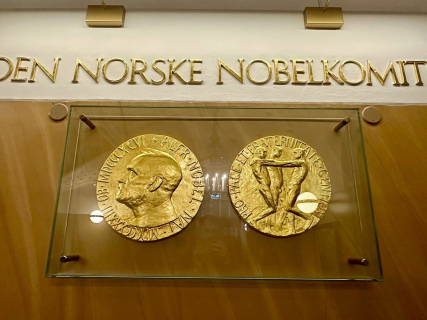

The Norwegian Nobel Committee announced this Friday the awarding of the Nobel Peace Prize to the South African jurist Navanethem Pillay, known as Navi Pillay, former United Nations High Commissioner for Human Rights and former judge of the International Criminal Court (ICC).
"The Nobel Peace Prize 2026 is for a person whose exceptional courage and integrity have led the way towards a more comprehensive international legal order," declared the committee's president, Jorgen Watne Frydnes, who emphasized his commitment to ensuring that those responsible for "war crimes, crimes against humanity, and genocide" are brought to justice.
"Navi Pillay's commitment to universal legal principles and her strong moral compass are constants in her long career," he highlighted, recalling her role as a lawyer and "legal pioneer" during Apartheid in South Africa, when she faced "deep structural discrimination, segregation, and exclusion."
Frydnes underscored the "thread" that links her work defending anti-apartheid leader Nelson Mandela with "her role as a judge in some key international judicial cases," including her positions in the Supreme Court of South Africa, the International Criminal Tribunal for Rwanda, and the ICC itself, as well as her time at the helm of the UN High Commission from 2008 to 2014.
Pillay, who between 2021 and 2025 chaired a United Nations commission tasked with investigating human rights violations in Israel and the Occupied Palestinian Territories, currently serves as an 'ad hoc' judge in the proceedings against Myanmar for the genocide allegations against the Rohingya Muslim minority in Rakhine state.
"In historic cases before international courts, she has demonstrated that legal measures can help prevent acts of war and violence," Frydnes noted, adding that Pillay "has also contributed to strengthening the institutions of International Law." "Her independence, experience, and firmness have made her one of the most respected international jurists of our time," he stated.
In his intervention, he emphasized that "in a moment of existential challenges, including more wars and conflicts than the world has seen in a long time, International Law is no longer a supplement to peace and security." "It is a necessity," he warned, while lamenting that "the system of International Law is under tremendous pressure" and that "its institutions are being attacked."
"We are witnessing a shift towards power politics to the detriment of legal frameworks and global respect for Law and justice. Whenever force is imposed over Law, stability, trust, and peaceful coexistence are undermined," he alerted. He then insisted that this year's award aims to "remind the world" that the rule of law "is the foundation of the established system to guarantee peace and resolve conflicts non-violently."
"Peace demands justice. History has shown that a world that operates outside the rule of law is unjust, reckless, and inhumane," he stated during the announcement, in which he highlighted that Pillay "has held states and national leaders accountable, and has brought hope to the victims of violence and conflicts."
In this line, he defended that the awardee "is one of the great defenders of the international legal principles of our time." "Her distinguished career reminds us of the need to support, strengthen, and expand the rule of law on a global scale. Navi Pillay's commitment to justice and human dignity is a source of hope and inspiration for all those who aspire to build a more peaceful world," he concluded.
Pillay claims international justice upon receiving the Nobel
Pillay responded to the Nobel announcement with a firm defense of International Law and international courts against attempts to "weaken international criminal justice and jeopardize the progress made" since the Nuremberg trials against the Nazi leadership of Germany after World War II, considered the origin of contemporary International Criminal Law.
The coincidence has wanted that Pillay found herself this Friday at the headquarters of the historic tribunal of Nuremberg, from where she has read a statement of gratitude. "I would like to dedicate this award to all the survivor victims of international crimes, as well as to the professionals and defenders of international justice, whose compassion and bravery continue to ensure that impunity is not tolerated," she has indicated.
In the face of attacks against international justice, she has warned of the danger of returning to a scenario "in which it is power, and not the law, that determines which suffering matters." "This award represents my firm conviction that we must remain united in defense of the rule of law and of independent courts and an international legal order based on principles, and not on the selective application of justice," she has emphasized.
In her statement, Pillay has remarked that the international legal framework is "an indispensable condition for a peaceful world" and has explained that, throughout her extensive career, she has maintained the purpose of "promoting and protecting the equal dignity of all human beings, as well as the rights of women and children."
In this way, she has appealed not to abandon the "promise" enshrined in the United Nations Charter to preserve future generations from the "scourge of war." "That is the promise we owe to all the victims and survivors of international crimes, to our children and to those who will inherit the world of tomorrow," she has emphasized.
Born in South Africa in 1941, the recognized international jurist succeeds the Venezuelan opposition figure María Corina Machado, distinguished in 2024 for her "tireless effort" to promote rights and freedoms in Venezuela and to favor a "just and peaceful" transition from "dictatorship to democracy."
The Norwegian Institute received more than 280 nominations this year, of which 208 corresponded to individuals and 79 to organizations. The candidacies remain secret and the names are only revealed 50 years after the award is granted.