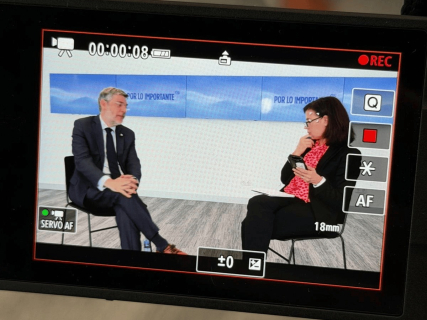
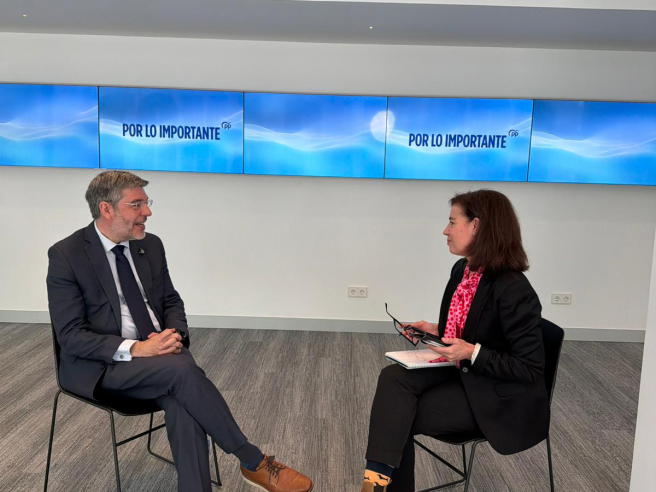
Democrat has gone to the national headquarters of the Popular Party, on Madrid's Génova 13 street, to interview the deputy general secretary of the Popular Party, Alberto Nadal. In an open-plan room, full of light, on the ground floor, next to the street, a team of technicians from this party received us, with whom an interview set was assembled in a few minutes. The popular leader, a civil servant from the senior corps of state commercial technicians, quickly arrives at this improvised studio.
He does it with a cold, but despite that, happy and eager to talk. Before starting the interview, we tell him that the Institute of Economic Studies (IEE) has just published a report on the deficit our economy has in public infrastructure. Swiftly, he pounces on the study... Minutes of concentration, to immediately after hear: “Silence, lights, and action!”
Alberto Nadal“Spain has a deficit, and not only in infrastructure. It should aspire to get closer to the 30 most advanced countries”
QUESTION. Mr. Nadal, thank you very much for receiving us at the headquarters of the Popular Party, in this space with so much light. Are you happy with the election result?
RESPONSE. Thank you very much for coming. We want to shed light on politics. I believe we have demonstrated that only through the Popular Party can a change be driven in Spain, and that can only be achieved with governments led by the Popular Party. Only in this way can policies that have caused so much damage and that are not giving hope to Spaniards be transformed. We have to talk about transformations.
Q. Now that you speak of transformations: a report from the Institute of Economic Studies has just been published, which analyzes the current situation of infrastructures in Spain and compares them with those of our European Union partners. The report indicates that Spain has an infrastructure deficit that, just to converge in per capita income with the EU, amounts to 55,000 million euros.
R. Spain has a deficit, and not only in infrastructure. It should aspire to get closer to the 30 most advanced countries. The problem is that the policies of Pedro Sánchez's Government discourage private investment. Ultimately, excessive regulation ends up taking its toll on the productive sector.
In the public sphere, the situation is also striking. We have had a Government with growing resources: more than 170,000 million additional euros in revenue compared to 2018 and 163,000 million in European funds, of which 40% has been returned. And, nevertheless, we have a public investment deficit.
What do we propose? Reduce the weight of public spending in the economy. That reduction must translate into a tax cut and, at the same time, into a prioritization of spending towards the essential: public services, education, and infrastructure. For this, we will need a great infrastructure plan.
Q. The report concludes something paradoxical: while tax collection increases, investment decreases. What is this due to?
R. It makes no sense that, with the increase in public resources and spending, Spain is not among the countries with the highest investment. If we want to modernize the country, public investment is essential.
The number one objective must be to increase productivity. Without productivity, public services cannot be sustained, nor pensions, nor can salaries be improved. The Government likes to raise the minimum wage; we want the average wage to rise. And for that, public and private investment is key.
Q. What are the most important infrastructures to reform and maintain?
R. All: roads, railway, reservoirs, irrigation systems or water recycling systems. The entire network must be maintained. Our high-speed rail was the envy of the world, but now Spain is not functioning as it should.
In the electrical sector, a blackout cannot be repeated: it is unacceptable in a developed country. We also need digital infrastructures. Spain must be prepared to attract investments in data centers and new technologies.
The measures of the PP focused on families with children
Q. What measures has the Popular Party taken to address the economic cost of the conflict in the Middle East? Do you think the Government is slow to respond?
R. Our measures not only seek to alleviate the cost of energy, but also to recover the purchasing power of families, especially middle classes with children.
The first measure is a reduction of the IRPF, which will be permanent. We want to return to families the increase in tax pressure derived from not having updated the tax. Personal minimums are increased and minimums for children are doubled. In addition, the tax brackets are revised to benefit 16 million taxpayers with 3.2 billion euros.
This is permanent because the loss of purchasing power also is. The rise in energy only aggravates a problem that comes from behind: for years, salaries have grown less than inflation, while taxes were increasing.
Alberto Nadal“We propose conjunctural measures to reduce the impact of the rising cost of energy: lower the VAT from 21% to 10% on energy products and eliminate the generation tax”
Q. So, are we Spaniards increasingly poorer?
R. In general yes, and especially families with children.
Furthermore, we propose conjunctural measures to reduce the impact of the rising cost of energy: lower the VAT from 21% to 10% on energy products and eliminate the generation tax.
We also proposed aid to particularly affected sectors: agriculture, fishing, electro-intensive industry, and gas consumers. It is a temporary tax reduction while this situation lasts.
Q. Is the Government late?
R. Yes. Other countries like Italy, Croatia, or Portugal have already acted. Measures can be linked to the duration of high prices and withdrawn afterwards. There is no excuse. The impact is already noticeable in fuels, heating, and electricity.
Q. Europe sends a double message: it asks to reduce taxes on electricity and, at the same time, not to close nuclear plants. How does this fit with competitiveness?
R. Energy is key for competitiveness. The Government is making serious mistakes, such as going ahead with the closure of nuclear power plants. And, the first thing is to reverse that process. Nuclear energy is necessary, as are hydroelectric and renewables.
In addition, we have a serious problem of access to the electricity grid. There are industrial and technological projects that cannot be developed due to lack of connection. This is not typical of an advanced country. We need a shock plan that resolves access to the grid within a period of 12 to 18 months.
Alberto Nadal“Sánchez designed an unrealistic energy plan and then did not implement policies to avoid problems. Therefore, we will have to order the energy system, maintain nuclear energy, and decarbonize at a competitive price”
The energy policy and nuclear power plants
Q-. Then they have little time left.
A-. Well, from 12 to 18 months. They, the Government, will not do it. We will do it as soon as the Spanish give us the opportunity.
Q-. Well, tell us about nuclear power plants to generate energy, not only for those databases, but also to prevent a new blackout.
A-. Of course. Demand is growing and the country is electrifying. In addition, there are new technologies, such as data centers, which are very intensive in electricity consumption. This is positive, because they are modern factories: while 19th and 20th century factories produced physical goods, 21st century factories work with data. That these facilities are installed in Spain is good news, but for that, our renewable sources —wind and photovoltaic— must be correctly integrated into the system, avoiding blackouts and ensuring connection to the grid.
The problem is that the Government of Pedro Sánchez designed an unrealistic energy plan and then did not implement concrete policies to avoid problems. That is why, once again, we will have to order the energy system, maintain nuclear energy and decarbonize at a competitive price.
Q-. Does that mean that Spain could be left alone in its stance on nuclear energy if the current policy is not corrected?
A-. Spain will be left alone, with respect to Europe and the rest of the world.
Q-. In this way, and according to what the PP defends, we will lose competitiveness.
A-. But it will not happen, as long as Spaniards give us their trust.
Alberto Nadal“Vox voted alongside the radical left for the Mercosur agreement to be reviewed by the Court of Justice, which in practice gave free rein to the European Commission”
Vox in the governments of the PP
Q-. You have stated that Vox must facilitate María Guardiola's government in Extremadura. After Sunday's result, do you believe that Vox is in a position to ask for a specific number of ministries?
A-. The electorate has said two things: first, that the governments of Extremadura, Aragon, and Castile and León must be led by the Popular Party, which has been the winning party with a significant difference over the second and third. Second, that of all possible governments, the most logical is one in which the Popular Party is supported by Vox, which until now has been reticent.
President Feijóo has already sent a government program with the fundamental points on which we can reach an agreement. These are common sense measures that respond to the needs of the autonomous communities and of Spain. Work must be done on that basis, guaranteeing stable governments and that everyone assumes the responsibility of their mandate.
Q-. It talks about the Popular Party's framework program.
A-. Exactly, we talk about the framework program, and then about stability, budgets and responsibility.
Q-. But Vox will also present its program, and there the "mother of all battles" could arise.
A-. The framework program proposed by the president is based on principles with which we are sure Vox will agree, because they respond to the concerns of Spaniards. From there, specific issues can be detailed, but the three governments must be negotiated to fulfill the mandate of the polls, which is unequivocal.
Q-. What if Vox is inflexible on issues like Mercosur?
A-. We agree that Mercosur is important for Spain and its farmers. Many problems existed before Mercosur, such as the reduction of Common Agricultural Policy funds and the overregulation of the sector. The Popular Party has always defended the interests of farmers, ranchers, and fishermen.
Regarding Mercosur and other trade agreements, farmers ask for equivalent regulation and investment guarantees at the border and origin. Vox, however, has voted in the European Parliament in such a way that Mercosur came into force without enough time to protect these guarantees. They voted alongside the radical left for the Agreement to be reviewed by the Court of Justice, which in practice gave free rein to the European Commission. We wanted to ratify it under conditions: 45,000 additional millions for the CAP, border controls, effective safeguards and deregulation to allow competition. The CAP was approved with Vox's vote against and the abstention of the radical left.
Q-. It seems this is not the first time that Vox, along with the radical left, votes against measures that protect Spanish agriculture.
A-. Here it is about protecting our farmers and ensuring that European policies, oriented towards new technologies, do not reduce agricultural funds, which are essential for Spain. We would like to see Vox closer to farmers and less focused on attacking the Popular Party.
Alberto Nadal“For them to function, independent bodies —CNMC, CNMV, Banco de España, AIReF— need capable and independent people, perceived as such”
The independence of the institutions
Q-. The Government has sent a message about the change in the presidency of the AIReF, with a person of confidence of Vice President Montero in the Ministry of Finance. Could the last bastion of independence of public institutions thus be lost?
A-. It's dramatic. For them to function, independent bodies —CNMC, CNMV, Bank of Spain, AIReF— need capable and independent people, perceived as such. Appointing someone directly linked to the Ministry of Finance, who also designed the autonomous financing system, to evaluate communities governed by the PP is unprecedented and dangerous.
Q-. Will this be taken to Congress?
A-. Yes, it will have to be voted on. In the Treasury Committee it could be approved by majority, but this would destroy the credibility of AIReF, which validates budgets and enjoys a high reputation in Europe. Such a change compromises Spain's fiscal and financial stability.
Q-. Would it function as a political commissar?
A-. Everything it says will be under suspicion, since it would go directly from the Ministry to evaluate the Ministry itself and other administrations. The AIReF is guarantor of the fiscal and financial stability of the entire country.
Alberto Nadal“The Spanish employment rate is below Germany's: 72% versus 82%. To equal Germany, we would need 14% more of the active population”
Audits, fixed discontinuous
Q-. Regarding the audit you plan if you come to power, what could be found?
A-. Not just "chiringuitos". Comparing public spending in 2017, the last year of the PP government, with the current one, it has risen four and a half points of GDP, much faster than the economy. Part is explained by pensions and healthcare, but there are inexplicable expenses: benefits with reduced requirements, bureaucratic increase, cultural vouchers and expenses that grow even when the unemployment rate decreases.
Furthermore, there is statistical manipulation: the “permanent intermittent” were previously considered temporary. The important thing is to know how many Spaniards work, how many hours and what they obtain. The Spanish employment rate is below Germany: 72% versus 82%. To equal Germany, we would need 14% more of the active population, increasing production and collection without raising taxes.
Q-. Would you reveal the true list of inactive permanent-seasonal workers?
A-. Statistics must be comparable and reliable. The LFS shows that unemployment decreases, but partly because half a million people enter the labor market each year. This does not increase productivity nor average wages; only the minimum wage rises due to governmental obligation, which does not reflect real productivity.
Alberto Nadal“We must align with our allies, adopting measures that affect families and businesses as little as possible”
The role of Spain
Q-. Spain is immersed in a war. What role does it play and what consequences can it have?
A-. Spain is part of the Western world and the EU. We must align with our allies, adopting measures that affect families and businesses as little as possible. Our proposals are not just cyclical due to energy; they seek to return to families the taxes increased by Sánchez and eliminate electricity taxes, now possible to suppress.
P-. Many thanks for your interview.
R-. Many thanks to you.
*The camera lights go out. Alberto Nadal seems satisfied for having answered this interview without coughing or feeling bothered. "At least -he states-, I have managed to explain the things I wanted to. I know that many topics are a matter for economists, and they are complex, but we have to strive to tell them and to tell the truth," he tells us before accompanying us to the door and taking a walk with us for a while down Zurbano street.