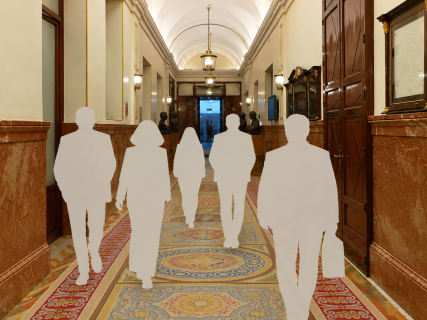

When Francina Armengol lifted the session on October 2, Pedro Sánchez had not yet announced the advance of the general elections. However, at the beginning of the debate, several deputies posed and took photos for the memory, as if it were the last day of school. After the repeal of the royal decree-laws on housing, their lordships left the hemicycle with a melancholic air, aware that they might have witnessed their last dance.
For their part, the senators did not even have room for that feeling, because the siren songs about an electoral advance intensified when the Upper House had already amortized the week. On October 6, the BOE published the dissolution of the Cortes and hundreds of parliamentarians said goodbye to their position and their office during the last three years.
For the memory, eternal days, races, debates, shocks, and endless votes that they could not have reached without the parliamentary advisors. They are the hidden face of the legislative power, the armed and technical arm of the political class.
With the electoral advance, the majority of deputies and senators have lost their status, but paradoxically, their teams will retain their jobs until mid-December.
Who they are
The parliamentary advisors are part of the so-called temporary staff of the Cortes Generales, a figure intended to provide direct and trusted assistance to certain positions and bodies of the Congress and the Senate. The presidencies of both Chambers, the vice presidents and secretaries of the Tables, and the parliamentary groups have the right to have these workers.
Initially, the temporary staff was exclusively intended to assist the members of the Tables of the Chambers. However, in February 1997, Congress expanded this service to the parliamentary groups, which since then can have their own advisors.
Currently, Congress could have a maximum of 424 temporary workers and the Senate 147, provided that all received the lowest salary of their respective pay scales. However, parliamentary groups have the freedom to assign higher salary categories, which reduces the number of possible hires within the available budget. Therefore, the actual number of advisors is lower than those theoretical maximums.
'El Gordo' has come out
The majority of these workers are assigned to parliamentary groups, which propose their incorporation, although the formal appointment corresponds to the Presidency of the Congress or the Senate.
In their case, the dissolution of the Cortes does not imply immediate cessation, but they maintain their positions until the day before the constitution of the new Chambers, scheduled for December 23 according to the current electoral calendar.
Consequently, on December 22, while all of Spain is awaiting the Christmas Lottery, the cessation of all assistants will be published. In their own appointment, it is already stated that the end of their functions is linked to the conclusion of the legislature, so their deadlines differ from those of the deputies and senators who lost their status with the publication in the BOE of the call for general elections on November 29.
It is urgent
According to parliamentary sources conveyed to this medium, it is expected that 4-5 days after the XVI Legislature is constituted, the new Presidency will already be in a position to guarantee assistance to all parties, and the staff that maintains the trust of the politicians will be re-hired.
In the past, this period was longer, but in recent years it has been opted to accelerate it to shorten the transition time of the staff that repeats in the position.
What they do in their free time
At this point, only 69 deputies and 36 senators retain their mandate, and parliamentary activity has been left in the hands of the Permanent Deputation, so the volume of work in the Chambers is very reduced and a question may arise: what are the advisors doing now?
The answer is simple, and several assistants convey it to DEMÓCRATA: supporting their formations in the electoral campaign. Even in ordinary periods, it is common for workers on the payroll of the Chambers to actually spend their day or engage in party matters, unrelated to what happens in the corridors of the Congress or the Senate. Therefore, this "deviation" from their functions is not foreign to them.
Small nuance
The situation is different for temporary workers who provide direct assistance to certain positions in the Congress and the Senate. This is a much smaller group than that of the advisors of the groups, whose appointment is linked to the person who occupies the corresponding institutional position: members of the Board, committee chairs…
The cessation of the position to which they provide service implies, in general, the automatic cessation of these workers. However, during the dissolution period, there are different possibilities to guarantee their continuity. One of them is that the parliamentarian they assist is part of the Permanent Deputation or that the parliamentary group "assumes" the worker within its own quota.
In any case, the majority of the temporary staff of the Cortes remains in their positions until December 22, since the assistants of the parliamentary groups constitute the bulk of the workforce.
AND THE DEPUTIES?
A priori, it may seem paradoxical that the assistants who work for the parliamentarians continue to be paid, while the deputies and senators (who are not part of the Permanent Deputation) no longer hold a mandate.
However, at the moment of the dissolution of the Cortes, the parliamentarians receive in a single payment the remuneration they would have received from that date until the day of the elections. This is known as a "transitional salary."
