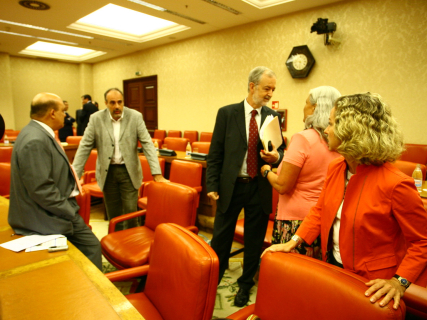

The Government's decision to reapprove the housing decrees rejected last week to now submit them to the Permanent Deputation has opened a new political battle over the use of this body during the electoral period. Vox has gone so far as to describe the operation as a "cacicada," and its spokesperson in Congress, Pepa Millán, has indicated that the party is considering going to court.
However, the validation of royal decree-laws by the Permanent Deputation once the Cortes are dissolved has numerous precedents, including one directly related to housing during the first Government of Pedro Sánchez. Article 151 of the Congress Regulations expressly states that the debate and voting on the validation or repeal of a royal decree-law can be held in the Plenary or in the Permanent Deputation within 30 days following its promulgation.
The Council of Ministers approved this Tuesday two new texts that recover a good part of the measures that were rejected on Friday, although with modifications compared to the previous ones, so that they can be submitted to a new vote. With Congress dissolved due to the call for the general elections on November 29, it will be the Permanent Deputation that decides on their validation.

Again, housing
The most recent precedent bears a particular similarity to the current situation. After the dissolution of the Cortes on March 5, 2019, the Permanent Deputation validated six royal decree-laws during that electoral period, including one on urgent measures in housing and rental. Among them was the extension of the mandatory extension of rental contracts from three to five years when the owner was a natural person and up to seven when it was a legal entity.
That episode also had another parallelism with the current one. The Government had previously approved, in December 2018, another rental decree that was rejected by Congress in January 2019. The Executive subsequently approved a new text, with changes, which ended up being validated by the Permanent Deputation once the Cortes were dissolved.
The PP subsequently appealed to the Constitutional Court the decree of 2019. The court annulled two additional provisions, one for not considering the extraordinary and urgent need sufficiently accredited and another for affecting a matter that could be regulated by regulation, but maintained the rest of the norm.
From 1979 to 2023
The appeal to the Permanent Deputation to validate decrees is not limited to 2019. Already in 1979, with Adolfo Suárez at the head of the UCD Government, the guard body covered several initiatives of this rank. The texts affected very different areas, from local administration and citizen security to the staffing of teachers and health professionals.
The practice was repeated in 1982, during the Government of Leopoldo Calvo-Sotelo, in the months that elapsed between the dissolution of the Cortes and the constitution of the new legislature arising from the elections of October 28 that would give an absolute majority to the socialists. The Permanent Deputation then intervened on decrees related to budgetary issues, Defense, Social Security, the effects of drought and floods, or the retirement of certain teaching officials.
Also during "felipismo"; in 1986 a decree on the public service of loading and unloading ships was validated, while in the electoral period of 1989 none was validated.
In 1993, this practice was recovered and the subjects ranged from actions related to the basins of the Tagus and Segura to tax changes, drought aid, subsidies for those affected by HIV, or an extraordinary credit for unemployment benefits.
In 1996, in the last gasps of the socialist governments, four were validated. One of them related to extraordinary credits and supplements for issues such as the financing of public health, the remuneration of public employees, or the financing of autonomous communities and local corporations.
Lorca and temporals
There are also precedents under PP governments. During the electoral period of 2000, with José María Aznar already as president, the Permanent Deputation on measures to improve family protection of Social Security. In contrast, in the electoral period of 2004 nothing was validated in these terms.
During the electoral period of 2008, already under the Government of José Luis Rodríguez Zapatero, this body validated a decree that set the Public Indicator of Multiple Effects Income (IPREM) for that year and granted an extraordinary credit of 200 million euros for the reception and integration of immigrants and educational reinforcement.
Activity was considerable again in 2011, also with Zapatero, when five royal decree-laws were validated. Among them were the creation of the Deposit Guarantee Fund for Credit Entities, extraordinary credits of more than 4.221 billion euros, and measures related to the damages caused by the earthquakes in Lorca.
Under Rajoy's presidency in October 2015, the Permanent Deputation validated a decree aimed at repairing the damages caused by storms in the Canary Islands and in the southern and eastern peninsula. In contrast, during the electoral period of 2016, none were validated.
With Sánchez at the wheel
Again, the year 2019 offers another particularly significant example. After the dissolution of the Cortes on September 24, which led to the repetition of the general elections on November 10, the Permanent Deputation validated another seven royal decree-laws.
Among them were measures to alleviate the damages caused by storms, respond to the insolvency of the Thomas Cook tourism group, update the advances to autonomous communities and local entities, adopt measures in digital administration and telecommunications, or facilitate the holding of the COP25 climate summit in Spain.
The most recent precedent corresponds to 2023. After the elections called for July 23, an extensive text was validated that included measures related to the economic consequences of the war in Ukraine, the reconstruction of La Palma, situations of vulnerability, and the transposition of European regulations.
An expressly foreseen competence
The question, therefore, is not whether the Permanent Deputation can validate royal decree-laws with the dissolved Cortes, a competence expressly provided for in parliamentary rules, but whether the new texts meet the constitutional requirements demanded of this figure and to what extent they differ from those recently rejected by the Plenary. And the rules approved yesterday, although they share the substance with those repealed by the Lower House, include novelties such as that rental announcements must specify whether it is from a large holder and if they have a capped price.
The difference regarding the vote on Friday lies in the arithmetic. The first of the texts will indeed gather in the Permanent Deputation 35 favorable votes against 34 opposed, after the PNV has confirmed its support, so the Government will be able to push it forward without needing Junts. The second, on the other hand, would still require the Basque party to change the no vote it maintained against the previous text.
Featured story
The PNV will support the first housing decree-law after the changes of the Government
3 minutes