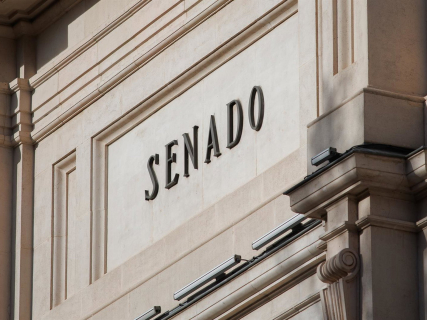

The Ateneo de Madrid has been this Tuesday the stage for the official presentation of the initiative "Senators for Democracy," a project promoted from civil society that demands a united candidacy of leftist forces for the Senate in the general elections on November 29, with the aim that the Upper House "ceases to be a bunker of the right." The proposal has the support of cultural figures such as the writer Elvira Lindo, the singer Víctor Manuel, or the actor Pepe Viyuela, among other public figures.
Its promoters have explained that the goal is for progressive formations throughout the State to agree on joint lists for the Senate in all provincial constituencies in the upcoming general elections, following previous experiences.
In the general elections of 2023, some united candidacies for the Senate were already articulated in different territories. ERC and EH Bildu sealed a coalition to run for the Upper House in Catalonia and the Basque Country, while in Ibiza and Formentera, the PSOE, Sumar, Esquerra Unida, and Ara Eivissa presented themselves together to obtain a Senate seat.
Among those promoting this common leftist list are the economist Bruno Estrada, the sociologist Enrique del Olmo, and the lawyer and former Podemos leader Gloria Elizo.
The event at the Ateneo, moderated by journalist María José Pintor, also featured the intervention of journalist Ana Pardo de Vera, jurist Javier Pérez Royo, writer Juan Pinilla, and former CCOO general secretary Antonio Gutiérrez.
In addition, nearly 5,000 people have signed the support manifesto. Among them are writers Rosa Montero, Elvira Lindo, and Carlos Bardem; lawyer Cristina Almeida; performers María Barranco, Pepe Viyuela, and Miguel Rellán; UGT unionist Antonio Ferrer; sociologist Marina Subirats; philosopher Santiago Alba Rico; singer Víctor Manuel; journalist Rosa Villacastín; and lawyers and politicians Nicolás Sartorius and Manuel de la Rocha.
First contacts with the parties
Del Olmo has pointed out that this Monday they have already started conversations with the main leftist forces and has assured that they are "active" and "set in motion"; although he has clarified that it will be necessary to verify if that activity "reaches the desirable and exigible level." He has also announced that this Wednesday they will hold a first meeting with Adelante Andalucía.
Questioned about the degree of involvement of the PSOE, the sociologist stated that on the part of the socialists "there has been not only receptivity" but that from the federal leadership they have already "set in motion," for example, "analyzing the determining territories."
Gloria Elizo has stated that they do not fear the reaction of PP and Vox when the announcement is formalized, as the political confrontation of both spaces at this moment "is radical, personal, and ideological." In this line, she has defended that "the progressive agenda must be forceful" with "a project of pragmatic unity" and has called to "ignore the comments from the right."
"An outrageous right and a desperate left"
Antonio Gutiérrez has expressed his confidence that the proposal will move forward in the face of "a landscape dominated by an increasingly outrageous, destabilizing, shameless, and aggressive right; and a desperate left that leads to melancholy." "With this initiative, whatever happens in the end, at least we have a channel to propose and not fall into melancholy," he added.
As he explained, the purpose is to stop "the democratic involution" that, in his opinion, the Spanish right is perpetuating "poisoning social coexistence and blowing up political debate" in order to "destabilize a coalition and progressive government."
"This government raises so much ire because it has contradicted all previous governments; far from harming the economy, it has made it the most efficient in Europe. This social and union mobilization has to converge in a generalized vote to the left on the 29th," he defended.
"A winning candidacy"
In this context, Javier Pérez Royo has described the initiative as "optimistic," arguing that, "although the Senate has no solution," it can contribute to "dignifying political life." He has also warned that "there is nothing more reactionary than pessimism and giving up the battle without even entering the fight."
"This is a winning candidacy that should not have difficulties in its articulation since it is intellectually thinkable and technically organizable, forcing all left parties to negotiate among themselves," he emphasized.
For his part, Bruno Estrada has emphasized that the project is "a practice to mobilize, inspire, and activate the citizenship" through a "resounding call" to the leftist forces, with the aim that the Senate "ceases to be a bunker of the right." "The future is not decided; achieving a progressive majority in the Senate after November 29 will be decisive," he concluded.