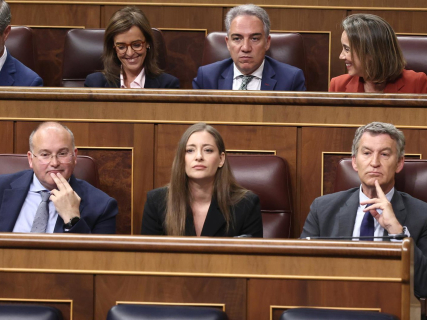
The PP brings to Congress a plan of 650 million for Ceuta and Melilla and demands to deploy Frontex.

The popular ones ask to declare the situation of interest for National Security in Ceuta, accelerate returns and expulsions, and permanently reinforce the National Police and Civil Guard.

3 minutes

fotonoticia 20260807202156 1920

fotonoticia 20260807202156 1920

Add DEMÓCRATA to Google

Ask FREN

Published

Last updated

3 minutes

Most read

The PP has registered this Monday in Congress a non-legislative proposal with a series of measures to respond to the crisis opened in Ceuta and "shield" the future of the two autonomous cities. Among its main proposals are activating the mechanisms of the National Security Law, deploying Frontex at the border, and approving an Economic Reactivation Plan for Ceuta and Melilla endowed with at least 650 million euros between 2027 and 2032.

The initiative transfers to Congress several of the measures that Alberto Núñez Feijóo presented during his visit to Ceuta last week, when he demanded an extraordinary response to a situation that the PP considers a "national security crisis" and not merely migratory. The popular leader then estimated the economic plan he proposes for the two autonomous cities at 650 million euros.

The popular party maintains that the massive entry of migrants overwhelmed the ordinary control mechanisms of an external border of Spain and the European Union and "profoundly" altered the functioning of Ceuta and the lives of its more than 80,000 residents.

Activate the National Security Law

The first block of the proposal focuses on managing the crisis. The PP urges the Government to declare a situation of interest for National Security, convene the National Security Council, and designate the functional authority contemplated in the legislation to coordinate the human and material resources mobilized.

The party also demands activating the legally provided procedures for voluntary return or the expulsion of people who entered Spain irregularly, deploying in Ceuta the necessary Immigration units, and establishing a schedule to process and resolve the files.

The text also proposes modifying the bilateral policy with Morocco based on the principles of "respect and reciprocity." The PP demands a relationship that "does not admit threats or blackmail" and defends that Spanish territorial integrity "is not questioned either in Ceuta, or in Melilla, or in Spanish waters".

The PP calls for deploying Frontex

Another of the main proposals involves resorting to the available national and European instruments to reinforce the border. The PP expressly requests the immediate deployment of Frontex in Ceuta, along with triage procedures, security checks, and border asylum and return procedures aimed at accelerating the management of arrivals.

In terms of infrastructure, it proposes to extend the border perimeter towards the sea, starting with the Tarajal pier. It also demands to consolidate permanent reinforcements of the Civil Guard and National Police, increase the units of Immigration, and strengthen the health staff, as well as promote a greater presence of judges and prosecutors.

The proposal also incorporates technological measures. Among them is the creation of a stable and integrated maritime and coastal surveillance system. In the legislative field, the Popular Party proposes modifications to the Immigration and asylum regulations.

A plan of 650 million until 2032

The initiative expands the focus beyond the immediate response to the crisis. The Popular Group wants the European Union to recognize the "singular and exceptional" situation of Ceuta and Melilla and grant them similar treatment to that of the outermost regions in areas such as European funds, the tax regime, and border management.

The PP also proposes that the two autonomous cities have their own representation within the Spanish delegation in the European Committee of the Regions.

The main economic proposal is a Reactivation Plan for Ceuta and Melilla with a minimum allocation of 650 million euros for the period 2027-2032, developed with the governments of both cities and the participation of their social fabric.

The plan would include a Special Regime Law for Ceuta and Melilla, economic incentives, increased public investment, and improvements in connections with the Peninsula. It also contemplates actions against youth unemployment and to facilitate access to housing.

The proposal is completed with a greater stable presence of the State in Health, Education, Justice, Security Forces and Bodies, and Armed Forces.

Feijóo had already advanced much of this package on August 19 during his second visit to Ceuta in less than twenty days. He then presented the 650 million plan as one of the pillars of the economic response that the PP proposes for the two autonomous cities.

More key points, information and questions with FREN

AI-GENERATED CONTENT

At what parliamentary stage is the non-legislative motion presented by the PP for Ceuta and Melilla, and what are the next steps for its processing?

The most recent non-legislative motion (PNL) from the Popular Party related to Ceuta and Melilla – the one demanding an “extraordinary health strategy” in response to migratory pressure – is, according to available information, registered and admitted for processing in the Congress of Deputies and pending debate and vote in the Health Commission. The next steps will be its inclusion on the agenda of the Commission, the debate among groups, and the final vote, after which, if approved, the Congress will politically urge the Government to implement said strategy.

1. Identification of the PP initiative on Ceuta and Melilla

Various PNLs from the Popular Group refer to Ceuta and/or Melilla (on health, armed forces, borders, customs, etc.). Among them, recent journalistic and parliamentary sources highlight the initiative in which the PP requests a specific health strategy for Ceuta and Melilla in the face of the migratory emergency. That PNL was registered in the Congress on August 3, 2026 and, according to this report from Gaceta Médica , “it remains pending debate in the Health Commission of the Congress of Deputies.”

On that basis, and given that the question is posed in the present, the following answer refers to this health PNL currently under processing. If you were interested in another PP PNL on Ceuta and Melilla (for example, one related to customs, military personnel, or tax regime), its specific file would need to be consulted.

2. Current parliamentary stage

The status described by sources is that of a PNL:

  • Registered by the Popular Parliamentary Group in the Congress of Deputies.
  • Qualified and admitted for processing by the Board, having indicated that “it will be debated in the Health Commission.”
  • Assigned to the Health Commission as the competent body for its debate.
  • Pending inclusion on the agenda of that Commission to be effectively debated and voted on.

Technically, its stage can be described as “under processing, pending debate and vote in Commission”. There is no record yet that the debate or vote on the text has taken place.

3. Next steps in the processing of the PNL

From this situation, the foreseeable steps in parliamentary processing are as follows:

  • 1) Inclusion on the agenda of the Health Commission.
    The Board and the Spokespersons' Board set when the PNL is scheduled in a specific session of the Commission. Until then, the initiative remains admitted but not debated.
  • 2) Debate in the Commission.
    In the scheduled session:
    • The PNL is defended by the Popular Group as the proposer.
    • The other groups intervene to state their position and, if applicable, propose changes.
    • A transactional text that replaces or nuances the original text may be negotiated if there is sufficient political agreement.
  • 3) Vote on the text.
    After the debate, the Commission votes on:
    • the original PP text, or
    • the transactional text agreed upon by several groups, if such agreement was reached.
    The result can be approval or rejection.
  • 4) Approval (if applicable) and political effects.
    If the Commission approves the PNL:
    • The agreement is published in the Official Bulletin of the General Courts.
    • The Congress, through the Commission, “urges the Government” to adopt the described measures (in this case, to approve and implement an extraordinary health strategy for Ceuta and Melilla, reinforce resources, recognize them as areas of difficult coverage, etc.).
    As parliamentary press reminds when explaining this type of initiatives, PNLs: are not laws nor do they have binding legal effects on the Executive; they establish a political position of the Chamber and exert institutional pressure on the Government.
  • 5) Rejection or conclusion of processing.
    If the PNL is rejected or, if applicable, once approved and published, the file is considered closed in parliamentary terms. From there:
    • It is up to the Government to decide whether to assume the political mandate and to what extent.
    • No additional processing phases are generated as with a bill or legislative proposal (it does not go to the Senate, is not sanctioned or promulgated).

In summary, the PP's PNL on an extraordinary health strategy for Ceuta and Melilla is currently in processing in the Congress, pending debate and vote in the Health Commission. The next steps are purely parliamentary (scheduling, debate, and vote) and, if approved, its effect will be political: urging the Government to act, without creating a new legal norm by itself.

What are the competencies of the National Security Council and who composes it according to Spanish legislation?

The National Security Council (CSN) is, according to Law 36/2015, of September 28, on National Security, the collegiate body that acts as the Government Delegated Commission for National Security and assists the President of the Government in directing national security policy and the National Security System itself. Its competencies and composition are defined in said law, which is complemented by regulations through a royal decree approved by the Council of Ministers.

Competencies of the National Security Council

According to Law 36/2015 (articles from titles I and II, as inferred from the consulted text), the National Security Council is responsible, among others, for the exercise of the following formal functions:

  • Issuing planning and coordination guidelines for National Security policy. That is, it sets the major orientations that the different departments and bodies involved must follow.
  • Directing and coordinating crisis management under the terms provided in title III of Law 36/2015, when facing risks or threats that may lead to a “situation of interest for National Security.”
  • Supervising and coordinating the National Security System, understood as the set of bodies, organizations, resources, and procedures that allow competent authorities to perform their functions in this area.
  • Verifying the degree of compliance with the National Security Strategy and promoting or driving its revisions, ensuring it adapts to the evolution of risks and threats.
  • Promoting and driving the development of second-level strategies (sectoral or specific) that develop the National Security Strategy, as well as their possible approval and periodic review.
  • Organizing the contribution of resources to National Security, as provided in the law itself, coordinating the availability and mobilization of human and material resources.
  • Approving the Annual National Security Report before its submission to the General Courts, a document that reports on the state of national security and the System's performance.
  • Agreeing on the creation and strengthening of support bodies (mainly specialized committees) necessary for the performance of its functions.
  • Promoting normative proposals aimed at strengthening the National Security System.
  • Exercising any other functions attributed to it by applicable legal and regulatory provisions.

Additionally, the law provides that, at the proposal of the President of the Government, the National Security Council reports to the King at least once a year. When the King attends a Council meeting, he presides over it.

Composition and institutional affiliation

Law 36/2015 establishes that the CSN is a Government Delegated Commission and, therefore, is directly under the scope of the President of the Government, in close relation with the Council of Ministers. The legal text itself states that its composition, organization, and functions will be developed by royal decree agreed upon by the Council of Ministers, at the proposal of the President of the Government.

Without prejudice to that regulatory development, the law sets a minimum core of ex officio members who “in any case” must be part of the National Security Council:

  • The President of the Government, who presides over it.
  • The Vice Presidents of the Government, if any.
  • The Ministers of:
    • Foreign Affairs and Cooperation,
    • Justice,
    • Defense,
    • Finance and Public Administrations,
    • Interior,
    • Development,
    • Industry, Energy and Tourism,
    • Presidency,
    • Economy and Competitiveness,
    • Health, Social Services and Equality.
  • Other senior officials of the General State Administration:
    • The Director of the Cabinet of the Presidency of the Government.
    • The Secretary of State for Foreign Affairs.
    • The Chief of the Defense Staff.
    • The Secretary of State for Security.
    • The Secretary of State-Director of the National Intelligence Center.

Additionally:

  • The Director of the National Security Department is always summoned to Council meetings. This Department exercises the Technical Secretariat and permanent working body of the CSN and its support bodies.
  • Other heads of ministerial departments and the affected regional authorities may be summoned depending on the matters to be addressed.
  • Likewise, heads of superior bodies and directors of the General State Administration, public organizations, Autonomous Communities, cities with Statute of Autonomy, and local authorities may be called when their contribution is considered necessary.
  • Natural or legal persons whose participation is deemed relevant to the agenda items (for example, experts or private sector representatives) may also be summoned.

With this design, the National Security Council is configured as the political-strategic center of the National Security System, articulating coordination between the President of the Government, the Council of Ministers, the National Security Department, the autonomous communities, and, when appropriate, other public and private actors.

What requirements does current legislation establish for the deployment of Frontex at a Spanish external border?

The deployment of Frontex at a Spanish external border (Ceuta, Melilla, Canary Islands, peninsular coasts, or Schengen airports/ports) is neither automatic nor discretionary on the part of the agency. Current legislation, mainly articulated in Regulation (EU) 2019/1896 on the European Border and Coast Guard and within the general Schengen framework, always requires the request or acceptance by the Member State, negotiation of an operational plan, and strict respect for Spanish and EU sovereignty and law.

1. Basic legal framework

According to explanatory analyses collected by Demócrata on Frontex and Regulation 2019/1896 (explanatory article and analysis on Ceuta), the agency:

  • Is part of the European Border and Coast Guard, along with national authorities (in Spain, National Police and Civil Guard).
  • Is mainly governed by Regulation (EU) 2019/1896, which sets its competencies, types of operations, and guarantees.
  • Does not have general competence to intervene on its own in Spanish territory nor can it “occupy” a border or unilaterally replace national authorities.
2. Starting condition: Spain's request or acceptance

Ordinary Frontex intervention always starts from the initiative of the affected Member State:

  • Spain must request assistance or formally accept an offer from the Commission/Frontex for additional deployment at an external border (for example, Canary route or Ceuta), as emphasized by both community sources and Demócrata pieces.
  • In the case of rapid border interventions, foreseen for “exceptional and urgent” pressures, the Spanish request must describe the situation, objectives, necessary means, and required agent profiles.
  • The Frontex executive director decides whether to accept the request and, if so, mobilizes the standing corps and contributions from other States.

Even in scenarios where the Regulation contemplates mechanisms for “serious deficiencies” of a State in controlling an external border, Demócrata highlights that the agency cannot impose a deployment that replaces the State: pressure is channeled through other means (Schengen evaluations, possible reintroduction of internal controls by other partners, etc.).

3. Operational plan and national command

Any deployment in Spain requires an operational plan agreed between Frontex and Spanish authorities:

  • The geographic scope is defined (for example, ports of Algeciras, Ceuta, and Tarifa in operation Minerva; Strait and Alboran Sea in Indalo; or ports and CATE of Canary Islands), duration, number of personnel, and their specific functions.
  • Rules of engagement are set, including which databases they can access, what executive tasks they can perform, and how they will coordinate with National Police and Civil Guard.
  • Frontex agents remain under the operational command and control of Spanish authorities and act according to EU law, applicable international law, and Spanish legislation.
4. Use of force, weapons, and competencies

The regulations and institutional summaries consulted point out several key material limits:

  • Members of the European contingent carrying weapons or performing executive controls require express authorization from the host State.
  • Their capacity to check documents, take fingerprints, record data, or carry out certain procedures is conditioned on the operational plan and Spanish legislation on immigration, citizen security, and police procedure.
  • “Sovereign” competencies (admission or denial of entry, detention, expulsion, granting or denial of asylum) remain exclusive to Spanish authorities; Frontex can only provide technical and logistical support.
5. Fundamental rights and responsibility

All operations must respect:

  • Asylum rights and the principle of non-refoulement, which prevents returning people to places where they face risk of persecution or inhuman treatment.
  • Protection of minors and vulnerable groups.
  • Frontex's internal mechanisms for fundamental rights supervision, including the possibility of suspending an operation if serious or persistent violations are detected.

Regarding responsibility for possible damages or abuses, Regulation 2019/1896 establishes a specific regime that articulates the responsibility of the host State and the agency itself, but always based on the primacy of EU law and national legal systems.

In summary, for Frontex to deploy at a Spanish external border, four essential conditions must concur: express request or acceptance by Spain, agency decision based on Regulation 2019/1896, agreement on an operational plan that keeps command in Spanish hands, and full respect for fundamental rights and national and European legislation on borders, immigration, and security.

Play

Test your knowledge with FREN!

How much do you know about this topic? Answer the following 3 questions.

How much money does the PP propose to allocate to the Reactivation Plan for Ceuta and Melilla?

Question 1 of 3

Which European agency does the PP request to deploy at the Ceuta border?

Question 2 of 3

What is one of the main objectives of the PP's proposal for Ceuta and Melilla?

Question 3 of 3