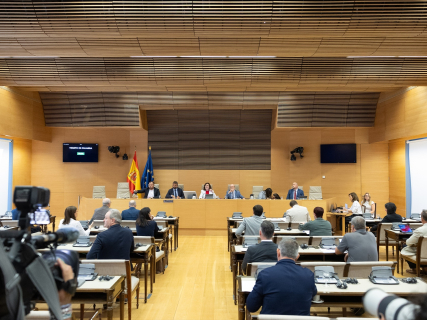
What happens to the investigative commissions when the Courts are dissolved?

The call for elections puts an end to the parliamentary work that has not concluded during the XV Legislature and obliges the new Chambers to decide whether to resume the pending investigations.

EuropaPress 7789615 expresident generalitat valenciana carlos mazon comparece comision

EuropaPress 7789615 expresident generalitat valenciana carlos mazon comparece comision

Add DEMÓCRATA to Google

Ask FREN

Published

2 minutes

Most read

Elecciones 29N · Encuestas

La media de las encuestas

Media a 19 de noviembre de 2026 · 17 institutos

  • PP31,3 %
  • PSOE27,5 %
  • Vox19,0 %
  • Frente Amplio6,2 %
  • ERC2,5 %
01020304050ene 2024jul 2024ene 2025jul 2025ene 2026jul 2026

Media del último estudio de cada instituto en 30 días y su evolución semanal desde el 23J. Partidos con al menos un 2 %.

Todas las encuestas

Elecciones generales del 29 de noviembre · Demócrata

The president of the Government, Pedro Sánchez, has called general elections for the next November 29 and has dissolved the Cortes, bringing an end to the XV Legislature. The decision not only paralyzes the ordinary activity of the Congress and the Senate but also affects the investigation committees that remain open, whose work cannot continue once the legislature ends. The new Chambers may investigate those same matters again, but they will have to reconstitute the corresponding committees.

The dissolution causes pending matters to lapse

The investigation committees have a limited duration to the legislature in which they were created. The article 207 of the Congress Regulations establishes that, once the Congress is dissolved or its mandate ends, all pending matters for examination and resolution lapse, except for those corresponding to the Permanent Deputation. The Senate Regulations contemplate a similar provision for pending matters when the Chamber is dissolved.

This affects both the investigations that are still holding hearings and those that are in the final phase of drafting conclusions. The work that has not been completed is interrupted with the end of the legislature.

The pending investigations in the Congress

The Congress reaches the end of the XV Legislature with several investigations still underway. Among them is the commission on the DANA of October 29, 2024, which has analyzed the management of the disaster and the actions of the different administrations.

The commission on the blackout of April 28, 2025, tasked with investigating the causes and responsibilities of the interruption of the electricity supply, also remains open.

In addition, there are investigations into the attacks in Barcelona and Cambrils on August 17, 2017 and the so-called Operation Cataluña. The 17-A commission, for example, continued holding hearings in May 2026.

The Senate leaves several works in the air

In the Upper Chamber, there are also pending investigations. Among them are the commissions on the Koldo case, the DANA, the alleged irregularities in the SEPI, the state of the railway network, and the management of RTVE.

The Senate calendar shows that some of them maintained activity even during the days immediately before the electoral advance. The commission on the railway network, for example, had a hearing scheduled for October 5 and another for October 8. The one on the Koldo case also had a new session planned for October 19.

The commission on the SEPI, established in February 2026, also remained open at the beginning of October.

What has been investigated so far does not disappear

The dissolution does not erase the hearings, documents, or session diaries that are already part of the parliamentary records. What ends is the capacity of those commissions to continue working within the XV Legislature.

If the next Congress or Senate considers it necessary to resume any of these investigations, it will have to reconstitute a commission and approve its corresponding object of investigation. There is, therefore, no automatic continuity between one legislature and the next.

It will be the composition of the new General Courts that will be formally established on the next 23rd of December, that determines which investigations return to occupy a place on the parliamentary agenda and which do not continue.

More key points, information and questions with FREN

AI-GENERATED CONTENT

What parliamentary procedures are necessary to establish an investigative committee in the new legislature?

To establish an investigative committee in the new legislature in the Cortes Generales, a sequence of procedures must be followed that begins once the Chambers are constituted (election of their Boards and formation of groups) and culminates with the constitutive session of the committee itself. The procedure is regulated, for the Congress, in the Rules of the Congress, especially in Article 52; in the Senate, a very similar logic is followed, based on its own Rules.

1. Timing and general framework in the new legislature

Investigative committees can only be created once:

  • The constitutive session of the Chamber has been held and it has been formally constituted.
  • The Board has been elected and parliamentary groups have been formed.

From that moment, the Chamber can agree to create investigative committees on matters of public interest, which are non-permanent committees with a limited mandate.

2. Initiative for creation (Congress)

Article 52.1 of the Rules of the Congress establishes who can propose the constitution of an investigative committee. The Plenary of the Congress can agree to its creation:

  • at the proposal of the Government,
  • of the Board of the Congress,
  • of two Parliamentary Groups, or
  • of one fifth of the members of the Chamber (that is, a minimum of 20% of the deputies).

In practice, this initiative takes the form of a registered document in the Chamber identifying the matter of public interest to be investigated and usually suggesting general lines of the object and the committee's term.

3. Qualification, inclusion in the agenda, and debate (Congress)

Upon receipt of the request, the Board of the Congress qualifies it (verifies its formal regularity and competence) and, if admitted for processing, agrees to send it to the Plenary and include it in the agenda of a session.

A specific debate on the creation of the committee takes place in the Plenary. In this debate, groups may intervene in favor or against, or propose nuances regarding the scope, duration, or name of the committee.

4. Voting and agreement on creation (Congress)

After the debate, the Plenary votes on whether to create the committee or not. The Rules do not establish a reinforced majority, so a simple majority of the votes cast applies, unless a legal provision or a specific political agreement states otherwise.

If the Plenary approves the proposal, the creation of the investigative committee is agreed upon, usually with a mandate or work object defined in the agreement itself.

5. Appointment of members and formal constitution (Congress)

Once creation is agreed, the Board of the Congress requests the parliamentary groups to appoint their members, in number and proportion reflecting the balance of power in the Chamber (general rule for committee composition).

Upon receiving the appointments, the President of the Congress convenes the constitutive session of the committee, in which, according to general rules on committees, the following takes place:

  • election of the Board of the committee (presidency, vice presidencies, and secretariats),
  • approval of a work plan with the schedule and the hearings and documentation to be gathered.

6. Basic functioning of the committee (Congress)

Articles 52.2 to 5 of the Rules of the Congress specify several essential aspects:

  • The committee drafts its own work plan and may create internal subcommittees.
  • It may require the presence of any person to be heard, through the Presidency of the Congress, with prior notification (generally 15 days in advance, or no less than 3 in urgent cases) and indication of rights and obligations.
  • Decisions are made by weighted voting, meaning each member's vote counts according to their group's representation.
  • Conclusions are collected in a report submitted to the Plenary, where it is debated and voted on, and once approved, published in the Official Bulletin of the Cortes Generales and sent to the Government; the Board may also forward it to the Public Prosecutor if appropriate.

7. Senate and mixed investigative committees

In the Senate, the scheme is similar: its Rules provide that the Plenary may agree to create investigative committees on matters of public interest, at the initiative of the number of senators or groups established therein, with plenary agreement, proportional appointment of members by groups, and constitutive session to elect the Board and approve the work plan.

When a mixed Congress-Senate investigative committee is intended, a coincident agreement of both Chambers is necessary: each adopts its own creation agreement and appoints the members who will represent it, then the joint committee is constituted with its own Board and operating rules.

8. Specificity in a new legislature

In a new legislature, the key is the political moment: the first weeks, once the Chambers are constituted and permanent committees set, are when groups usually register proposals for investigative committees they consider priorities. Legally, however, the steps are the same: initiative by authorized subjects, qualification, debate and voting in Plenary, proportional appointment of members, and formal constitution of the committee.

Could you detail exactly how the composition and weighted voting system are set in a Congress investigative committee? What practical differences exist between a Congress investigative committee and a mixed Congress-Senate committee? What legal limits do investigative committees have regarding courts and official secrecy?

What are the powers and functions of the Permanent Deputation of the Congress?

The Permanent Deputation of the Congress of Deputies is the body that guarantees the continuity of the Chamber when the Plenary cannot meet (between ordinary session periods, or when the Congress is dissolved or its mandate has expired). Its basic regulation is in the Rules of the Congress (arts. 56 to 59) and it connects with several constitutional provisions on decree-laws, states of emergency, and extraordinary sessions.

Basic composition and organization

According to Article 56 of the Rules:

  • The Permanent Deputation is chaired by the President of the Congress.
  • It is composed of a minimum of 21 members, representing parliamentary groups in proportion to their numerical importance in the Chamber. Each group appoints the members corresponding to it and as many substitutes, following the general rules for committee composition (reference to Article 40 of the Rules).
  • Within it, two Vice Presidencies and two Secretariats are elected, applying the same rules as for the election of the Board of the Congress, adapted to the smaller number of positions.
  • It is convened by the Presidency, either on its own initiative or at the request of two parliamentary groups or one fifth of its members.

Additionally, when the Congress is dissolved or its mandate expires, the Rules provide that the members, both titular and substitutes, of the Permanent Deputation extend their functions until the new Congress is constituted. This ensures that there is always a body capable of acting.

General function: safeguarding the powers of the Chamber

Article 57 establishes the general clause: the Permanent Deputation is responsible for "safeguarding the powers of the Chamber when it is not convened." From there, it lists specific functions, differentiating two situations:

1. In cases of dissolution or expiration of the Congress mandate

When there is no operative Plenary because the Congress is dissolved or its mandate has ended, the Permanent Deputation assumes especially relevant functions, directly connected with the Constitution:

  • Decree-laws: it assumes all powers that Article 86 of the Constitution attributes to the Congress regarding decree-laws. This includes debating and voting on their validation or repeal within a maximum of thirty days from their promulgation, and the possible decision to process them as bills by the urgent procedure. The Rules specify that validation or repeal can be done in the Plenary or in the Permanent Deputation and empower the latter to agree on processing as a bill when the Congress is dissolved or out of session.
  • States of alarm, exception, and siege: it exercises the powers that Article 116 of the Constitution attributes to the Congress regarding these states. When one is declared and the Congress cannot meet, the powers assigned by the Rules to the Plenary (authorization, extensions, control) are exercised by the Permanent Deputation.
2. In the intervals between session periods

Between ordinary session periods (for example, between the February-June and September-December periods), the Congress can only meet in extraordinary sessions if the Constitution's provisions are met. Article 57.2 of the Rules attributes to the Permanent Deputation the capacity to:

  • Exercise the initiative to convene extraordinary sessions provided in Article 73.2 of the Constitution. This provision allows extraordinary sessions to be held at the request of the Government, the Permanent Deputation itself, or the absolute majority of the members of the Congress, with a determined agenda.

Thus, the Permanent Deputation acts as an institutional "hinge": in periods without ordinary activity, it can promote the convening of extraordinary Plenary sessions when the political or institutional situation requires it.

Operating regime and accountability

Article 58 of the Rules establishes that the sessions and functioning of the Permanent Deputation are generally governed by the provisions applicable to the Plenary: it follows the same rules for holding sessions, debates, adoption of agreements, and publicity (Minutes, votes, etc.), except for adaptations due to its composition.

Once an electoral process has been held, Article 59 requires that, once the new Congress is constituted, the Permanent Deputation reports to the Plenary on all matters it has dealt with and decisions it has made during the period when the Plenary was not operative. This accountability appearance allows the new Congress to politically ratify that action and directly resume ordinary functions.

Government control and other powers

Although the Rules do not exhaustively detail all control techniques, it can be inferred from the set of provisions that the Permanent Deputation not only adopts formal decisions (validating decree-laws, pronouncing on states of emergency, or promoting extraordinary sessions) but can also articulate forms of political control over the Government during those periods: convening sessions in which the Executive accounts for the use of decree-laws, measures adopted in states of alarm, exception, or siege, or urgent matters justifying an extraordinary session.

In sum, the Permanent Deputation concentrates the minimum indispensable powers for the Congress to keep its legislative and control powers alive even when the Plenary cannot meet, acting as a guarantor of continuity and balance between Government and Parliament in any circumstance.

How are the members and substitutes of the Permanent Deputation specifically chosen among the different parliamentary groups? What practical differences exist between a decree-law being validated in the Plenary or in the Permanent Deputation? Can you explain with recent examples how the Permanent Deputation has acted in states of alarm, exception, or siege?

What results did the main parties obtain in the last general elections?

The last general elections in Spain were held on July 23, 2023. In them, the 350 seats of the Congress of Deputies were elected. Below is a summary of the main parties' results, with their vote percentage and number of seats, followed by a brief commentary on what these data imply.

Results of the main parties (23J 2023)

Aggregated data at the national level for the Congress:

Party Votes % vote Seats
People's Party (PP) 8,091,840 33.05 % 137
PSOE 7,760,970 31.70 % 121
Vox 3,033,744 12.38 % 33
Sumar 3,014,006 12.31 % 31
ERC 462,883 1.89 % 7
Junts per Catalunya 392,634 1.60 % 7
EH Bildu 333,362 1.36 % 6
PNV 275,782 1.12 % 5
BNG 152,327 0.62 % 1
Canarian Coalition (CC) 114,718 0.47 % 1
Navarrese People's Union (UPN) 51,764 0.21 % 1

Vote figures may show minimal variations depending on the source or counting criteria (valid votes, candidacies, etc.), but the seat distribution shown in the table matches the official results published for the Congress.

Basic political reading of these results

1. Victory for the PP, but without sufficient block majority

The PP was the most voted list and obtained 137 seats and just over 33 % of the vote. This is a clearly better result than in 2019, but it was not enough to form a stable investiture majority with its natural allies. Even adding its 137 deputies with the 33 from Vox and the seat of UPN, the right-wing parliamentary block fell short of the absolute majority (176).

2. PSOE narrowly loses but retains alliance capacity

The PSOE came in second place, very close to the PP in percentage (31.7 % versus 33.05 %) and with 121 seats. Although it did not win the elections in terms of votes or seats, it was in a relatively favorable position to negotiate support with several territorial and left-wing formations, which ended up being decisive in the configuration of the legislature.

3. Fragmentation of the space to the right and left of bipartisanship
  • Vox consolidated as the third force with 12.38 % and 33 seats, but far from the expectations it had at other moments in the political cycle.
  • Sumar, as a platform grouping several forces to the left of the PSOE, obtained a similar result in votes to Vox (12.31 %) and 31 deputies. Its role was key to renewing a broad progressive block.
4. Decisive weight of nationalist and regionalist parties

Although with relatively low national vote percentages, parties such as ERC, Junts, EH Bildu, PNV, BNG, and Canarian Coalition concentrate very strong support in their territories and obtained between 1 and 7 seats each. In such a fragmented Congress, these seats were decisive for adding majorities both in investiture and in the processing of key laws.

Overall, the results of 23J 2023 outlined a scenario of strengthened bipartisanship at the top (PP and PSOE recover centrality around 65 % of the vote between them), but with a very fragmented chamber and an absolute majority unattainable for any block without counting several smaller partners. This is the basis of the parliamentary arithmetic and political negotiation that has marked the legislature derived from these elections.

Play

Test your knowledge with FREN!

How much do you know about this topic? Answer the following 3 questions.

What happens to investigative committees when the Cortes are dissolved?

Question 1 of 3

What determines if a parliamentary investigation is resumed in the next legislature?

Question 2 of 3

What happens to the documents and session diaries generated by an investigative committee when the Cortes are dissolved?

Question 3 of 3