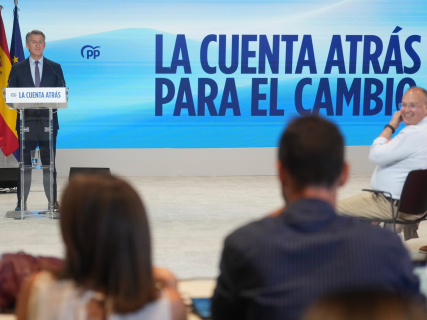
Feijóo considers the legislature finished and assures that for Sánchez "he only has to call elections."

The leader of the PP maintains that the Government has lost social support, the parliamentary majority, and moral authority, and states that "change is closer."

3 minutes

WhatsApp Image 2026 07 22 at 13.04.17 (1)

WhatsApp Image 2026 07 22 at 13.04.17 (1)

Add DEMÓCRATA to Google

Ask FREN

Published

Last updated

3 minutes

Most read

The president of the Partido Popular, Alberto Núñez Feijóo, has certified this Tuesday the political end of the legislature and has assured that Pedro Sánchez faces "his last summer" at the head of the Government. In a balance of the three years elapsed since the general elections of July 23, 2023, the leader of the opposition has drawn a "tired", "blocked" Executive and without political legitimacy to continue governing.

"Spain is not better than it was three years ago," Feijóo has stated, who has summarized this period in a succession of "scandals, kickbacks, jail, and broken promises." In his opinion, it is not "a bad streak," but the result of "eight years of progressive deterioration" of the institutions.

The president of the PP has maintained that the Government has lost the three pillars that, in his opinion, support any Executive: citizen support, parliamentary majority, and moral authority.

On the political front, he has assured that the successive electoral victories of the PP against the defeats of the PSOE demonstrate that "the people do not want this Government." Furthermore, he has accused Sánchez of remaining in La Moncloa despite having lost the ability to approve budgets, evade parliamentary control, and ignore more than 150 requests for appearances. He has also reproached that throughout the legislature there has not been a Debate on the State of the Nation and that dozens of legislative initiatives from the Partido Popular remain blocked in Congress.

"The only way out is to call elections," Feijóo has concluded, convinced that both "the ballot boxes and the Cortes want a new political stage."

"I do not want to inherit rubble"

Against that diagnosis, the popular leader has wanted to present the PP as the alternative to start a "national reconstruction." "I do not want to inherit rubble; I want to manage the country and move it forward, which is what the Spaniards deserve," he has stated.

Feijóo has articulated that alternative around three major axes: recovering institutional decency, returning to a Government that manages real problems, and achieving that "working is worth it."

In institutional matters, he has accused the Executive of having extended a "systemic corruption" that, according to him, affects various state agencies. In this context, he has cited the judicial investigations affecting the Government's environment and has also directed his criticisms at the former president José Luis Rodríguez Zapatero, whom he has linked to various episodes that, he has said, must be clarified by the courts.

Even so, he has insisted that it will be Justice who determines the responsibilities. "I always accept the decisions of the judges," he has stated when asked about the various open cases, differentiating the position of the PP from the attitude that, in his opinion, the Executive maintains towards the judicial resolutions.

"Change is closer"

During the question period, Feijóo has also claimed the electoral strength of the Popular Party despite the political context.

"Voting today for the Popular Party is an act of bravery," he has affirmed, convinced that his party maintains leadership "despite all the state apparatus and demagoguery."

In this sense, he has downplayed the polls and has assured that the surveys place the PP between 30 and 40 seats ahead of the PSOE.

"I have seen the polls and I have not seen them worrying. It's not bad," he has joked, before recalling that the PP is currently the largest delegation of the European People's Party and the one that obtained the highest percentage of votes in the last European elections.

Feijóo has concluded his speech by assuring that his party is ready to govern and that the countdown for political change has already begun. "Only months remain. Change is closer," he has affirmed.

More key points, information and questions with FREN

AI-GENERATED CONTENT

What are the parliamentary procedures required to call general elections in Spain?

In parliamentary systems like the Spanish one, the calling of general elections is linked to the dissolution of the Chambers and the political control of the Government by the Parliament. However, in the available information, only some key control instruments (motion of no confidence and vote of confidence) and the general role of parliamentary regulations are explicitly regulated, but the specific procedure for the dissolution of the Cortes and the electoral call is not detailed. Based on these sources, only a partial explanation can be given of the parliamentary procedures surrounding or conditioning a possible call for elections. There is no more specific information on the formal steps, exact deadlines, or decisions of the Head of State or Government in calling general elections.

Parliamentary instruments that may lead to a change of Government

The available information focuses on how the Congress can change or question the Government through two main figures: the motion of no confidence and the vote of confidence. Both are relevant because their outcome may lead to the need to recompose political majorities or open a new political cycle, usually linked to the subsequent holding of elections.

Motion of no confidence

According to the available data, the motion of no confidence is an instrument through which the Congress of Deputies can demand the political responsibility of the Government. It is regulated in Article 113 of the Spanish Constitution and in the Congress Rules of Procedure. Its basic features are:

  • Who can present it: it must be proposed by at least one-tenth of the deputies, that is, by 35 deputies.
  • Content: it must include an alternative candidate for the Presidency of the Government; hence it is called a constructive motion of no confidence.
  • Form: it is submitted in writing and must be motivated.
  • Admission for processing: the President of the Congress admits it for processing and a 2-day period is opened to present alternative motions.
  • Debate and voting: it is debated in the Plenary of the Congress and, to be approved, requires an absolute majority.

If a motion of no confidence succeeds, the alternative candidate becomes the new President of the Government. This change of Government does not imply the immediate calling of general elections by itself, but it can completely alter the political scenario and the duration of the legislature. The regulation found does not explain how this outcome is legally connected with a possible dissolution of the Cortes or electoral call.

Vote of confidence

Conversely, the vote of confidence is an initiative that only the President of the Government can present to verify if he maintains the support of the Congress. The available data indicate that:

  • The President of the Government presents it before the Plenary of the Congress, usually linked to a program or general policy statement.
  • It is debated and voted on in the Plenary.
  • To pass it, a simple majority (more votes in favor than against) is enough.
  • If it does not obtain confidence, the Government must resign and the process to appoint a new President begins.

Again, this figure links to governmental stability and, ultimately, to the possibility that new elections may be called if an alternative majority cannot be formed. However, the available information does not detail how this failure and the absence of majorities connect with the formal decision to dissolve the Chambers and call elections.

Role of the Parliament Rules and procedural limits

To understand the parliamentary procedures related to any major political decision (including those that may lead to elections), the Parliament Rules are essential. According to the available information, the rules of each Chamber (Congress and Senate) are the set of internal norms that regulate:

  • Organization and internal functioning of the Chamber.
  • Procedures and deadlines that initiatives must follow.
  • Admission for processing of initiatives by the Board.
  • Speaking turns, debates, and votes, including quorums and majorities.
  • Competences of the committees, which carry out much of the detailed work.
  • Parliamentary discipline and sanctions.

Although the information found focuses on the processing of laws (bills and proposals) and not on the dissolution of the Cortes, it makes clear that any decision to be adopted through debate and voting in the Congress or Senate will be conditioned by these rules: deadlines, formal requirements, majorities, intervention of the Boards and the Plenary, etc.

Limits of the available information

Regarding the specific question about the parliamentary procedures necessary to call general elections in Spain — who can call them, what prior decisions are necessary, what role the Government, Congress, Senate, and Head of State play, the temporal limits of the legislature, early elections, or restrictions linked to motions of no confidence, votes of confidence, or exceptional states — no detailed regulation or complete procedural scheme has been found in the consulted sources. Only the partial regulation of the motion of no confidence, the vote of confidence, and the general role of parliamentary rules is available.

Therefore, it is not possible, with this information, to reliably describe all the formal, constitutional, and regulatory procedures that lead to the calling of general elections in Spain, nor to specify who exactly makes each decision, within what deadlines, and under what material or circumstantial temporal limits.

What majority and specific procedure are required in the Congress and Senate to decide the dissolution of the Cortes Generales in Spain? What temporal and material limits does the Spanish Constitution impose on the dissolution of the Chambers and the early call of general elections? How is the approval or failure of a motion of no confidence legally coordinated with the possible subsequent call of general elections?

What powers does the President of the Government have according to the Spanish Constitution?

The President of the Government, according to the Spanish Constitution, is the head of the executive power and the ultimate responsible for directing the country's policy. His powers are mainly articulated around the direction of the Government, the relationship with the Cortes Generales, and the intervention in formal decisions of the King. Additionally, he concentrates the political initiative of the Executive and the capacity to generate or end government crises. The following functions are detailed as derived from the constitutional text, especially within articles 97 to 116.

1. Direction of the Government and political action

The Constitution configures the President of the Government as the center of direction of the executive power.

  • Headship of the Government: He is the highest responsible of the Government, above the other members of the Council of Ministers.
  • Direction of the Government's action: He sets the general lines of domestic and foreign policy, economic, social, and security, establishing the Executive's main priorities.
  • Coordination of ministers: He organizes and coordinates the work of the different ministerial departments, resolving conflicts of competences among them and guaranteeing unity of action.
  • Appointment and dismissal of ministers: He proposes to the King the appointment and dismissal of the other members of the Government, thus shaping the structure and political profile of the Council of Ministers.

In practice, this means that the Government program, the bills sent to the Cortes, and the general response to political, economic, or social crises are articulated under the political authority of the President.

2. Relationship with the Cortes Generales and political responsibility

The President of the Government is the key figure in the relationship between the Executive and the Cortes Generales (Congress and Senate), especially with the Congress of Deputies, which grants or withdraws confidence.

  • Investiture and initial confidence: He accesses the office after an investiture process in the Congress, where he presents his program and must obtain the confidence of the Chamber.
  • Vote of confidence: He can present a vote of confidence so that the Congress ratifies its support for the political line or a specific program. If he loses it, the President must resign and a new investiture phase opens.
  • Motion of no confidence: Although it is an initiative of the Congress, the President is its direct object: if a constructive motion of no confidence is approved, the acting President ceases and is replaced by the elected candidate.
  • Direction of the Government's parliamentary action: He decides the Executive's strategy regarding bills and proposals, appearances, general policy debates, and relevant votes.

Regarding budgetary matters, the Constitution recognizes a strengthened position for the Government. For example, Article 134.6 allows the Government to oppose the processing of amendments that imply increased expenditure or decreased revenue compared to the General State Budgets; this faculty is exercised under the political authority of the President.

3. Relations with the Crown: countersignature and proposals

The President of the Government intervenes centrally in the acts of the King, which require countersignature to be valid:

  • Countersignature of the King's acts: He signs, together with the King, key decisions such as the appointment and dismissal of ministers, the calling of elections, or the dissolution of the Chambers, assuming political responsibility for those acts.
  • Proposal of dissolution of the Cortes: He can propose to the King the dissolution of the Congress, the Senate, or the Cortes Generales and the calling of general elections, within the limits and conditions set by the Constitution.
  • Consultative referendum: He proposes to the King the calling of a consultative referendum on political issues of special importance.

These powers give the President a decisive capacity to open and close legislatures and to resort to the electorate in moments of deadlock or need for political endorsement.

4. Government crises and acting government

The President of the Government is also the central figure in the opening and closing of government crises:

  • Resignation of the President: His resignation causes the dismissal of the entire Government, which remains acting until the new Executive takes office.
  • Dismissal due to loss of confidence: The loss of a vote of confidence or the approval of a motion of no confidence imply his departure from office and that of the entire Government.
  • Acting government: During this period, the President and ministers have limited powers to ordinary management until a new President is invested.

5. Exceptional situations and security

Within the constitutional framework of states of alarm, exception, and siege, the President of the Government directs the Executive's political response. Although the specific regulation of each situation is detailed in specific norms, the Constitution places the Government — under the President's leadership — as responsible for proposing and managing these extraordinary measures, always with the intervention and control of the Cortes.

Overall, the Constitution concentrates in the President of the Government the political direction of the country, the coordination of the Executive, the primary interlocution with the Cortes, and a decisive role in the most relevant acts of the Crown, configuring him as the central figure of the Spanish parliamentary system.

What exactly does the investiture procedure of the President of the Government in the Congress of Deputies consist of? What specific limitations does the President of the Government have when acting in an acting capacity according to the Constitution and laws? How does the President of the Government coordinate in practice with the ministers and what margin of autonomy do they have?

What has been Alberto Núñez Feijóo's political trajectory before leading the Popular Party?

Before becoming the national president of the Popular Party in 2022, Alberto Núñez Feijóo developed a political trajectory strongly marked by management in the Galician autonomous administration and in the General State Administration. He began his career as a senior technical official in the Xunta de Galicia in the early 1990s, moved to Madrid during José María Aznar's governments, and later returned to Galicia, where he became a minister, vice president, and finally president of the Xunta. At the same time, he built his internal leadership in the Galician PP, which he presided over from 2006 until assuming command of the national PP.

Early steps in the Xunta de Galicia

Feijóo joined the Popular Party in 1991 and began his institutional career as technical general secretary in the Ministry of Agriculture, Livestock, and Forests of the Xunta de Galicia, a high public function position that placed him in the management environment of the autonomous government, according to profiles collected by the party itself on its institutional website of the PP and various biographical summaries such as those from Portuguese Wikipedia or Electoral Politics. Shortly after, he moved to the Ministry of Health and Social Services in an equivalent position, reinforcing a managerial profile linked to the health sector.

In those 1990s, he is generally placed as a senior official of the Xunta between 1991 and 1996, before his jump to state politics, according to the parliamentary record of the Congress of Deputies [link].

Stage in the General State Administration

In 1996, with José María Aznar's arrival at Moncloa, Feijóo was called to Madrid as general secretary of Health Assistance in the Ministry of Health and Consumption. From this position, he entered the management of the state public health system, and shortly after became president of INSALUD, the body responsible for health management in much of the territory, according to biographies collected in Nueva Economía Fórum, Noticias Trabajo and several international summaries such as English Wikipedia.

Later, between 2000 and 2003, he assumed the presidency of Correos y Telégrafos, one of the positions that most marked his public image as a technocratic manager. This stage is highlighted both in the PP's biographical records and in media profiles such as eldiario.es, which emphasize his passage through the large public company before returning to Galician politics.

Return to Galicia: minister, vice president, and leader of the PPdeG

In 2003, Feijóo returned to Galicia to join the autonomous government as minister of Territorial Policy, Public Works, and Housing, as summarized by various biographies such as those from Galician Wikipedia and the profile from El Confidencial. The following year, he became first vice president of the Xunta de Galicia, consolidating his position in the top of the autonomous government.

In 2005, he entered the Galician Parliament, and in 2006 he was elected president of the Popular Party of Galicia after Manuel Fraga's retirement. This internal leadership, maintained until 2022, became the springboard from which he built his hegemony in Galician politics, as various linguistic editions of Wikipedia in Catalan, French, and German, as well as the PP itself, record.

Presidency of the Xunta de Galicia (2009-2022)

In 2009, Feijóo won the Galician regional elections and became president of the Xunta de Galicia, a position he renewed in successive elections with absolute majorities until 2020. In total, he governed Galicia between 2009 and 2022, a long cycle in which he consolidated his image as an effective and moderate leader, key to his later jump to national politics, according to analyses such as that of El País, which defines him as a pragmatic politician whose “ideology is to win.”

The consulted biographical profiles agree in portraying this stage as the basis of his national projection: four absolute majorities, tight control of the PPdeG, and a government style oriented to management, although not without controversies and criticisms also mentioned in the synthetic biography prepared in the parliamentary environment.

Jump to the national presidency of the PP

After the internal crisis that forced Pablo Casado's departure, the PP held an extraordinary congress in Seville in April 2022 where Feijóo was elected national president of the Popular Party, with 98.35% of the votes, as the analysis by Demócrata on that transition recounts in “Feijóo's legislature: four years since Casado's fall…”. At that moment, he left the presidency of the Xunta and the exclusive leadership of the PPdeG to assume the role of opposition leader in the Congress.

Overall, before leading the national PP, Feijóo had already been a leader with a long and continuous trajectory in high autonomous and state administration (health, INSALUD, Correos), vice president and president of the Xunta, and leader of the Galician PP, with a public profile associated with technical management, moderation, and pragmatism, as summarized by reference media and biographies such as Antena 3 or Política Prosa.

Other complementary profiles and biographical references can be consulted at Cuatro, Senate, as well as in video compilations such as this audiovisual content or this piece, which review his political evolution.

How did his management at the head of the Xunta de Galicia influence his election as national leader of the PP? What main controversies marked Feijóo's stage before becoming president of the Popular Party? What has been his relationship with other PP leaders, such as Aznar, Rajoy, or Casado, throughout his career?

Play

Test your knowledge with FREN!

How much do you know about this topic? Answer the following 3 questions.

Who has declared the political end of the legislature and called for elections?

Question 1 of 3

According to Feijóo, what three pillars has Pedro Sánchez's Government lost?

Question 2 of 3

What recent results has Feijóo highlighted to demonstrate the PP's electoral strength?

Question 3 of 3