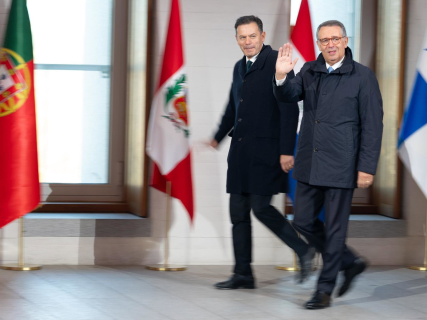

The Luso prime minister, Luis Montenegro, has formalized Portugal’s will to host the Ibero-American Summit scheduled for 2030, underscoring the relevance of this meeting space and the need for it to continue offering “concrete results” to citizens.
During his address at the plenary session of the XXX Ibero-American Summit, he reiterated that his country is “resolved and committed” to continue helping to “build a stronger, more dynamic community with better results”. If the Portuguese bid ultimately succeeds, Lisbon would take on the pro tempore secretariat in 2028, once Honduras organizes the next gathering.
Montenegro has emphasized that the decisions made within the framework of the summit “have to have a practical side” and focus “on the concrete, on what really makes the difference”, and that it was, he has recalled, what justified “the creation of this community”.
He described this community as “one of political dialogue: a community of coordination, but also a community with concrete, tangible results that can be experienced by our populations, from academic mobility to mastery of Artificial Intelligence”.
On the other hand, the president of Portugal, Antonio José Seguro, has underlined that “in a world marked by fragmentation and rivalry among the great powers, this community can build bridges between regions, cultures and civilizations”.
Along these lines, he called to “strengthen the Ibero-American voice in the international sphere so that it is a voice of peace and dialogue for the benefit of all” and so that “the progress and development of our countries can align with good practices on the commercial and political side”.
“We are not going to fuel antagonisms against the benefits of peoples, since we can prosper in coordinated environments,” Seguro said, for whom the Ibero-American Community “is fundamental”.
He stressed that it is “a space made up of friendly countries with which we share values, historical, linguistic, cultural, economic and human ties, driven by our diasporas” and defined by “dialogue, coordination, cooperation and solidarity, freedom and convictions”.