Most read

Elecciones 29N · Encuestas

La media de las encuestas

Media a 18 de noviembre de 2026 · 17 institutos

  • PP31,4 %
  • PSOE27,4 %
  • Vox19,0 %
  • Frente Amplio6,1 %
  • ERC2,4 %
  • SALF2,0 %
01020304050ene 2024jul 2024ene 2025jul 2025ene 2026jul 2026

Media del último estudio de cada instituto en 30 días y su evolución semanal desde el 23J. Partidos con al menos un 2 %.

Todas las encuestas

Elecciones generales del 29 de noviembre · Demócrata

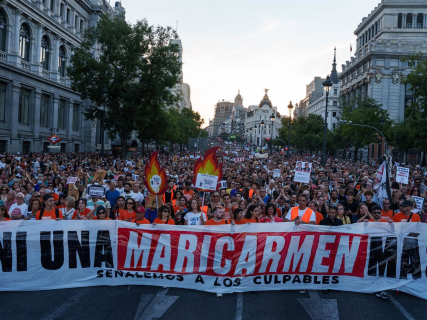
The death of Maricarmen, the 87-year-old woman whose eviction on September 23 triggered a wave of mobilizations for the right to housing, has provoked the first political reactions this Wednesday. The woman had been hospitalized since the day of the eviction and passed away at the Gregorio Marañón Hospital.

The president of the Government, Pedro Sánchez, has conveyed his condolences to the family and to her loved ones through a message published on X. "All my love to the family and to the loved ones of Maricarmen. A hug also to all those of us who feel this loss as our own today. Rest in peace", he wrote.

The spokesperson for ERC in Congress, Gabriel Rufián, has also spoken out, reacting to the news with a brief message on X: "What sons of bitches".

The Sol camp holds a minute of silence

The news has also reached the camp at Puerta del Sol, where participants held a minute of silence after learning of Maricarmen's passing. The concentration has been established since September 26 as a protest against the housing situation.

The Tenants' Union, which accompanied Maricarmen during the process, announced her death and lamented that the agreement reached for her to return to her home came too late. The organization has claimed her legacy and has assured that it will continue to defend the right to housing.

Maricarmen's case had acquired national dimensions after the eviction and subsequent mobilizations, with demonstrations, camps, and the call for a general strike for housing, while the Government placed protection against evictions among the measures of the decrees approved this week.

More key points, information and questions with FREN

AI-GENERATED CONTENT

What is the parliamentary process for amending eviction legislation in Spain?

There is no "special procedure" to amend eviction legislation in Spain: the general legislative procedure is used, applicable both to new laws and to reforms of existing laws. What matters is the type of law, the initiative route, and the possible use of royal decree-laws.

1. Ordinary law or organic law?

The Constitution distinguishes:

  • Ordinary law: this is the usual route to regulate housing, leases, civil eviction procedures, social protection measures, etc. A simple majority in each Chamber is sufficient (more votes in favor than against in a valid vote).
  • Organic law (art. 81 CE): reserved for the development of fundamental rights and public freedoms in Title I, statutes of autonomy, general electoral regime, and other expressly provided matters. It requires an absolute majority of the Congress in a final vote on the whole.

A reform on evictions will be organic only if it directly affects the essential content of a fundamental right (for example, strongly shaping the constitutional protection of the home or judicial protection). In practice, most changes on evictions are processed through ordinary law, although punctual modifications can be inserted in existing organic laws, applying then the reinforced majorities of art. 81 CE.

2. Legislative initiative routes

According to art. 87 CE and the Congress Rules (Title V, art. 108 et seq.), the initiative to reform eviction regulations can come from:

  • The Government – submits a bill to the Congress, accompanied by a statement of reasons and background. This is the most frequent route when it comes to broad and coordinated reforms (for example, a package on housing and rent).
  • Parliamentary groups or deputies of the Congress – through private members' bills. These can be very specific (for example, introducing a moratorium for certain groups) or comprehensive.
  • The Senate – can also send private members' bills to the Congress.
  • Legislative assemblies of autonomous communities – can approve and send state private members' bills on housing and evictions.
  • Popular Legislative Initiative (ILP) – requires gathering the signatures and requirements set by the Organic Law. An ILP on evictions, once validated, enters the Congress as a private members' bill.
3. Stages in the Congress of Deputies

The common legislative procedure applies in the Congress (Rules, arts. 109-129):

  • Admission and, if applicable, consideration:
    • Government bills are published, an amendment period opens, and they are sent directly to Committee.
    • Private members' bills (from groups, autonomous communities, Senate or ILP) are first submitted to the Plenary for a "consideration" debate, where it is decided whether to process them or not.
  • Amendments: groups and deputies submit total amendments (rejection or alternative text) and to the articles (deletion, modification, addition). Those affecting income or expenses require Government approval.
  • Committee of rapporteurs: a small group of deputies studies the text and amendments and issues a report with a proposed articulated text.
  • Committee: debates the report of the Committee of rapporteurs, may approve additional amendments, and approves a opinion.
  • Congress Plenary: debates the opinion, votes on pending amendments, and finally on the whole bill or private members' bill. If it is organic, the final vote must reach an absolute majority.
4. Processing in the Senate and resolution of discrepancies

Once approved by the Congress, the reform text passes to the Senate (Constitution, art. 90; Senate Rules):

  • The Senate can:
    • Approve the text without changes → the law is ready for sanction and publication.
    • Formulate a veto by absolute majority → the text returns to the Congress, which can override the veto by absolute majority or, after two months, by simple majority.
    • Approve amendments → the text returns to the Congress, which decides whether to accept (incorporate) or reject them by vote.

Once discrepancies are resolved, the law is sent to the King for sanction and promulgation and published in the Official State Gazette (BOE); from then on it comes into force on the date set by the law itself.

5. Role of royal decree-laws in eviction matters

The Government can approve royal decree-laws (art. 86 CE) "in cases of extraordinary and urgent need," which has been used on occasions to:

  • Temporarily suspend certain evictions.
  • Introduce transitional regimes to protect mortgage debtors or vulnerable tenants.

The decree-law comes into force upon publication, but the Congress must validate or repeal it within a maximum of 30 days, through a debate and vote in Plenary (Congress Rules, Title VI). Moreover, the validation agreement itself may include that the decree-law be processed as a bill by the urgent procedure, allowing amendments and "reopening" the text to adjust, toughen, or relax it. This subsequent processing follows, with shortened deadlines, the same phases of committee of rapporteurs, committee, plenary, and Senate described above.

Can you detail what specific majorities are required at each stage to approve a legal reform on evictions? How has the royal decree-law been used in practice to regulate or suspend evictions in recent years? What leeway do autonomous communities have to regulate evictions within their housing competencies?

What powers does the President of the Government have regarding housing according to the Spanish Constitution?

The Spanish Constitution does not assign the President of the Government a specific material competence in "housing," but his role is built from his general functions of directing the Government and the State-Autonomous Communities distribution. In housing, therefore, the President acts as the highest political responsible for the State Government's action within a predominantly autonomous scope.

1. Right to housing and distribution of competencies

The starting point is Article 47 CE: "all Spaniards have the right to enjoy decent and adequate housing." This provision orders the public authorities (not only state, but also autonomous and local) to promote the necessary conditions and establish the pertinent rules to make that right effective and regulate land according to the general interest.

The Constitution configures housing as mainly an autonomous competence. Article 148.1.3 CE states that Autonomous Communities may assume competencies over "territorial planning, urbanism, and housing." From there, most statutes of autonomy have assumed these competencies, so that the Autonomous Communities regulate and execute, to a large extent, housing policies (autonomous plans, public housing stock, use regulation, urban discipline, etc.).

The State retains different competence titles that affect housing, although not named as such:

  • Basic conditions of equality (art. 149.1.1 CE): setting minimum common frameworks that guarantee a homogeneous standard of rights.
  • Civil legislation (art. 149.1.8 CE): for example, rules on property and urban leases.
  • General economic planning (art. 149.1.13 CE): economic planning, credit policy, tax incentives, or state programs affecting the housing market.

State competencies in housing are largely exercised through state laws, royal decree-laws, and financing programs (state housing plans, aid, agreements with Autonomous Communities, etc.), approved by the Government and then developed in coordination with the communities.

2. Constitutional position of the President of the Government

The framework of the President's functions is in Article 97 CE, which states that the Government directs domestic and foreign policy, the Administration, and State defense, and exercises executive and regulatory functions. Article 98.2 CE adds that the President directs the Government's action and coordinates the functions of other members, without prejudice to their direct competence and responsibility.

From this perspective, the President's competencies in housing are indirect: he does not alone approve housing regulations nor manage programs, but sets the political orientation, decides priorities, and coordinates the responsible ministries.

3. What belongs to the President and what to the Government as a whole

From these provisions, it is possible to distinguish:

  • President's own competencies regarding housing:
    • Set the Government's general political line, including the priority given to housing (for example, promising a large affordable rental plan or strengthening the public housing stock).
    • Coordinate the ministries with sectoral competencies (usually transport, housing, economy, treasury) so that their actions are coherent.
    • Promote normative projects on housing or with impact on housing (such as state laws or royal decree-laws) through his political leadership in the Council of Ministers.
    • Represent the Government before other levels of power (European Union, conferences of autonomous presidents) when housing is part of the general political agenda.
    • Defend the State's position in competence conflicts, through the constitutional legitimacy to promote an appeal of unconstitutionality against autonomous laws (art. 162.1.a CE), also in housing matters, if it is understood that they invade state competencies.
  • Government's competencies as a whole:
    • Approve bills and royal decree-laws with content on housing.
    • Approve regulations and state housing plans and framework agreements with Autonomous Communities to execute them.
    • Design and execute budgetary policies that finance rental aid, rehabilitation, energy efficiency, etc.
4. State versus Autonomous Communities

In summary, housing is a shared policy:

  • Autonomous Communities have the main competence in urbanism and housing (art. 148.1.3 CE), regulate territorial planning, urban discipline, and much of effective housing policy.
  • The State, politically led by the President and organized through the Government, exercises competencies of general framework, bases, and equality, as well as defining large state programs and interterritorial coordination.

Therefore, the President of the Government is not a "housing authority" in a technical sense, but he is the ultimate responsible for the State's political orientation on housing and for defending the State's competencies in this area against the Autonomous Communities.

How many evictions have occurred in Spain in the last five years and which parliamentary groups have presented initiatives to stop them?

The official sources consulted allow narrowing down, but not calculating with exact precision in a single table, how many evictions have occurred in Spain in the last five years. The data are distributed between:

  • Eviction statistics from the General Council of the Judiciary (CGPJ), which measure evictions ordered by courts (mortgages, rentals, etc.), and
  • Foreclosures published by the INE, which record execution procedures on homes.

From these records and sector analyses citing them, the following can be stated:

  • Each year in Spain there are tens of thousands of evictions (sum of evictions by rent and mortgage), not hundreds or millions.
  • According to the INE note on foreclosures in 2023, new foreclosures on homes of individuals fell by 21.3% in 2023 compared to 2022, and among them those affecting primary residences dropped by 24.8% in the fourth quarter of 2023 (INE, Foreclosure Statistics 2023).
  • The same INE statistic confirms that most foreclosures still correspond to mortgages constituted in the bubble years (2005-2008), indicating that we still drag a "tail" from the previous crisis, although in smaller volume.
  • Studies such as the one cited by eldiario.es, prepared by the DESCA Observatory on the anti-eviction moratorium during the pandemic, estimate that these moratoria have avoided more than 58,000 evictions of tenant families only during the COVID period, giving an idea of the magnitude of the accumulated phenomenon since 2020.
  • By territories, partial data point to significant figures: for example, the CGPJ recorded 1,304 evictions in the Canary Islands in just the first three quarters of 2024 (about 4.8 per day), according to information cited by eldiario.es.

Overall, and with the limits of the information available in the consulted documents, the volume of evictions in Spain in the last five years clearly stands in the range of hundreds of thousands of accumulated evictions, with a downward trend in foreclosures and a higher persistence of procedures for non-payment of rent.

Which parliamentary groups have promoted initiatives to stop evictions?

At the state and autonomous level, the fight against evictions has been addressed mainly with three types of instruments: moratoria and suspension of evictions, strengthening protection of mortgage debtors, and regulation of the rental market / public housing stock. The main promoters have been:

1. Government of Spain (PSOE and partners)

  • Law 12/2023, of May 24, on the right to housing (Bill 121/000089, approved in 2023, processed in Congress and Senate).
    • Promoted by the coalition Government (PSOE-Unidas Podemos in the XIV legislature).
    • Introduces the figure of stressed residential market zones, measures of rent containment, and strengthening of the public housing stock, with the explicit goal of preventing residential expulsion situations and facilitating alternatives to eviction.
  • Extension of the suspension of evictions on primary residences:
    • Royal Decree-law 1/2024, of May 14, and its processing as Bill 121/000024, which extends until May 15, 2028 the suspension of mortgage evictions on primary residences of certain vulnerable groups, modifying Law 1/2013.
    • Part of the chain of extensions of protection started after the financial crisis, aimed at preventing vulnerable families from losing their homes due to foreclosures while no alternative is offered.
  • "Omnibus" royal decree-laws with housing measures, converted into bills:
    • Bill 121/000003 (from RDL 8/2023) and Bill 121/000047 (from RDL 1/2025) include packages of economic and social protection measures, among them:
      • facilities to restructure mortgages of vulnerable households,
      • strengthening of codes of good banking practices,
      • and continuation of rental aid for households at risk of losing their homes.
    • These texts were promoted by the Government (PSOE and, in the current legislature, Sumar).

2. Groups that have presented specific private members' bills

  • Plurinational Parliamentary Group Sumar:
    • Bill to amend Law 12/2023 (122/000178), aimed at limiting the capacity of legal entities to acquire residential housing, reinforcing the social function of property and, thereby, residential stability.
    • Bill to amend the Urban Leases Law (122/000162), proposing more stable and long-term rental contracts, to reduce forced turnover and the risk of eviction due to sudden rent increases.
    • Bill to guarantee residential use of homes and against speculation in the Balearic Islands (122/000289), which limits speculative pressure and tourist use to prioritize residents' access to housing, reducing local population expulsion.
  • Socialist Parliamentary Group:
    • Bill to promote affordable rental housing (122/000196), with tax incentives and regulatory changes to expand affordable rental supply and reduce the weight of stressed rental that leads to evictions.
  • EH Bildu Parliamentary Group (together with Sumar, ERC, PNV, Mixed, etc.):
    • Bill to regulate temporary rental contracts and room rentals (122/000136), agreed among several groups, seeking to curb the fraudulent use of temporary contracts and rooms to evade LAU protection and increase rent, one of the gateways to evictions of precarious tenants.
  • Mixed Parliamentary Group (Podemos and other members):
    • Bill on prevention of speculation and guarantees of housing as a social good (122/000102), introducing:
      • limitations on speculative purchases,
      • regulation of seasonal and tourist rentals,
      • and obligations for large holders to put part of their stock into social rental.
      All aimed at reducing dynamics that end in evictions.

3. Autonomous parliaments

  • Valencian Corts: Decree-law 3/2023, validated by Resolution 654/X, which creates a Help Unit for Eviction and Residential Emergency, regulates the registry of large holders, and enables rehousing measures and sanctions for real estate abuses.
  • Catalan Parliament and Madrid Assembly, among others, have processed regulations and bills to expand public housing stock and regulate rents, aiming to reduce pressure leading to evictions.

In summary, the data point to a still very high volume of evictions, although with some decline in foreclosures, and a wide range of initiatives promoted by the Government (PSOE-Sumar) and groups such as Sumar, PSOE, EH Bildu, ERC, PNV, Mixed/Podemos and autonomous forces, all aimed at strengthening protection of vulnerable households and acting on the structural causes that generate evictions.

Play

Test your knowledge with FREN!

How much do you know about this topic? Answer the following 3 questions.

What event triggered the wave of protests for the right to housing related to Maricarmen?

Question 1 of 3

What action did the participants of the camp at Puerta del Sol take after learning about Maricarmen's death?

Question 2 of 3

What message did the President of the Government, Pedro Sánchez, convey after Maricarmen's death?

Question 3 of 3