What the list of Interior journalists that Marlaska defines as a "working document" contains

Interior acknowledges that its Communication Office prepared an internal document with profiles of journalists and notes on their political orientation between the end of 2023 and 2024. Marlaska denies any "spurious purpose," while FAPE, APM, PP, and Sumar question the list, and the PSOE itself demands explanations.

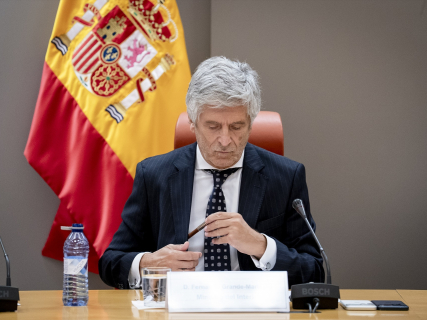
EuropaPress 7755744 ministro interior fernando grande marlaska presentacion datos provisionales

EuropaPress 7755744 ministro interior fernando grande marlaska presentacion datos provisionales

Add DEMÓCRATA to Google

Ask FREN

Published

Last updated

7 minutes

Most read

The Ministry of the Interior has acknowledged the existence of an internal list with names of journalists and commentators in which annotations about their political positions appear. The department led by Fernando Grande-Marlaska claims that it was an "informative document, of an internal nature" intended to improve the Ministry's communication work and denies that its objective was to identify, censor, or discriminate against any professional.

However, the publication of the document has provoked a political and professional reaction that even reaches the PSOE. Patxi López has admitted that he does not like "absolutely at all" this type of lists, Sumar has announced that it will request parliamentary explanations from Marlaska, and the FAPE and the Association of the Press of Madrid consider the practice "incompatible with the rule of law".

This is what is known so far about the document.

Does a list of journalists created by the Interior really exist?

Yes. The Ministry of the Interior itself has acknowledged its existence.

Sources from the department have confirmed that the Communication Office prepared an internal use document in which different journalists appeared. The Interior defines it as an "informative document, of an internal nature" and claims that it was used as a working tool to understand the treatment that professionals gave to the Ministry's activities.

According to information initially published by El Confidencial, the document was titled Commentators. Radio and Television and was identified with the seal of the Ministry of the Interior and its Communication Office.

The Association of the Press of Madrid, by joining the FAPE's statement this Tuesday, also confirms that the Interior prepared a document that ideologically classifies dozens of information professionals between late 2023 and 2024.

What information appears in the files?

The issue that has generated the most controversy is that the document does not limit itself to compiling names, media outlets, or professional areas.

According to the published information and the known files, alongside photographs of the journalists, descriptions of their political positions appear. Among the expressions collected are "affiliated with the PSOE", "supports the Government", "conservative tendency", "aligned with right-wing positions", "independent", "moderate center-right", "critical of the amnesty", "recognized anti-Sanchista", "socialist militant" or "defends the policies of the PSOE".

References to the position of certain journalists on issues that are not directly related to the competencies of the Ministry of the Interior, such as the amnesty law, Pedro Sánchez, the PSOE or the independentist parties, would also be included.

Who appears in the document?

The known information points to a broad list that includes media directors, columnists, commentators, editors, and specialized journalists.

Among them is the director of El Confidencial, Nacho Cardero, to whom the document attributes a "center-right tendency" and notes that he maintains "criticisms of the Government" that he qualifies as moderate.

The FAPE and the APM have confirmed that among the classified individuals are also responsible or former responsible individuals of professional associations, including the Federation of Associations of Journalists of Spain, the Association of the Press of Madrid, and the Association of Parliamentary Journalists.

There are also professionals who regularly cover information related to Interior, National Police, and Civil Guard.

When was it prepared?

Interior places the document in 2024, although the information published by El Confidencial places the origin of the commission at the end of 2023, around Christmas time.

The media claims, citing sources knowledgeable of its preparation, that in an initial meeting it was requested to classify journalists including references to their political ideas and that subsequently instructions were given to incorporate photographs into the files.

Interior has confirmed the existence of the document, but has not yet made public a detailed reconstruction of who gave each instruction, who selected the criteria used, or how long it remained in use. That is one of the points that remain to be clarified.

Did Marlaska order the list to be made?

Interior assures that he did not. Sources from the Ministry maintain that Fernando Grande-Marlaska did not order the list to be made and that he was also unaware of its existence until it was revealed publicly.

The minister referred to the matter this Tuesday from Ceuta and described the dossier as a "working document" intended "simply to know and understand what is said about the actions and activities of the Ministry."

Marlaska has denied any irregular use of the document. "It has no ulterior motive," he defended, before pointing out that its objective was to contribute to a "more effective" communication.

According to the version conveyed by the Interior, the document was not sent to high-ranking officials and the Communication Office has attended to media and journalists "without distinctions".

What does the Interior say it was for?

The official explanation is that it was an internal tool to facilitate the functioning of the Communication Office.

Government sources present it as a kind of "photograph" of journalists and commentators that would allow knowing their public interventions and better organizing the Ministry's relationship with the media.

The department's argument is that there was no intention to target, censor, or harm specific professionals.

What the Interior has not yet publicly explained in detail is why a tool intended to know the coverage of the Ministry needed to include ideological assessments or positions on political issues outside the department's competencies.

What has the Government said?

The spokesperson minister, Elma Saiz, has supported the explanations offered by the Interior and has defended that the Executive "deeply respects the work of the media, believes in press freedom, and acts accordingly every day."

Saiz has insisted that the objective of the document "is in no case to target, censor, or accuse media or journalists or to restrict their freedom".

She has also tried to return the criticism to the opposition by stating: "Those who come in with a flamethrower at RTVE or those of 'we are going to crush you' are not us."

Saiz's appearance after the Council of Ministers this Tuesday is officially recorded by La Moncloa.

The PSOE demands explanations from the Interior

The controversy has generated discomfort even within the party that supports the Government. The PSOE spokesperson in Congress, Patxi López, has been explicit in stating that he does not like "absolutely at all" that lists are made to classify people.

"I absolutely do not like any list that classifies anyone: neither by their thoughts, nor by their ideology, nor by their race, nor by anything," he stated.

López has added that he hopes that the Ministry of the Interior provides explanations about what happened.

The position of the socialist spokesperson introduces a difference compared to the defense made by the Government: while the Executive insists on the purely internal and operational nature of the document, López directly questions the fact that such a classification occurred.

Sumar will ask Marlaska in Congress

Sumar has also reacted harshly. The Compromís deputy Alberto Ibáñez has announced that he will take advantage of the Government's control session this Thursday to ask Marlaska why "journalists are classified ideologically".

Ibáñez has described the practice as a "attack on freedom of expression".

The Más Madrid deputy Tesh Sidi has considered that, if the published terms about those reports are confirmed, we would be facing a "very serious" issue. From Més-Compromís, Águeda Micó has pointed out that it seems "a bit strong" to her that there is a document of these characteristics.

The PP speaks of a "blacklist"

The Popular Party has raised the tone against Marlaska.

Its parliamentary spokesperson, Ester Muñoz, has expressly used the expression "blacklist of journalists from the Minister of the Interior" and has assured that its existence "takes us back to another era."

The PP links the episode with its broader criticisms of the Government for its relationship with media and judges.

It is worth distinguishing, however, between the politically used designation by the PP and the official definition: Interior does not recognize the existence of a "blacklist," but of an internal working document.

Vox downplays the list in light of the Ceuta crisis

Vox has followed a different strategy.

Its spokesperson in Congress, Pepa Millán, has stated that the report from the Communication Office is "the least relevant" of the explanations that, in her opinion, Marlaska has pending.

Millán has shifted the focus to the minister's actions during the Ceuta crisis and has again demanded his resignation and that of the Government.

FAPE and APM: "Incompatible with the rule of law"

The most forceful reaction from the professional field has come from FAPE and APM.

Both organizations have expressed their "strongest condemnation" and believe that no public body should "register, catalog, or ideologically profile" journalists.

The APM maintains that this type of practice introduces a risk of surveillance or retaliation and can condition the exercise of critical journalism. It also considers it especially delicate that an institution capable of influencing access to sources, accreditations, or institutional treatment manages classifications regarding the political affinity of professionals.

The associations have demanded three things: that any practice of ideological classification of journalists cease, guarantees that the individuals included did not suffer retaliation or differential treatment, and that responsibilities be clarified within the Communication Office.

What is still left to know?

The recognition of the document by the Interior clears up a central issue: the list existed.

However, several questions remain without complete public answers: who gave the exact order to create it, who decided to incorporate ideological categories, what specific use it had, how many people could access it, if there were successive versions, how long it was operational, and if the classifications influenced in any way the relationship of the Ministry with the included professionals.

The Interior maintains that Marlaska was not aware of the document, that it was not communicated to high-ranking officials, and that no journalist received different treatment for appearing on it. The professional associations are now demanding guarantees and responsibilities, while the controversy will reach Congress this Thursday in the session of control to the minister.

More key points, information and questions with FREN

AI-GENERATED CONTENT

What competencies and functions does the Minister of the Interior have according to Spanish legislation?

The Minister of the Interior is a member of the Government to whom the regulations attribute political leadership and the highest responsibility over the State's internal security policies. Their functions generally derive from Law 50/1997, of November 27, on the Government and, more specifically, from the regulations on the organization of the General State Administration and the structure of the Ministry itself.

Generally, Law 50/1997 (text in the BOE) establishes that ministers, as heads of their departments, must:

  • Develop the Government's action within the scope of their department, in accordance with the guidelines of the Prime Minister and the agreements of the Council of Ministers.
  • Exercise regulatory authority in matters pertaining to their department (propose and sign royal decrees and ministerial orders).
  • Exercise the competencies assigned to them by laws and the rules of organization and functioning of the Government.
  • Endorse, when appropriate, the acts of the King in matters within their competence.

Law 40/2015, on the Legal Regime of the Public Sector (text in the BOE) complements this framework by establishing the principles of action for senior bodies (ministers and secretaries of state): responsibility for directing public policy in their area, hierarchy over management bodies, internal coordination, promotion of administrative activity, and accountability.

On this general basis, the specific functions of the Minister of the Interior are detailed in the royal decrees on organizational structure. Royal Decree 139/2020, of January 28 (basic structure of ministerial departments) and its amendment by Royal Decree 146/2021, of March 9 (text in the BOE) place the Ministry of the Interior as responsible for public security policy and coordination of the State Security Forces and Corps through the Secretariat of State for Security.

Regarding citizen security and public order, the minister:

  • Defines internal security policy and sets the main lines of action against crime, terrorism, and other risks to public order.
  • Directs, through the Secretariat of State for Security, the planning of specific strategies against crime, the preparation of instructions and master plans, and supervises their execution by the various police forces.
  • Promotes the development and exploitation of the national crime statistics and periodic reports on its evolution, as a basis for political and regulatory decisions.

Regarding the State Security Forces and Corps (National Police and Civil Guard), the cited royal decrees assign the minister the political leadership of the Department on which the police management bodies depend. Through the Secretariat of State for Security and the general directorates of the Police and Civil Guard, the minister coordinates their actions, sets priorities, approves security plans, and supervises the organization of resources and personnel.

The minister also assumes relevant competencies in international police cooperation and in relations with regional and local police forces. The Directorate General for Coordination and Studies, dependent on the Secretariat of State for Security, acts as a support body for coordination with regional and local police, participation in European training and police cooperation networks and agencies, and maintaining operational contacts with other States.

In the field of civil protection and critical infrastructures, the Ministry's organizational structure assigns to bodies dependent on the minister the preparation and execution of population protection plans against serious emergencies, as well as coordination of the National System for the Protection of Critical Infrastructures. The minister, through the Secretariat of State for Security and the Directorate General for Coordination and Studies, promotes prevention policies, prepares general plans, and coordinates with other ministries and territorial administrations.

The structural regulations also assign the Ministry of the Interior functions in internal cybersecurity, channeled through the Cybersecurity Coordination Office. Under the minister's political responsibility, this body acts as the national contact point for information exchange with the European Commission and other States regarding attacks on information systems and technically coordinates cybersecurity within the ministry and its agencies.

In the area of immigration and police cooperation on migration matters, Royal Decree 146/2021 highlights the existence of a Directorate General for International Relations and Immigration under the Secretariat of State for Security. Through it, the minister guides police cooperation policy at borders, coordination with other countries and international organizations, and participation in devices controlling migratory flows and combating human trafficking networks, without prejudice to the competencies of other ministries in migration policy and asylum.

Finally, the Ministry of the Interior's structure incorporates specific functions for prevention and protection of vulnerable groups (gender violence, hate crimes, missing persons), channeled through the Directorate General for Coordination and Studies and CITCO. Under the minister's responsibility, these bodies prepare statistics, design common protocols, promote campaigns, and coordinate the actions of security forces and other public and private actors involved.

Could you detail how the Ministry of the Interior is internally organized (secretariats of state, general directorates, etc.) according to current regulations? What legal differences exist between the competencies of the Ministry of the Interior and those of the Interior departments of autonomous communities with their own police? How is the Ministry of the Interior's international cooperation in combating terrorism and organized crime legally structured?

What is the political and professional background of Fernando Grande-Marlaska?

Fernando Grande-Marlaska Gómez is a magistrate of the National Court who has served for years as Minister of the Interior in the Government of Spain. His profile combines a long judicial career with intense political exposure, especially in matters of security, migration policy, and international police cooperation. Additionally, he has become a reference for LGBTI visibility within State institutions.

In the judicial field, Grande-Marlaska comes from the Judiciary career and reached the position of magistrate of the National Court, one of the central bodies of criminal jurisdiction in Spain. Various press reports, collected by the newspaper Demócrata, recall that when he served as a judge in the National Court, he handled highly relevant cases, such as the so-called “Faisán case,” in which he issued an order instructing police officers to report exclusively to his court within the investigation of a police leak linked to the ETA environment. Such actions placed him at the core of specialized criminal jurisdiction and earned him a solid reputation as a judge of complex cases.

His connection with the National Court also appears in his later stage as a government member. In a letter addressed to the General Council of the Judiciary (CGPJ), mentioned by Demócrata, Grande-Marlaska himself emphasizes his “dual status as Minister of the Interior and magistrate,” advocating both respect for judicial independence and the need for the Government to have relevant information for national security. This reference reflects that, even as minister, he maintains his profile as a jurist and career judge, which shapes his public discourse on the relationship between the Interior Ministry, the Police, and the courts.

In the political and governmental sphere, the consulted stakeholder base identifies him as Minister of the Interior of the Government of Spain, a position he continues to hold. The agendas and press releases from La Moncloa and the Ministry of the Interior show sustained activity domestically and at the European level: he regularly participates in the EU Interior Ministers' councils, Justice and Home Affairs (JHA) Council meetings, and international conferences on terrorism, organized crime, road safety, or migration cooperation. Examples include his intervention at the Ambassadors' Conference, appearances before the EU Interior Ministers' Council, or presence at multilateral forums on safe mobility and combating organized crime, documented in numerous press releases from the Interior Department and La Moncloa, such as the one related to the bicentennial of the National Police (press release on the National Police).

Besides his executive role, the parliamentary base consulted shows he is registered as a deputy/author and has held various positions in Congress committees, including roles as member, spokesperson, and attached member in sectoral committees (such as equality, industry, culture, or monitoring the State Pact against gender violence). Although these roles have not given him the most public visibility, they indicate a parliamentary dimension complementary to his governmental role, with presence in oversight and legislative work bodies.

As Minister of the Interior, Grande-Marlaska has been at the forefront of very sensitive debates: managing migration crises, cooperation with Sahel and Maghreb countries, participation in Frontex operations, and coordination with other EU member states on security matters. Official press releases highlight his repeated calls to strengthen the “preventive strategy” in migration policy, international cooperation in the fight against terrorism and organized crime, and modernization of police and border infrastructures. He has also been involved in political and institutional controversies, for example regarding judicial investigations into the Ceuta migration crisis or decisions by certain judges, leading to exchanges of letters and formal complaints between the Interior Ministry and the CGPJ, widely covered by Demócrata.

On a personal and symbolic level, his figure has impacted the normalization of diversity within institutional elites. A Demócrata report on key leaders in the evolution of LGBTI rights in Spain highlights Grande-Marlaska as a “judge and Minister of the Interior” who “broke taboos” in the Judiciary by openly discussing his sexual orientation. According to that text, in October 2005, while magistrate of the National Court, he publicly came out as homosexual and married his partner, becoming a reference for LGBTI visibility within the judiciary and later in government.

Overall, Fernando Grande-Marlaska's trajectory is articulated around three axes: a consolidated judicial career in the National Court, marked by handling sensitive cases; a high-profile political stage as Minister of the Interior, with strong European presence and protagonism in debates on security, migration, and police cooperation; and a symbolic role as a figure who has contributed to making the LGBTI community visible within State institutions. This combination of legal experience, executive responsibility, and public dimension explains his relevance in recent Spanish political and judicial life.

What are the parliamentary steps for Sumar to formally request explanations from a minister in Congress?

In Congress, Sumar has several regulatory instruments to demand formal explanations from a minister. All of them are governed by the same Rules of Procedure as for other groups; what matters is not the specific party but the fact of being a Parliamentary Group with its deputies.

1. Who can activate these mechanisms from Sumar

  • Each deputy of Sumar can, individually, submit questions (written or oral) and also interpellations (articles 180 and 185).
  • The Sumar Parliamentary Group as such (through its spokesperson) can submit interpellations and request appearances.
  • The internal distribution of turns (who signs what, in which committee, etc.) is decided politically within the group, but for the Chamber it suffices that a deputy or the spokesperson signs.

2. Role of the Congress Board

All parliamentary writings (interpellations, questions, requests for appearances) are addressed to the Congress Board. According to article 31, the Board:

  • Qualifies the writings “according to the Rules” and decides their admission or rejection.
  • Determines the processing that each initiative follows (Plenary, committee, type of session, etc.).
  • If the group disagrees with a Board decision on admission or processing, it can request reconsideration; the Board resolves definitively, after hearing the Board of Spokespersons.

No parliamentary majority is required to submit these instruments; majority only comes into play in possible subsequent votes (e.g., motions derived from interpellations or resolutions after appearances).

3. Interpellations to the Government or a minister

  • They can be made by deputies or Parliamentary Groups (including Sumar) to the Government or a specific minister (art. 180).
  • They are submitted in writing to the Board and must concern “the reasons or purposes of the Executive's conduct on matters of general policy” of a department or the Government (art. 181.1).
  • The Board qualifies the text and, if it does not fit as an interpellation, can redirect it to an oral or written question, notifying the author (art. 181.2).
  • After 15 days from its publication, the interpellation can be included in the Plenary agenda (art. 182.1), following a quota system by group.
  • The Plenary holds the interpellation debate, with turns for the interpellant's statement, Government response, and replies (art. 183).
  • The interpellation can lead to a motion where the Chamber sets a position (art. 184), debated and voted as a non-legislative proposal. A simple majority is required to approve it.

4. Questions to the minister

4.1 Questions with written response
  • Any Sumar deputy can register them.
  • They are submitted in writing to the Board (art. 186) and, unless otherwise indicated, it is understood that a written response is requested (art. 187).
  • The Board admits or rejects according to Rules criteria (general interest, not being a mere legal query, etc.).
  • The Government must respond within 20 days from publication, extendable by another 20 with Board authorization (art. 190.1).
  • If no response is given in time, at the author's request the question can move to committee as an oral question (art. 190.2).
4.2 Oral questions in Plenary
  • They are submitted in writing indicating that an oral response in Plenary is sought (arts. 187 and 188).
  • They must formulate a single, concise question and be submitted within the timeframe set by the Board (between 48 hours and 7 days before, art. 188.1).
  • The Board qualifies; the Presidency, in agreement with the Board of Spokespersons, sets the quota of questions and their distribution by groups (art. 188.2).
  • In Plenary, the Sumar deputy briefly asks the question, the minister responds, there may be a reply and counter-reply, with a total maximum time of five minutes (art. 188.3).
4.3 Oral questions in committee
  • They are also registered as questions, indicating that an oral response is sought in the competent committee (arts. 187 and 189).
  • After seven days from publication, they can be included in the committee agenda (art. 189.1).
  • The debate format is similar, with slightly longer times (10 minutes initial and 5 for reply, art. 189.2).

5. Minister appearances

There are two ways:

  • Appearances at the Government's own request: the minister himself requests to appear before plenary or committee; the Board and the Board of Spokespersons schedule it. No specific majority is required for the Government to request attendance.
  • Appearances at a group's request: Sumar can register requests for a minister's appearance in the competent committee or, if applicable, before the Plenary. The Board qualifies them and, depending on the case, they are subject to agreement of the corresponding body:
    • In committee, a majority agreement of the committee usually suffices to compel the appearance.
    • In Plenary, the matter can be articulated through debates or motions voted by simple majority.

6. Political effects

All these mechanisms have in common that they oblige the Government to provide public and formal explanations in parliamentary sessions, generate official records and publicity, and allow Sumar to:

  • Force clarifications on decisions or inactions of the minister.
  • Set its own political position and subject the Government to scrutiny by other groups.
  • In the case of interpellations and appearances, trigger votes (motions, resolutions) which, although not legally binding, have strong political impact.
In practical politics, what are the differences between an interpellation and a minister's appearance to request explanations? What margin does the Congress Board have to reject or redirect control initiatives that Sumar presents against a minister? How is a group like Sumar internally organized to distribute quotas of questions and interpellations among its deputies?

Play

Test your knowledge with FREN!

How much do you know about this topic? Answer the following 3 questions.

What has the Ministry of the Interior officially acknowledged regarding the list of journalists?

Question 1 of 3

What kind of assessments appear in the files of the document prepared by the Interior Ministry?

Question 2 of 3

What has Fernando Grande-Marlaska declared about his involvement in the preparation of the document?

Question 3 of 3