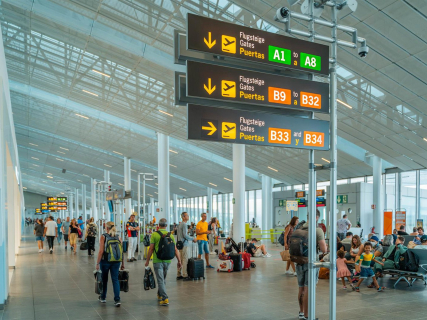
Evacuate a plane at Tenerife South airport after a bomb threat from a passenger

The Civil Guard has ordered the evacuation of the aircraft as a precaution and to examine it to check if there is any risk.

Airport Tenerife South ISLAND COUNCIL OF TENERIFE

Airport Tenerife South ISLAND COUNCIL OF TENERIFE

Add DEMÓCRATA to Google

Ask FREN

Published

Last updated

1 minute

Most read

Elecciones 29N · Encuestas

La media de las encuestas

Media a 8 de noviembre de 2026 · 11 institutos

  • PP30,8 %
  • PSOE26,2 %
  • Vox19,5 %
  • Frente Amplio6,8 %
  • ERC2,6 %
  • Podemos2,0 %
01020304050ene 2024jul 2024ene 2025jul 2025ene 2026jul 2026

Media del último estudio de cada instituto en 30 días y su evolución semanal desde el 23J. Partidos con al menos un 2 %.

Todas las encuestas

Elecciones generales del 29 de noviembre · Demócrata

A plane has been evacuated this Friday at Tenerife South airport after one of its passengers alerted to a presumed bomb threat, according to sources from the Civil Guard confirmed to RTVC.

The agents have ordered to evacuate the aircraft preventively while the necessary checks are carried out to determine if there is any risk. After the evacuation, it was planned to examine the plane to rule out the presence of any explosive device.

For the moment, the existence of any bomb has not been confirmed and the action of the security forces responds to a precautionary protocol in response to the alert made by the passenger.

The Civil Guard examines the aircraft

The first information does not detail how the alert was exactly made, the identity of the passenger who made it, or the affected flight. It has not been revealed so far whether the incident has caused disruptions in other airport operations.

According to what Atlántico Hoy has published, the plane would belong to the airline Jet2.com, although this detail is not included among the data initially confirmed by the Civil Guard collected by RTVC.

The security forces remain evaluating the situation while the checks on the aircraft are being carried out. The information available so far does not confirm the location of any explosive.

More key points, information and questions with FREN

AI-GENERATED CONTENT

What security protocols do the law enforcement agencies in Spain follow in the event of a bomb threat at an airport?

In the event of a bomb threat at an airport in Spain, the State Security Forces and Corps (mainly the Guardia Civil and National Police, or the competent regional police forces) act according to pre-established security plans coordinated with AENA, Civil Protection, and the airport manager itself. The goal is twofold: to protect lives and to maintain, as much as possible, the safe continuity of operations.

1. Reception and initial evaluation of the threat

  • Receipt of the alert: it may come via phone call, email, anonymous message, notification from a crew, a passenger, or airport staff.
  • Recording the threat: time, channel, literal content, accents, background noises, and any data that may help assess credibility are noted.
  • Preliminary evaluation: security teams (Airport Security Office and deployed police forces) apply risk matrices: recent background, level of detail, technical plausibility, apparent motivation, etc.
  • Initial classification: although many threats turn out to be false, as a principle they are treated as real until proven otherwise, following the prudence criterion.

2. Activation of emergency plans

  • Airport security plans: each airport has a Security Plan and a Self-Protection Plan that foresee scenarios of explosive device threats.
  • Coordination center: an Advanced Command Post is activated where Guardia Civil/National Police, airport manager, fire services, health, and Civil Protection sit.
  • Determination of scope: it is decided whether the threat affects a specific area (a counter, a boarding gate, a check-in zone) or a specific aircraft, or if it is generic about the airport.

3. Immediate measures on site

  • Establishment of perimeters: a security cordon is set around the affected area. The distance is adjusted to the type of threat (abandoned luggage, aircraft on the apron, interior public area, etc.).
  • Access control: entry of people and vehicles to critical areas is restricted; service accesses, internal roads, and loading zones are checked.
  • Surveillance reinforcement: uniformed officers and private security personnel increase patrols in terminals, parking lots, and high-traffic areas.
  • Internal communication: airport staff, airlines, and auxiliary services are informed quickly but in a controlled manner to follow instructions.

4. Evacuation or relocation of people

  • Selective evacuation: if the threat is focused on a specific area, it is evacuated orderly to safe meeting points inside or outside the building.
  • Partial or total evacuation: in higher risk scenarios, complete terminals or the entire airport may be emptied, always prioritizing people with reduced mobility, minors, and vulnerable groups.
  • Passenger management: priority is given to maintaining calm, avoiding panic and crowding. Basic and coherent information is provided without entering into details that could hinder the operation.

5. Intervention of explosives experts

  • Activation of TEDAX/NBQR units: specialized explosive disposal teams are deployed to the area.
  • Technical reconnaissance: cameras, robots, detectors, and scanners are used to examine suspicious packages, aircraft, or facilities.
  • Neutralization: if a device or high-risk object is located, TEDAX decides whether to neutralize it on site or move it to a safe place for controlled detonation.
  • Thorough searches: systematic searches of areas, baggage belts, warehouses, and holds may be conducted depending on the threat level.

6. Institutional coordination and public communication

  • Coordination with authorities: contact is maintained with the Government Delegation, regional authorities, and, if applicable, European or international bodies if the threat has a transnational dimension.
  • Media information management: an official spokesperson is designated. Truthful but limited information is provided to avoid compromising the operation or causing unjustified alarm.
  • Complementary measures: depending on the evaluation, security controls may be intensified at other airports or critical infrastructures.

7. Incident closure and subsequent analysis

  • Declaration of safe zone: once the risk is ruled out or the device neutralized, the cordon is lifted and progressive return to operational normality is allowed.
  • Investigation: an investigation is opened to identify the author of the threat, even if false, as it constitutes a serious crime.
  • Lessons learned: the protocol’s functioning, response times, coordination, and communication are reviewed to update security plans and improve future reactions.

In summary, the protocols combine maximum prudence, very detailed procedures, and strong coordination among police forces, airport managers, and emergency services, with the absolute priority of protecting lives while minimizing the impact on air operations.

How exactly do Guardia Civil, National Police, and regional police coordinate within a specific airport? What criminal consequences does making a false bomb threat at an airport have in Spain? What role do self-protection plans and drills play in airport preparedness against bomb threats?

What are the competencies of the Guardia Civil regarding airport security?

The Guardia Civil plays a key role in Spanish airports within the public security system: it acts as a State security force and body with functions of citizen security, judicial police, and specific surveillance of sensitive infrastructures. Its competencies are generally supported by Organic Law 2/1986 on Security Forces and Corps, and, in the aeronautical field, by Law 21/2003 on Air Safety, the National Security Program for Civil Aviation, and the coordination framework established by Royal Decree 550/2006.

1. Protection of airport facilities and infrastructures

Organic Law 2/1986 assigns to the State Security Forces and Corps, and therefore to the Guardia Civil:

  • Surveillance and protection of public buildings and facilities that require it and of critical infrastructures.
  • Prevention and maintenance of citizen security in places with large public attendance.

Applied to the airport environment, this translates into:

  • Armed surveillance of terminals, parking lots, access roads, and service areas, especially those considered sensitive from the public security or antiterrorism point of view.
  • Protection of critical installations (fuel depots, electrical stations, control centers, etc.) in coordination with the airport manager (AENA or the corresponding entity) and the aeronautical authority.
  • Security patrols and perimeter controls of the airport to prevent intrusions, unauthorized access, or sabotage.

2. Control and protection of passengers and luggage

The National Security Program for Civil Aviation, developed based on Law 21/2003, sets protection measures for passengers, crews, luggage, and supplies against acts of unlawful interference (terrorism, hijacking, introduction of weapons or explosives, etc.).

Within this framework, the Guardia Civil:

  • Supervises and controls, as a public security authority, the correct application of security measures at passenger and luggage checkpoints (explosives, weapons, prohibited items), although the direct operation of the teams is usually carried out by private security companies contracted by the airport manager.
  • Intervenes when prohibited objects, dangerous substances, or signs of crime are detected, assuming custody, instructing proceedings, and submitting facts to the judiciary.
  • Controls and protects restricted security zones, collaborating in access control, accreditation, and circulation of personnel and vehicles on the apron and critical areas.

3. Investigation and fight against terrorism and organized crime

As a state-level Armed Institute with citizen security and judicial police functions, the Guardia Civil:

  • Investigates crimes committed in the airport environment (arms and explosives trafficking, terrorism, organized crime, smuggling and customs fraud, crimes against collective security, etc.) through its specialized units (Information, Judicial Police, Fiscal and Border Service, among others).
  • Participates in prevention and response to terrorist threats linked to civil aviation, both in the intelligence phase and in operational action.
  • Collaborates with the State Aviation Safety Agency and judicial and prosecutorial authorities when the facts have criminal relevance.

4. Public order and support to other authorities

In airports, the Guardia Civil shares space with other actors: National Police (which generally assumes border control, passenger documentation, and immigration functions at border posts), regional police where they exist, local police, and private security personnel.

In this context, its own public order and support functions include:

  • Maintaining order in situations of crowds, serious operational incidents, protests, or emergencies, acting as a public security force under the Ministry of the Interior’s direction.
  • Supporting the airport manager (AENA or others) in managing incidents that go beyond purely operational security (altercations, bomb threats, evacuations, etc.).
  • Collaborating with the National Police at border posts when reinforcements or joint actions are required (for example, large operations against human trafficking or drug networks).
  • Supporting customs authorities in fighting fraud and smuggling, especially through the Fiscal and Border Service.

5. Coordination with other bodies and international organizations

Organic Law 2/1986 assigns the Ministry of the Interior responsibility for collaboration and assistance relations with police authorities of other countries. In the airport field, this is articulated with:

  • The participation of the Directorate General of the Guardia Civil in the National Civil Aviation Security Committee (created by Royal Decree 550/2006), along with the Directorate General of Police, AENA, Defense, Customs, Civil Protection, and other bodies, to coordinate security measures and protocols.
  • Operational cooperation and information exchange with foreign police forces and international air security organizations in investigations affecting flights, passengers, or international cargo.
  • Contribution to the implementation in Spain of ICAO and European Union standards and recommendations on civil aviation security, from the perspective of public security and crime fighting.

In sum, the Guardia Civil is not the only body responsible for airport security, but it is an essential pillar of the system: it ensures the citizen security, police, and antiterrorism aspect of infrastructures considered critical for national security by the legal framework.

What legal requirements must an evacuation of an aircraft due to a bomb threat in Spanish territory comply with?

The evacuation of an aircraft due to a bomb threat in Spanish territory is not regulated by a single “evacuation law,” but by a set of air safety and antiterrorism regulations. The core is in Law 21/2003, on Air Safety, Law 1/2011 (State Operational Safety Program), the National Security Program for Civil Aviation (PNS) (public part updated by the Resolution of January 17, 2024), and European aviation security regulations, especially Regulation (EC) 300/2008 and its development through Implementing Regulation (EU) 2015/1998.

These regulations establish the general framework: who is the competent authority, how security against acts of unlawful interference (including false bomb threat communication) is organized, and what obligations airports, companies, and public authorities have.

1. Who can order the evacuation and chain of command

The PNS and Law 21/2003 configure a chain of responsibilities:

  • Aircraft commander: is the highest authority on board and responsible for flight safety. In the face of a serious threat, they can order immediate evacuation if they perceive imminent danger to occupants, applying the company’s operational emergency procedures and air traffic regulations.
  • Airport manager (Aena or other): responsible for security within the airport premises. In coordination with the commander and Security Forces and Corps (FCS), they can order the deployment of resources, positioning of emergency teams, and disembarkation or evacuation on the ground according to the airport’s Security Program (derived from the PNS).
  • State Security Forces and Corps: are the police authority to assess the threat, activate antiterrorism protocols, order the establishment of security perimeters, and direct explosive searches. Their judgment is decisive in the decision to isolate the aircraft and evacuate the area.
  • Civil aeronautical authority (Ministry of Transport / AESA): sets security guidelines, approves Security Programs of airports and companies, and can impose extraordinary measures. They usually do not “order” the specific evacuation but set the technical framework and preventive or reinforced measures.
2. Coordination among actors and activation of evacuation

The PNS requires each airport and air operator to have a Security Program detailing coordination against acts of unlawful interference:

  • Coordination center at the airport (crisis room) integrating airport manager, FCS, rescue services, and, when appropriate, representatives of the company and air traffic control.
  • Activation criteria: a bomb threat is considered, by default, an act of unlawful interference. Evacuation is activated when risk assessment (police and operational) indicates relevant danger to people or when procedures establish immediate evacuation upon certain signals (e.g., finding a suspicious object on board).
  • Communication: formal notification channels must be followed among commander, air traffic control, airport manager, FCS, and emergency services; the Air Traffic Regulations and PNS foresee these flows.
3. Security measures on the ground

Although the most sensitive operational details are part of the restricted section of the PNS, the public part and European regulations set the principles:

  • Aircraft isolation: location in an area away from terminals and crowds, with a security perimeter set by FCS and airport manager.
  • Evacuation / disembarkation: can be done with jet bridges or stairs if there is no imminent explosion risk, or by slides if there is serious and urgent risk, following emergency manuals approved by the aeronautical authority.
  • Search: inspection of the aircraft, luggage, and perimeter area by specialized units (EOD) and security personnel, supported by detection equipment, according to air safety procedures and dangerous goods regulations.
  • Safe zones for passengers: the airport must have spaces to regroup, identify, and attend to passengers away from the risk area.
4. Information obligations and passenger rights

The combination of air safety regulations and passenger protection (Regulation (EC) 261/2004 and consumer regulations) imposes:

  • Information: the company and airport manager must inform passengers, understandably, about the situation (within security limits), expected times, and transport alternatives.
  • Assistance: obligation to provide food, drink, communication means, and, if applicable due to prolonged delay or cancellation, accommodation and transport between airport and hotel.
  • Physical protection: procedures must minimize risk during evacuation (orderly exit, attention to persons with reduced mobility, minors, etc.) and avoid crowding in unsafe areas.
  • Data handling and controls: any additional identifications or security checks must respect data protection regulations and principles of necessity and proportionality.

In summary, evacuation due to a bomb threat is governed by a scheme in which the commander protects immediate safety on board, the airport manager and FCS direct management on the ground, and the aeronautical authority sets the regulatory and supervisory framework, all under the rules of the National Security Program and European civil aviation security regulations.

Play

Test your knowledge with FREN!

How much do you know about this topic? Answer the following 3 questions.

Why was a plane evacuated at Tenerife South airport?

Question 1 of 3

What has been confirmed about the existence of a bomb on the aircraft according to the available information?

Question 2 of 3

Which security force handled the situation after the bomb threat at Tenerife South?

Question 3 of 3