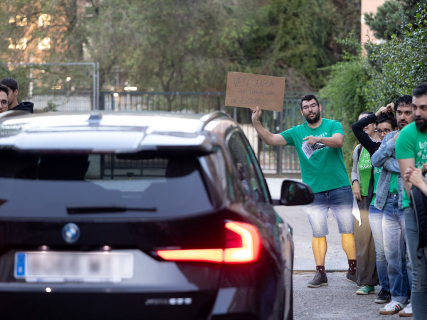
Teachers' strike in Madrid: traffic cuts, protests, and follow-up this Wednesday, October 14.

Dozens of early childhood educators have blocked Castellana early in the morning and about 300 people participated in a sit-in at Complutense; the unions have called for a concentration at noon and a demonstration in the afternoon.

huelga profesores madrid

huelga profesores madrid

Add DEMÓCRATA to Google

Ask FREN

Published

Last updated

3 minutes

Most read

Elecciones 29N · Encuestas

La media de las encuestas

Media a 13 de noviembre de 2026 · 15 institutos

  • PP31,4 %
  • PSOE26,8 %
  • Vox19,1 %
  • Frente Amplio6,3 %
  • ERC2,4 %
01020304050ene 2024jul 2024ene 2025jul 2025ene 2026jul 2026

Media del último estudio de cada instituto en 30 días y su evolución semanal desde el 23J. Partidos con al menos un 2 %.

Todas las encuestas

Elecciones generales del 29 de noviembre · Demócrata

The teachers' strike in the Community of Madrid began this Wednesday, October 14 with protests from early on. Dozens of early childhood educators have blocked part of the Paseo de la Castellana, in the Rubén Darío area, to demand salary improvements. The sit-in has caused delays on one of the main arteries of the capital and has required the intervention of the Civil Guard.

The day also comes after a lock-in at the Faculty of Information Sciences of the Complutense University of Madrid (UCM), in which around 300 students, teachers, and university workers participated to prepare for the mobilizations. The organizers have planned new actions throughout the day, with a concentration at Puerta del Sol at 12:00 hours and a demonstration in the afternoon.

The main call is an indefinite strike of non-university public education, promoted by CCOO, UGT, CGT, CNT, STEM, and Solidaridad Obrera, along with various teaching platforms. It is joined by the independent call from CSIF, which has urged teachers to support three full days of strike, from October 14 to 16. The call affects about 65,000 teachers of non-university education, who teach more than 666,000 students in the region.

Teachers' strike in Madrid: protests and demonstrations today

The mobilizations have started before the central concentrations planned for this Wednesday. The protest by early childhood educators on the Castellana has interrupted traffic for several minutes in the area around Paseo de Eduardo Dato. This group has been maintaining its own conflict for more than six months and demands to open a negotiation table with the Community and the City Council to address their working and salary conditions.

The union agenda continues at noon with a concentration at Puerta del Sol. CSIF, for its part, has called for a protest in front of the Ministry of Education. Both actions are part of the start of a day that seeks to give visibility to the discontent of teachers and pressure the regional Government to negotiate the demands.

The main demonstration is scheduled for 6:00 PM, departing from Atocha and going to Puerta del Sol. The organizers have also announced new mobilizations for the coming days: on Thursday the 15th there will be a human chain in front of the Department of Education and on Friday the 16th an open assembly is planned in Retiro Park, in addition to another march from Atocha to Sol in the afternoon.

What teachers on strike in Madrid are asking for

The strike committee demands an improvement in working conditions and resources for public education. Among their main demands is a salary increase of 600 euros per month, with the aim of reducing pay disparities with other autonomous communities, as well as lowering the number of students per classroom.

The ratio limits proposed by the unions vary according to the educational stage: 13 students in Early Childhood, 15 in Primary, 20 in Secondary, 23 in Baccalaureate, and 15 in Vocational Training. They also ask to strengthen support for students with special educational needs and to increase staff in schools.

Another of the demands refers to the weekly teaching hours. The organizers request to reduce it to 17 hours in Secondary and to 22 in Primary, compared to the hours they denounce as excessive. In addition to these measures, they include reducing bureaucratic burdens, improving centers of special complexity, changes in the bilingual model, and a climate control plan for schools and institutes.

The Community of Madrid considers the demands unfeasible

The Minister of Education, Science and Universities, Mercedes Zarzalejo, questioned the call on Tuesday and described the union demands as "impossible" and "totally unattainable." She also stated that some of the participating unions had signed the educational framework agreement from the previous year and defended that the Department maintains an open dialogue at the sectoral table.

The regional government has stated that it will guarantee minimum services during the strike days to balance the right of teachers to join the strike with the educational attention and the right to work of those who attend their jobs. The organizers, for their part, have criticized the conditions established for those minimum services.

The conflict is thus open from the first day of indefinite strike. The unions link the continuity of the protests to the opening of a negotiation that allows addressing their salary demands, work organization, and educational resources, while the Community maintains that its current proposals are not acceptable in the terms raised.

More key points, information and questions with FREN

AI-GENERATED CONTENT

What parliamentary procedures would be necessary for the demands of teachers' unions to become law in the Community of Madrid?

For the demands of teachers' unions to become an autonomous law in the Community of Madrid, those demands must first be transformed into a legislative initiative text and go through the ordinary legislative procedure provided in the Rules of the Assembly of Madrid (Title VII, arts. 139 et seq.). What today are union requests only enter the “parliamentary circuit” when an entity with legislative initiative assumes them and presents them as a bill or legislative proposal.

1. Who can turn the demands into a legislative initiative?
  • Government Council: can present a bill (art. 139). This is the most common route for major sectoral laws, such as a future autonomous education law.
  • Deputies or Parliamentary Groups: can register a legislative proposal. Here, union demands are translated into a proposal drafted by a political group.
  • Citizens and City Councils: through popular or municipal legislative initiative, following Law 6/1986. It is more complex (signature collection, formal requirements), but also possible in educational matters.

In all cases, the text must be drafted as a law with articles and accompanied by a statement of reasons and background.

2. Start of the procedure: qualification and publication
  • The initiative enters the Assembly Registry and is sent to the Assembly Board, which qualifies and admits it for processing if it meets formal and substantive requirements.
  • Once admitted, its publication in the Official Bulletin of the Assembly of Madrid is ordered and it is sent to the competent Commission (in this case, the education commission), opening amendment periods (art. 140 and 141 for bills; arts. 151 et seq. for proposals).

For bills, the Rules also provide an initial citizen participation period: during the first ten days of the amendment period to the articles, any citizen of the Community can submit written considerations on the text (art. 141).

3. Amendments and consideration

There are two types of amendments:

  • To the entirety: challenge the principles of the initiative and propose its return or a complete alternative text. They lead to a plenary debate on the entirety (art. 142 for bills; equivalent article for proposals).
  • To the articles: propose modifying, adding, or deleting specific articles.

In the case of legislative proposals, a specific consideration procedure by the Plenary is also required: the Chamber debates whether to process the proposal or not. Only if the consideration is approved does the ordinary processing in commission continue (arts. 151 et seq.).

4. Work in Commission: hearings, drafting committee, and report
  • Groups can request the appearance of social agents (art. 144), including teachers' unions and other sector organizations, to present their position before the commission. The Commission Board sets the number of appearances and sessions (maximum three).
  • The commission can appoint a Legislative Drafting Committee, with at least one rapporteur per group, which drafts a report based on the text and amendments.
  • Based on that report, the commission debates article by article and amendment by amendment and approves a report, which is the text submitted to the Plenary.

At this stage, the incorporation or rejection of many specific demands (ratios, staff, working conditions, etc.) is negotiated through amendments.

5. Debate and approval in Plenary
  • The Plenary debates the commission's report. “In voce” or transactional amendments may be presented under the terms set by the Rules (arts. 147 et seq.).
  • Finally, the vote on the entire bill or legislative proposal takes place. If it obtains sufficient majority, the law is approved.

After approval, the text is sent to the Government Council for promulgation by the Presidency of the Community and subsequent publication in the Official Bulletin of the Community of Madrid. Only from that publication does it come into force, according to its final provision.

6. Deadlines and variants
  • Amendment deadlines are measured in working days and can be extended by agreement of the Board and the Spokespersons' Committee.
  • The Rules provide special procedures, such as single reading or urgent processing, but their use for a major education law would be politically sensitive, as it reduces amendment and debate phases.

In summary, for union demands to become law in Madrid they need: (1) to be assumed by an actor with legislative initiative; (2) to pass admission for processing; (3) to survive amendments and negotiations in commission, with possible direct participation of unions in hearings; and (4) to achieve a sufficient political majority in the Assembly Plenary to approve the resulting text as autonomous law.

Could you detail with real examples how a recent education law has been processed in the Assembly of Madrid? What margin does the Government Council have to limit or veto amendments that imply more expenditure in a future education law? How could teachers' unions strategically influence each of these phases of the legislative procedure?

What are the legal competences of the Ministry of Education, Science and Universities of the Community of Madrid in labor negotiation matters?

The Ministry of Education, Science and Universities of the Community of Madrid plays a central role in labor negotiations for educational staff, but its competences are framed and limited by basic state legislation, the Statute of Autonomy, and autonomous public service regulations.

1. General framework of competences

The Statute of Autonomy of the Community of Madrid, approved by Organic Law 3/1983, assigns to the Community of Madrid:

  • Legislative development and execution of education in all its extent, levels, and grades (educational competence).
  • Execution of state labor legislation in its territory, with the State maintaining labor legislation and high inspection.
  • Regulation of the statutory regime of its civil servants and its own Administration, through autonomous laws, within the framework of state bases.

On this basis, Law 1/1986, on the Public Service of the Community of Madrid (BOE-A-1986-23734) and Law 5/1989 on employment relations criteria (BOE-A-1989-12126) were approved, organizing autonomous civil servant and labor personnel and referring negotiation matters to basic state legislation (today, essentially, the Basic Statute of the Public Employee and Law 7/1990 on collective bargaining of public employees).

2. Organic competences of the Ministry regarding personnel

Decree 248/2023, of October 11, on the organic structure of the Ministry, modified by Decree 28/2024 (BOCM 25‑4‑2024), distributes internal functions relevant to labor negotiation:

  • The Vice Ministry of Educational Policy and Organization assumes, among others, the general coordination of non-university educational policy.
  • Within its scope is the General Directorate of Human Resources, which the decree places within the Vice Ministry and to which it entrusts staff planning, position provision, organization of non-university teaching staff, and other aspects of their personnel regime.
  • Article 5 assigns to this Vice Ministry the preparation and coordination of the Ministry's general plans on personnel policy and remuneration matters for non-university teaching staff, “without prejudice” to the competences of the Ministry of Economy, Finance, and Employment.
  • The Technical General Secretariat assumes the processing of draft general provisions and agreements and accords, as well as management of civil servant and labor personnel of the Ministry itself, except those assigned to educational centers.

In parallel, agreements of the Sectoral Table of Non-University Teaching Staff (for example, those of 2016 and 2023, approved by Government Council Agreements and published in the BOCM: 2016, 2023) show that sectoral teaching negotiation is formally channeled through that Table, with participation of the educational Administration and unions, and that its results must be ratified by the Government Council.

3. What the Ministry can do in labor negotiation

Within this framework, the Ministry of Education, Science and Universities can legally:

  • Represent the autonomous Administration in the Sectoral Education Table for non-university teaching staff and in other specific forums of its sector.
  • Negotiate with trade union organizations the working conditions of teaching staff and, where appropriate, non-teaching staff of public centers within its scope (teaching hours, schedules, work organization criteria, staffing, temporary employment, training, aspects of professional career, etc.), always respecting basic and budgetary regulations.
  • Promote sectoral agreements that are then submitted to the General Table of public employees and the Government Council for approval and budget allocation.
  • Propose supplements, remuneration improvements, or working condition enhancements for non-university teaching staff and certain groups linked to the educational network, within limits set by the Ministry responsible for Finance and Public Service.
  • In the university field, negotiate financing frameworks and programs with universities and their rectors, indirectly conditioning resources for staff, without replacing university autonomy or the collective bargaining of teaching and research staff and administration and services.

4. Limits and matters outside its direct competence

Regarding limits, the Ministry:

  • Cannot modify basic labor legislation nor the Basic Statute of the Public Employee nor the Workers' Statute.
  • Is not the competent body for the general negotiation of all autonomous public employees, which corresponds to the General Table and public service and finance bodies.
  • Cannot sign statutory collective agreements nor register labor personnel agreements; these functions correspond to the labor authority (General Directorate of Labor) and the competent Ministry.
  • Cannot impose remuneration or expenditure commitments outside the budget or Government Council decisions.
  • Does not directly assume negotiation of working conditions of public university staff, which corresponds to each university as employer, within its own collective bargaining.

In summary, the Ministry is the political and administrative actor that leads sectoral labor negotiation in education within the Community of Madrid, but always in coordination with the Ministry of Economy, Finance, and Employment, with the General Table of public employees, and subject to basic state legislation and final approval by the Government Council.

Could you detail which specific matters are negotiated in the Sectoral Table of Non-University Teaching Staff of the Community of Madrid? What differences are there between the competences of the Ministry and those of the Ministry of Economy, Finance, and Employment regarding teaching staff? How do these competence limits affect a possible salary increase for teachers agreed upon in a strike or negotiation?

What requirements must teachers in the Community of Madrid meet to access a salary increase or a reduction in working hours according to current regulations?

In the Community of Madrid, non-university teachers can improve their conditions through two main routes: on one hand, salary increases or supplements approved generally; on the other, reductions in working hours or teaching hours, which can be collective (affecting an entire body) or individual (at the request of the interested party). Below is a summary of the main requirements according to current regulations and agreements.

1. Salary increases and supplements

Salary increases for Madrid teaching staff are generally not granted on an individual demand basis but are applied when a budget law, remuneration provision, or sectoral agreement approves them for all personnel included in its scope.

For public non-university teaching staff (career civil servants, interim staff, and, where applicable, labor staff), the basic requirements to benefit from these increases are:

  • Being included in the scope of the norm or agreement (for example, the Sectoral Agreement of Non-University Teaching Staff ratified by the Agreement of 06/21/2017 and approved by the Government Council on 01/09/2018, published in the BOCM on 01/17/2018).
  • Having the appropriate legal status (teaching civil servant, interim, or labor teaching staff) according to the supplement involved.
  • Being in active service, or in an administrative situation that maintains the right to remuneration (not, for example, on unpaid leave except in cases where certain supplements are preserved).
  • Meeting the specific conditions of each supplement, such as:
    • Performing a tutorship or other functions linked to a productivity bonus (the agreement of 04/23/2025 extends the tutorship supplement in Vocational Training to all cycles).
    • Holding certain positions or responsibilities (management, head of studies, coordination, etc.), according to autonomous decrees and orders that set their remuneration.
    • For supplements linked to seniority or professional career, accrediting years of service and merits established by basic state regulation and agreements negotiated in the Sectoral Table.

In 2026, the Community of Madrid has updated the amounts of some teaching supplements and remunerations through budgetary norms published in the Official Bulletin of the Community of Madrid, increasing them over the amounts in force in 2024 and 2025. The teacher does not have to “request” that increase; the Administration applies it ex officio if the inclusion requirements in the beneficiary group are met.

Additionally, in September 2026, the regional Government has opened negotiation of a horizontal professional career for teachers, which could mean increases of up to about 350 euros monthly, but whose grades, merits, and years of service required still need to be specified in the Sectoral Table. Until it is formally approved, there is no consolidated right nor definitive requirements.

2. Reduction of working hours and teaching hours

2.1. Collective reductions of teaching hours

Since the 2025/26 school year, an agreement between the Ministry of Education and trade unions is in force whereby:

  • The weekly teaching hours of teachers in Secondary, Vocational Training, and special regime teachings change from 20 to 19 teaching hours for the entire group.
  • It is planned to reduce to 18 teaching hours:
    • In the 2027/28 school year for those holding the status of tutors.
    • In the 2028/29 school year for all teachers in those stages.
  • In Infant and Primary, since that agreement, teachers have an additional hour of free disposal for class preparation.

These reductions are automatic for those active in the affected bodies; no individual request is required, it suffices to:

  • Provide teaching services in a public non-university center of the Community of Madrid in the bodies and stages covered by the agreement.
  • Be in active service status in the school year in which the measure is applied.
2.2. Individual reductions of working hours

The 2017 Sectoral Agreement, approved by the Government Council, also regulates reductions of working hours at the teacher's request. Highlights include:

  • Reduction of working hours for personal interest (career civil servants):
    • Can be requested by teaching civil servants who have provided effective services in the Madrid educational Administration during the five years immediately prior to the request.
    • The reduction must be at least 50% of the working day, with proportional reduction of remuneration.
    • Has a minimum duration of one school year and maximum of three within a five-year period.
    • Must be requested for full school years, within the deadlines set for assignment of destinations and schedules at the start of the school year.
    • The management team organizes schedules trying to make the resulting working day as continuous as possible and that the reduction proportionally affects teaching and complementary hours.
  • Reductions for care of a family member with a very serious illness:
    • Possibility of reduction of up to 50% of the working day, with pay, to care for a first-degree relative with a very serious illness, for a maximum of one month, proratable if there are several holders of the right.
    • Requires medical certification and proof of kinship.

Alongside these figures, the Sectoral Agreement details a broad catalog of paid and unpaid leaves, and situations “equivalent to leave” for interim staff for care of children under three years or dependent relatives. In all cases, documents proving the cause (medical certificates, school certificates, family book, etc.) are required and the request must comply with the channels and deadlines established by the Ministry.

In summary, salary increases depend on general norms or agreements and are applied automatically to those within their scope; collective reductions of teaching hours are also applied ex officio to the affected bodies; and voluntary reductions of working hours require being a career civil servant, having at least five years of recent service in Madrid education, and accepting, where applicable, proportional salary reduction, in addition to meeting specific requirements of each modality (care of relatives, very serious illness, personal interest, etc.).

Could you specify exactly what the 2017 Sectoral Teaching Agreement says about leaves and working hour reductions for family reconciliation? What differences are there between the working hour reduction conditions of public and chartered school teachers in the Community of Madrid? How would the future horizontal professional career affect the salary structure of a typical teacher in Madrid according to the scenarios being negotiated?

Play

Test your knowledge with FREN!

How much do you know about this topic? Answer the following 3 questions.

What monthly salary increase are the teachers' unions demanding in the Madrid strike?

Question 1 of 3

Which union has called an independent strike of three full days of stoppage from October 14 to 16?

Question 2 of 3

What is one of the main arguments of the Ministry of Education to reject the demands of the teachers' unions?

Question 3 of 3