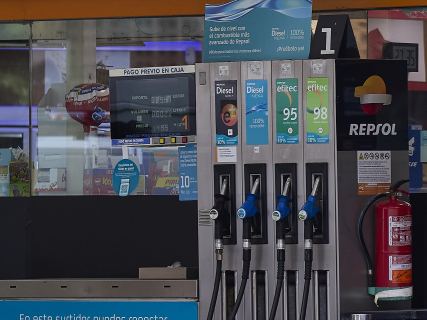

The drivers of gasoline cars will be the most affected by the price increases derived from the war in Iran, according to a T&E analysis. With oil exceeding 100 dollars per barrel, the additional cost of refueling a combustion vehicle can multiply by five the increase involved in recharging an electric car.
At T&E they explain that driving 100 kilometers with a gasoline car already reaches an average cost of 14.20 euros, which represents an increase of 3.80 euros. In contrast, recharging an electric vehicle costs 6.50 euros per 100 kilometers, with a much more contained increase of 0.70 euros due to the rising cost of electricity.
“This difference shows how energy crises impact much more intensely on fossil fuels than on electricity, marking a growing gap between both mobility models,” they point out in the analysis.
Companies and fleets: the additional cost skyrockets
The economic impact is even greater in the case of business fleets, where the volume of kilometers traveled multiplies the effect of the price increase. According to the report, each company gasoline car will entail an additional cost of 89 euros per month.
In contrast, electric vehicles within these same fleets barely register an increase of 16 euros per month. This difference reinforces “the role of electrification as a tool to reduce exposure to energy volatility”, they emphasize at T&E.
Furthermore, the report underlines that corporate fleets are key in the market, since they constitute the main source of second-hand vehicles, which amplifies the impact of any change in this segment.
In this regard, the current debate also includes the electrification of business fleets. The objectives proposed by the Commission are limited to following the market trend and would not be sufficient to accelerate the change, argue the authors of the report.
A strengthening of these goals would allow that, in 2035, “3.6 million additional electric vehicles would reach the second-hand market, facilitating access to more affordable options for consumers,” they comment.
In this context, T&E insists that “CO₂ emission standards are key to forcing manufacturers to offer more electric vehicles at competitive prices. The legislative decisions adopted now will have a direct impact both on the energy transition and on the cost citizens face in the event of future oil crises”.
The Automobile Package and the political pulse in the EU
The context of these figures coincides with a key moment in Brussels. The Environment ministers of the European Union are debating the European Commission's proposal to lower CO₂ emission targets within the so-called “Car Package”.
As the analysis gathers, the Commission proposed last December to relax these targets for passenger cars and set electrification goals for large fleets. However, some European leaders, such as Friedrich Merz and Giorgia Meloni, advocate going further and further softening the rules, in addition to opposing the targets for fleets.
This regulatory reduction, warn in T&E, “would delay the transition towards the electric vehicle and would prolong the dependence on oil, at a time of special geopolitical vulnerability”.
The report puts figures to that dependence: the European Union imported in 2025 around 1,000 million barrels of oil destined for road transport, with a total cost of 67,000 million euros.
Against this, the 8 million electric vehicles already in circulation allowed to save 46 million barrels of oil, which is equivalent to 2.9 billion euros in avoided imports.
Furthermore, they detail, strengthening the ambition of the ‘Car Package’ would allow reducing oil imports by 45 billion euros between 2026 and 2035, compared to a scenario of reduced targets.